A 100-N applied force (30 degrees to the horizontal) accelerates
a box across a horizontal sheet of ice (see diagram). Casey, Jack
and Ronnie are discussing the problem. Casey suggests that the
normal force is 200 N; Jack suggests that the normal force in the
diagram is 150 N; and Ronnie suggests that the normal force is 100
N. While all three answers may seem reasonable, only one is
correct. Indicate which two answers are wrong and explain why they
are wrong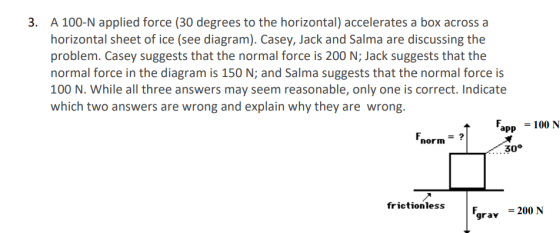
Homework Answers

Add Answer to:
A 100-N applied force (30 degrees to the horizontal) accelerates
a box across a horizontal sheet...
A force of 60 N is required to start a 10kg box moving across a horizontal...
A force of 60 N is required to start a 10kg box moving across a horizontal floor. (a) What is the coefficient of static friction between the box and the floor? (b) If the 60 N force continues, the box accelerates at 3m/s^2. What is the coefficient of kinetic friction? P.S please write the right equations and answers asap!!
A box weighs 60 N and is sitting on a horizontal frictionless floor. A 100 N...
A box weighs 60 N and is sitting on a horizontal frictionless floor. A 100 N force pulls the box at an angle 30 degrees above the horizontal. What is the normal force of the box?
1. 55Kg Block is being pulled to the right across a table with an applied force...
1. 55Kg Block is being pulled to the right across a table with an applied force of 250N at 45.0 degrees above the horizontal. an opposing force of 30.0 N is acting on the block to the left. a) draw a FBD b) Find the net force c) find the acceleration d) Find the Y component of the applied force e) Find the normal force 2. A 50 kg box if a dolly pushes the cart with an applied force...
A force of 175 N is applied at an angle of 37 degrees above the horizontal....
A force of 175 N is applied at an angle of 37 degrees above the horizontal. If the weight of the box is 275 N, determine the maximum kinetic friction force (in N) between the box and the floor if the coefficient of friction is 0.48. Assume friction force is positive (i.e., no sign needed).
A 100 N force is applied to a box at an angle of 60° to the...
A 100 N force is applied to a box at an angle of 60° to the horizontal via a rope. How much force “lifts” the box and how much “pulls” it along the surface? a. 86.6 N; 50 N b. 100 N; 100 N c. 50 N; 50 N d. 50 N; 86.6 N
a student pulls a box of books on a horizontal floor with a force of 100...
a student pulls a box of books on a horizontal floor with a force of 100 N in a direction of 37.0 degrees above the horizontal. if the mass of the box and the books is 40.0 kg and the coefficient of static friction between the crate and the dock is 0.55, what is the maximum force of friction? (Will the box move?) Show the free body diagram. (183, 167, 332 or 350 N)
A box is being accelerated across perfectly frictionless ice by a 30-N force suddenly the box...
A box is being accelerated across perfectly frictionless ice by a 30-N force suddenly the box encounters a second force of 30 N in the opposite directionWith both forces acting on the box it A . is brought to a rapid halt B. continues to accelerate C . continues at the speed it had when it encountered the second force D. none of the above
A 30-kg box is at rest on a horizontal floor with friction coefficients μs = 0.65...
A 30-kg box is at rest on a horizontal floor with friction coefficients μs = 0.65 (static) and μk = 0.55 (kinetic). You push on the box HORIZONTALLY (parallel to the floor) with varying applied force. For each applied force below, find the magnitude of the friction force exerted by the floor on the box (in Newtons), and state whether the friction is static or kinetic. (a) Applied force 100 N. (b) Applied force 150 N. (c) Applied force 190...
A 30-kg box is at rest on a horizontal floor with friction coefficientsμs= 0.65 (static) and...
A 30-kg box is at rest on a horizontal floor with friction coefficientsμs= 0.65 (static) and μk= 0.55 (kinetic). You push on the box HORIZONTALLY (parallel to the floor) with varying applied force. For each applied force below, find the magnitude of the friction force exerted by the floor on the box(in Newtons), and state whether the friction is static or kinetic. (a) Applied force 100 N. (b) Applied force 150 N. (c) Applied force 190 N. (d) Applied force...
3) A constant pulling force of 150 N applied at an angle of 21.7° above the...
 3) A constant pulling force of 150 N applied at an angle of 21.7° above the horizontal, accelerates a crate across a rough horizontal surface. The has mass 35.2 kg, and the acceleration is 0.571 m/s. a) What is the normal force acting on the crate? b) What is the friction force acting on the crate? c) What is the coefficient of kinetic friction between surface?
 3) A constant pulling force of 150 N applied at an angle of 21.7° above the horizontal, accelerates a crate across a rough horizontal surface. The has mass 35.2 kg, and the acceleration is 0.571 m/s. a) What is the normal force acting on the crate? b) What is the friction force acting on the crate? c) What is the coefficient of kinetic friction between surface?
Most questions answered within 3 hours.
-
Where is the error in this code sequence?
String s1 = "Hello";
String s2 = "ello";...
asked 10 months ago -
Financial data for Joel de Paris, Inc., for last year
follow:
Joel de Paris, Inc.
Balance...
asked 10 months ago -
Consider this reaction:
Al2(SO4)3 (aq)+ BaCl3
(aq) Al2Cl6 (aq)- +
3BaSO4(s) . What is the...
asked 10 months ago -
Suppose that Savneet is considering increasing her
recent random sample from 20 car rentals to 40...
asked 10 months ago -
Trucks arrive at an unloading terminal at an average rate of 120
per hour.
Trucks arrive...
asked 10 months ago -
Why are methanol and ethanol completely soluble in water while
octanol is not very little soluble....
asked 10 months ago -
A facilities manager at a university reads in a research report
that the mean amount of...
asked 10 months ago -
When the CuSO4 is rehydrated by adding water to the anhydrous
compound, is this an endothermic...
asked 10 months ago -
A ray of sunlight is passing from diamond into crown glass; the
angle of incidence is...
asked 10 months ago -
A block of mass 0.249 kg is placed on top of a light, vertical
spring of...
asked 10 months ago -
how do the kidneys compensate in the presences of acidosis
a) trigger hyperventilate
b) reserve acid...
asked 10 months ago -
Question 501 pts
The rental rate of capital to the firm increases. Which of the
following...
asked 10 months ago