Both KCl and BaCO3 are white solids. If you were given a sample of either solid,...
Both KCl and BaCO3 are white solids. If you were given a sample of either solid, describe how you would determine which one it is.
Homework Answers
KCl is completely soluble in water but BaCO3 is insoluble in water with Ksp of 2.58×10⁻⁹.So, if the given compound is soluble in water, it is KCl otherwise it is BaCO3.
Add Answer to:
Both KCl and BaCO3 are white solids. If you were
given a sample of either solid,...
#2) You are given two similar looking white, organic crystalline solids and determine their melting points....
 #2) You are given two similar looking white, organic crystalline solids and determine their melting points. You find one to be 156-158° C and the other to be 154-157° C. Explain how to determine whether the two substances are identical or different. Briefly describe how the results obtained would differ if the substances were identical or if they were different.
KCl and KBr are both ionic solids. A mixture of KCl and KBr has a mass...
KCl and KBr are both ionic solids. A mixture of KCl and KBr has a mass of 3.595 g. When this mixture is heated in the presence of excess Cl2, all of the KBr is converted to KCl. If the total mass of KCl present after this reaction is 3.129 g, what percentage (by mass) of the original mixture was KBr? (HINT: Be sure that you understand why the mass of the sample has decreased. It may help if you...
17. You are given 2.00 g of a white solid and told that it is a...
 17. You are given 2.00 g of a white solid and told that it is a mixture of KCl and K2CO3. You dissolve the sample in water and titrate with HCl; complete neutralization requires 23.0 mL of 1.00 M HCI K2CO3+ 2 HCl + H2CO3+ 2 KCI Calculate the mass of K2CO3 in the unknown sample. A. 1.23 B. 1.59 C. 1.33 D. 1.50 11 T
Stock solutions are HCl and NaOH If you are given the following solids: NasPO4 K3PO4 NAH2PO4...
 Stock solutions are HCl and NaOH
If you are given the following solids: NasPO4 K3PO4 NAH2PO4 2. MW 174.17 g/mol MW= 141.96 g/mol MW- 136.08 g/mol K2HPO4 NazHPO4 KH2PO4 MW = 163.94 g/mol MW 212.26 g/mol MW 119.98 g/mol Which compounds would you use to prepare your stock solutions? Why? given deionized water, the solid you selected in the previous question and the following If you are volumetric glassware: 100.00 ml volumetric flask(s) 250.00 ml volumetric flask(s) 25.00 ml volumetric...
Stock solutions are HCl and NaOH
If you are given the following solids: NasPO4 K3PO4 NAH2PO4 2. MW 174.17 g/mol MW= 141.96 g/mol MW- 136.08 g/mol K2HPO4 NazHPO4 KH2PO4 MW = 163.94 g/mol MW 212.26 g/mol MW 119.98 g/mol Which compounds would you use to prepare your stock solutions? Why? given deionized water, the solid you selected in the previous question and the following If you are volumetric glassware: 100.00 ml volumetric flask(s) 250.00 ml volumetric flask(s) 25.00 ml volumetric...
17. You are given 2.00 g of a white solid and told that it is a...
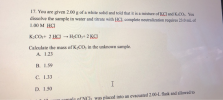 17. You are given 2.00 g of a white solid and told that it is a mixture of KC and K.CO;. You dissolve the sample in water and titrate with HCl; complete neutralization requires 23.0 mL of 1.00 M HCI K2CO3+ 2 HC H2CO3+ 2 KC) Calculate the mass of K C03 in the unknown sample. A. 1.23 B. 1.59 C. 1.33 1 D. 1.50 nomnle of NCs was placed into an evacuated 2.00-L flask and allowed to
a. Assume you are given a water, H2O, solution and told that it contains either hydrochloric...
a. Assume you are given a water, H2O, solution and told that it contains either hydrochloric acid, HCl or sodium chloride, NaCl. Describe how you could determine which of these is present. b. Assume that you are given a H2O solution that contains either sodium hydroxide, NaOH or sodium chloride, NaCl. Describe how you could determine which is in solution.
12. You are given a sample that is believed to be either cis- or trans-cinnamic acid....
 12. You are given a sample that is believed to be either cis-
or trans-cinnamic acid. Would TLC be a good method to determine
which compound you have? Why or why not? See structures
arom COOH (A) trans-cinnamic acid (B) cis-cinnamic acid
12. You are given a sample that is believed to be either cis-
or trans-cinnamic acid. Would TLC be a good method to determine
which compound you have? Why or why not? See structures
arom COOH (A) trans-cinnamic acid (B) cis-cinnamic acid
12. You are given a sample that is believed to be either cis-or trans cinnamic acid....
 12. You are given a sample that is believed to be either cis-or trans cinnamic acid. Would TLC be a good method to determine which compound you have? Why or why not? See structures attached COOH OH (A) trans-cinnamic acid (B) cis-cinnamic acid
In a titration experiment using Mohr Titration, I am given the weight of an unknown sample...
In a titration experiment using Mohr Titration, I am given the weight of an unknown sample being titrated against AgNO3 and determined the ratio of Cl- to be 0.55. The weight of the unknown sample is 0.6821g. Titrated end point volume of AgNo3 = 22.5ml The question is that given the unknown solid only contains NaCl and KCl, determine the % of each in unknown solid. I am told that "KCl and NaCl have different molar mass, and with the...
If you have a white powder that could be either Epsom salt or table salt, how...
If you have a white powder that could be either Epsom salt or table salt, how could you decide which one it is?
 #2) You are given two similar looking white, organic crystalline solids and determine their melting points. You find one to be 156-158° C and the other to be 154-157° C. Explain how to determine whether the two substances are identical or different. Briefly describe how the results obtained would differ if the substances were identical or if they were different.
 17. You are given 2.00 g of a white solid and told that it is a mixture of KCl and K2CO3. You dissolve the sample in water and titrate with HCl; complete neutralization requires 23.0 mL of 1.00 M HCI K2CO3+ 2 HCl + H2CO3+ 2 KCI Calculate the mass of K2CO3 in the unknown sample. A. 1.23 B. 1.59 C. 1.33 D. 1.50 11 T
 Stock solutions are HCl and NaOH
If you are given the following solids: NasPO4 K3PO4 NAH2PO4 2. MW 174.17 g/mol MW= 141.96 g/mol MW- 136.08 g/mol K2HPO4 NazHPO4 KH2PO4 MW = 163.94 g/mol MW 212.26 g/mol MW 119.98 g/mol Which compounds would you use to prepare your stock solutions? Why? given deionized water, the solid you selected in the previous question and the following If you are volumetric glassware: 100.00 ml volumetric flask(s) 250.00 ml volumetric flask(s) 25.00 ml volumetric...
Stock solutions are HCl and NaOH
If you are given the following solids: NasPO4 K3PO4 NAH2PO4 2. MW 174.17 g/mol MW= 141.96 g/mol MW- 136.08 g/mol K2HPO4 NazHPO4 KH2PO4 MW = 163.94 g/mol MW 212.26 g/mol MW 119.98 g/mol Which compounds would you use to prepare your stock solutions? Why? given deionized water, the solid you selected in the previous question and the following If you are volumetric glassware: 100.00 ml volumetric flask(s) 250.00 ml volumetric flask(s) 25.00 ml volumetric...
 17. You are given 2.00 g of a white solid and told that it is a mixture of KC and K.CO;. You dissolve the sample in water and titrate with HCl; complete neutralization requires 23.0 mL of 1.00 M HCI K2CO3+ 2 HC H2CO3+ 2 KC) Calculate the mass of K C03 in the unknown sample. A. 1.23 B. 1.59 C. 1.33 1 D. 1.50 nomnle of NCs was placed into an evacuated 2.00-L flask and allowed to
 12. You are given a sample that is believed to be either cis-
or trans-cinnamic acid. Would TLC be a good method to determine
which compound you have? Why or why not? See structures
arom COOH (A) trans-cinnamic acid (B) cis-cinnamic acid
12. You are given a sample that is believed to be either cis-
or trans-cinnamic acid. Would TLC be a good method to determine
which compound you have? Why or why not? See structures
arom COOH (A) trans-cinnamic acid (B) cis-cinnamic acid
 12. You are given a sample that is believed to be either cis-or trans cinnamic acid. Would TLC be a good method to determine which compound you have? Why or why not? See structures attached COOH OH (A) trans-cinnamic acid (B) cis-cinnamic acid
Most questions answered within 3 hours.
-
Where is the error in this code sequence?
String s1 = "Hello";
String s2 = "ello";...
asked 10 months ago -
Financial data for Joel de Paris, Inc., for last year
follow:
Joel de Paris, Inc.
Balance...
asked 10 months ago -
Consider this reaction:
Al2(SO4)3 (aq)+ BaCl3
(aq) Al2Cl6 (aq)- +
3BaSO4(s) . What is the...
asked 10 months ago -
Suppose that Savneet is considering increasing her
recent random sample from 20 car rentals to 40...
asked 10 months ago -
Trucks arrive at an unloading terminal at an average rate of 120
per hour.
Trucks arrive...
asked 10 months ago -
Why are methanol and ethanol completely soluble in water while
octanol is not very little soluble....
asked 10 months ago -
A facilities manager at a university reads in a research report
that the mean amount of...
asked 10 months ago -
When the CuSO4 is rehydrated by adding water to the anhydrous
compound, is this an endothermic...
asked 10 months ago -
A ray of sunlight is passing from diamond into crown glass; the
angle of incidence is...
asked 10 months ago -
A block of mass 0.249 kg is placed on top of a light, vertical
spring of...
asked 10 months ago -
how do the kidneys compensate in the presences of acidosis
a) trigger hyperventilate
b) reserve acid...
asked 10 months ago -
Question 501 pts
The rental rate of capital to the firm increases. Which of the
following...
asked 10 months ago