
Homework Answers
 only c will give two different
fragments.
only c will give two different
fragments.
B give same fragments whereas a and b will give just one product not fragments.
Add Answer to:
Which one of the following diols would cleave into two different fragments with HIO4? A) (1S,25)-1,2-cyclopentanediol...
Which of the following sets of compounds contain a pair of diastereomers? (i) (1S,4R)-1,3-dichlorocyclohexane & (1R,4S)-1,3-dichlorocyclohexane...
Which of the following sets of compounds contain a pair of diastereomers? (i) (1S,4R)-1,3-dichlorocyclohexane & (1R,4S)-1,3-dichlorocyclohexane (ii) (R)-chloroiodomethanesulfonic acid & (S)-chloroiodomethanesulfonic acid (iii) (1R,4S)-1,4-cyclohexanediol & (1S,4R)-1,4-cyclohexanediol (iv) (1R,2R)-1,2-dimethylcyclopentane & (1R,2S)-1,2-dimethylcyclopentane (v) (2R,3R)-2,3,4-trihydroxybutanal & (2S,3R)-2,3,4-trihydroxybutanal Which of the following sets of compounds are enantiomers? (i) (E)-1-chloro-1-butene & (Z)-1-chloro-1-butene (ii) (1R,3S)-1,3-cyclopentanediol & (1S,3S)-1,3-cyclopentanediol (iii) (S)-1-cyano-1-propanol & (R)-1-cyano-1-propanol (iv) (1R,3S)-1,3-cyclopentanediol & (1R,3R)-1,3-cyclopentanediol (v) (R)-2-tert-butyl-2-methylcyclobutanone & (S)-2-tert-butyl-2-methylcyclobutanone
17) Consider the conversion of 1-butanol to each of the compounds shown below. In which conversion...
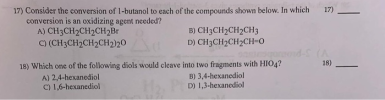 17) Consider the conversion of 1-butanol to each of the compounds shown below. In which conversion is an oxidizing agent needed? A) CH3CH2CH2CH2Br C) (CH3CH2CH2CH2)20 17) B) CH3CH2CH2CH3 D) CH3CH2CH2CH=O S (A 18) 18) Which one of the following diols would cleave into two fragments with HIO4? B) 3,4-hexanediol D) 1,3-hexanediol A) 2,4-hexanediol C) 1,6-hexanediol
17) - 17) Consider the conversion of 1-butanol to each of the compounds shown below. In...
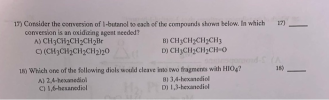 17) - 17) Consider the conversion of 1-butanol to each of the compounds shown below. In which conversion is an oxidizing agent needed? A) CH3CH2CH2CH2Br B) CH3CH2CH2CH3 C) (CH3CH2CH2CH2)20 D) CH3CH2CH2CH=0 18) 18) Which one of the following diols would cleave into two fragments with HIO4? A) 2,4-hexanediol B) 3,4-hexanediol C) 1,6-hexanediol D) 1,3-hexanediol
17) Consider the conversion of 1-butanol to each of the compounds shown below. In which conversion is an oxidizing a...
 17) Consider the conversion of 1-butanol to each of the compounds shown below. In which conversion is an oxidizing agent needed? A) CH3CH2CH2CH2Br B) CH3CH2CH2CH3 C) (CH3CH2CH2CH2)20 D) CH3CH2CH2CH=0 le 18) Which one of the following diols would cleave into two fragments with HIO4? A) 2,4-hexanediol B) 3,4-hexanediol C) 1,6-hexanediol D) 1,3-hexanediol 19) What is the product of the following reaction? lab (1) LIAH (2) H20 OH ОН i uw A) B) B) D D ) A ta C) B...
Which of two diols: ethan-1,2-diol or 2,2-bis(4-hydroxyphenyl)propane would you choose for polycondensation with dicarboxylic acid, if...
Which of two diols: ethan-1,2-diol or 2,2-bis(4-hydroxyphenyl)propane would you choose for polycondensation with dicarboxylic acid, if you want to obtain: a) Transparent polyester b) Polyester with higher Tg
Which of the following are meso compounds? (i) (R)-2-methylcyclobutanone (ii) (S)-2-methylcyclobutanone (iii) (1S,2S)-1,2-dimethylcyclohexane (iv) (1R,2R)-1-chloro-2-methylcyclobutane (v)...
Which of the following are meso compounds? (i) (R)-2-methylcyclobutanone (ii) (S)-2-methylcyclobutanone (iii) (1S,2S)-1,2-dimethylcyclohexane (iv) (1R,2R)-1-chloro-2-methylcyclobutane (v) (1S,2S)-1-chloro-2-methylcyclobutane
Which of the following statement(s) is(are) true about restriction enzymes? A)discovered in bacteria B)cleave the...
Which of the following statement(s) is(are) true about restriction enzymes? A)discovered in bacteria B)cleave the phosphodiester bond in the backbone C)cleave the peptide bond in the backbone D)produces random fragments E)recognizes specific sequences
We learned that to create vicinal diols from alkenes, the cis-1,2-diol or trans-1,2 diol required very...
 We learned that to create vicinal diols from alkenes, the cis-1,2-diol or trans-1,2 diol required very different reagents. This isn't always the case and one notable reaction that defies this convention is the Prévost reaction! (4 points) To make the cis-diol, we typically use osmium tetroxide (catalytic amounts!). What other reagent combination would work for this particular transformation? a. OH OH (rac b. (4 points) To make the trans-diol, what reagent combination would be employed? ?? 1F2 OH (4 points)...
convert from alcohol to alkane by reduction process vis SN2 mechanism. (SHOW MECHANISM) 1-ethylcyclohexan-1-ol reacts with...
convert from alcohol to alkane by reduction process vis SN2 mechanism. (SHOW MECHANISM) 1-ethylcyclohexan-1-ol reacts with 1.TsOH, Pyridine/2.LiAlH4, H3O^+ I don't know how to describe the second one its a Phenol as the main ring with a carbon group attached to the side. It has a methyl, ethyl and alcohol attached to this carbon which is connected to the main ring. This phenol compound with the attached alcohol, ethyl and methyl groups reacts with TsCL, Pyridine/ LiAlH4, acetone. Obtain the...
22) What is the product of the following reaction? (t о H2, Pt A) 1,2-cyclohexanediol C)...
 22) What is the product of the following reaction? (t о H2, Pt A) 1,2-cyclohexanediol C) cyclohexene B) cyclohexanol D) cyclohexane 23) What is the product of the following reaction? (2 H3C CH3 OsO4, (CH3)3COOH C=C (CH)3СОН, ОН н н B) cis-2,3-epoxybutane A) CH3CH-O C) 2,3-butanediol D) 1,3-butanediol 24) 24) Which of the following reagents will convert cyclohexene into cis-1,2-cyclohexanediol? HO CHP HOll. yn A) CH3CO3H (peroxyacetic acid) B) OsO4, (CH3)3 COOH, (CH3)3COH, OH C) 03 followed by Zn/H20 D)...
 17) Consider the conversion of 1-butanol to each of the compounds shown below. In which conversion is an oxidizing agent needed? A) CH3CH2CH2CH2Br C) (CH3CH2CH2CH2)20 17) B) CH3CH2CH2CH3 D) CH3CH2CH2CH=O S (A 18) 18) Which one of the following diols would cleave into two fragments with HIO4? B) 3,4-hexanediol D) 1,3-hexanediol A) 2,4-hexanediol C) 1,6-hexanediol
 17) - 17) Consider the conversion of 1-butanol to each of the compounds shown below. In which conversion is an oxidizing agent needed? A) CH3CH2CH2CH2Br B) CH3CH2CH2CH3 C) (CH3CH2CH2CH2)20 D) CH3CH2CH2CH=0 18) 18) Which one of the following diols would cleave into two fragments with HIO4? A) 2,4-hexanediol B) 3,4-hexanediol C) 1,6-hexanediol D) 1,3-hexanediol
 17) Consider the conversion of 1-butanol to each of the compounds shown below. In which conversion is an oxidizing agent needed? A) CH3CH2CH2CH2Br B) CH3CH2CH2CH3 C) (CH3CH2CH2CH2)20 D) CH3CH2CH2CH=0 le 18) Which one of the following diols would cleave into two fragments with HIO4? A) 2,4-hexanediol B) 3,4-hexanediol C) 1,6-hexanediol D) 1,3-hexanediol 19) What is the product of the following reaction? lab (1) LIAH (2) H20 OH ОН i uw A) B) B) D D ) A ta C) B...
 We learned that to create vicinal diols from alkenes, the cis-1,2-diol or trans-1,2 diol required very different reagents. This isn't always the case and one notable reaction that defies this convention is the Prévost reaction! (4 points) To make the cis-diol, we typically use osmium tetroxide (catalytic amounts!). What other reagent combination would work for this particular transformation? a. OH OH (rac b. (4 points) To make the trans-diol, what reagent combination would be employed? ?? 1F2 OH (4 points)...
 22) What is the product of the following reaction? (t о H2, Pt A) 1,2-cyclohexanediol C) cyclohexene B) cyclohexanol D) cyclohexane 23) What is the product of the following reaction? (2 H3C CH3 OsO4, (CH3)3COOH C=C (CH)3СОН, ОН н н B) cis-2,3-epoxybutane A) CH3CH-O C) 2,3-butanediol D) 1,3-butanediol 24) 24) Which of the following reagents will convert cyclohexene into cis-1,2-cyclohexanediol? HO CHP HOll. yn A) CH3CO3H (peroxyacetic acid) B) OsO4, (CH3)3 COOH, (CH3)3COH, OH C) 03 followed by Zn/H20 D)...
Most questions answered within 3 hours.
-
Where is the error in this code sequence?
String s1 = "Hello";
String s2 = "ello";...
asked 11 months ago -
Financial data for Joel de Paris, Inc., for last year
follow:
Joel de Paris, Inc.
Balance...
asked 11 months ago -
Consider this reaction:
Al2(SO4)3 (aq)+ BaCl3
(aq) Al2Cl6 (aq)- +
3BaSO4(s) . What is the...
asked 11 months ago -
Suppose that Savneet is considering increasing her
recent random sample from 20 car rentals to 40...
asked 11 months ago -
Trucks arrive at an unloading terminal at an average rate of 120
per hour.
Trucks arrive...
asked 11 months ago -
Why are methanol and ethanol completely soluble in water while
octanol is not very little soluble....
asked 11 months ago -
A facilities manager at a university reads in a research report
that the mean amount of...
asked 11 months ago -
When the CuSO4 is rehydrated by adding water to the anhydrous
compound, is this an endothermic...
asked 11 months ago -
A ray of sunlight is passing from diamond into crown glass; the
angle of incidence is...
asked 11 months ago -
A block of mass 0.249 kg is placed on top of a light, vertical
spring of...
asked 11 months ago -
how do the kidneys compensate in the presences of acidosis
a) trigger hyperventilate
b) reserve acid...
asked 11 months ago -
Question 501 pts
The rental rate of capital to the firm increases. Which of the
following...
asked 11 months ago