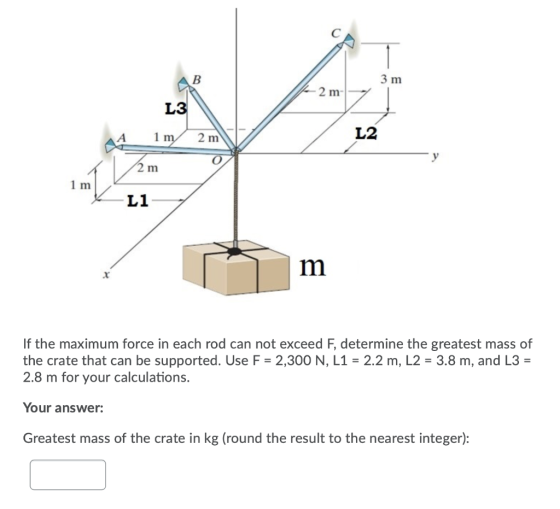
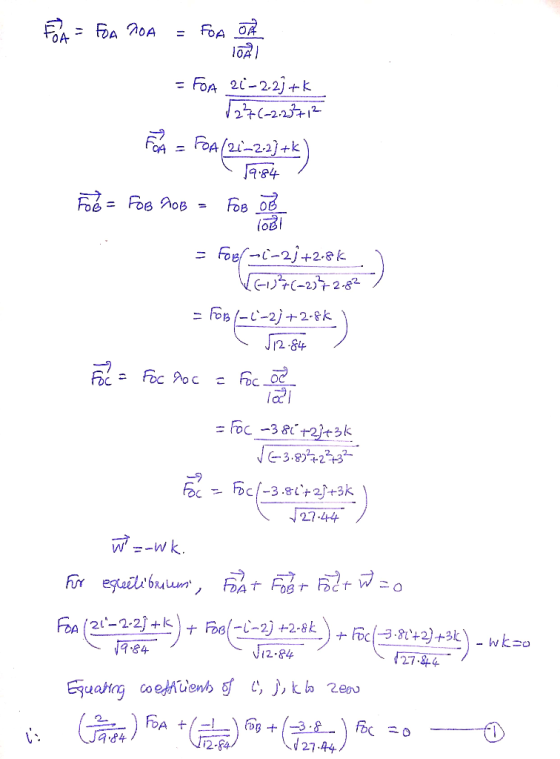
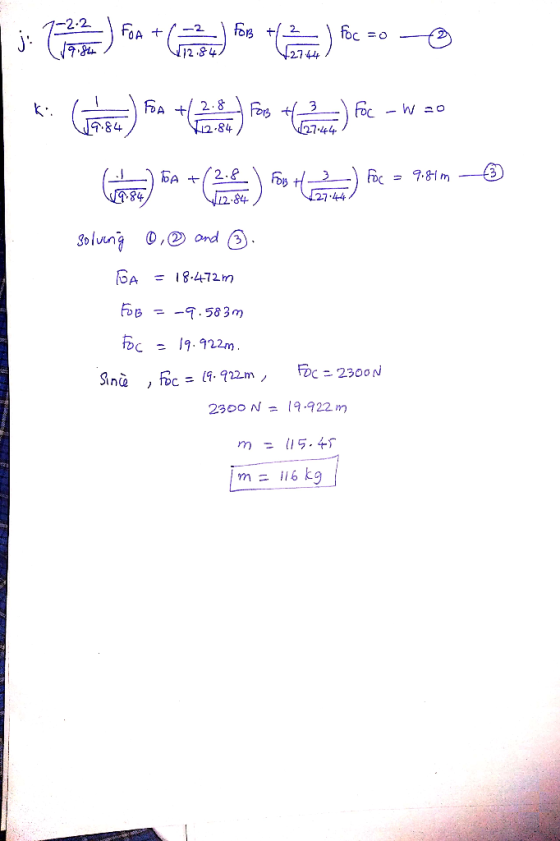
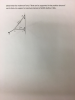
If the maximum force in each rod can not exceed F, determine the greatest mass of the crate that can be supported. Use F = 2,300 N, L1 = 2.2 m, L2 = 3.8 m, and L3 = 2.8 m for your calculations.
Homework Answers
Add Answer to:
If the maximum force in each rod can not exceed F, determine the
greatest mass of...
If the maximum force in each rod can not exceed F, determine the greatest mass of...
 If the maximum force in each rod can not exceed F, determine the
greatest mass of the crate that can be supported. Use F = 3,400 N,
L1 = 1.1 m, L2 = 4.9 m, and L3 = 3.9 m for your calculations.
1 m 2 m m
If the maximum force in each rod can not exceed F, determine the
greatest mass of the crate that can be supported. Use F = 3,400 N,
L1 = 1.1 m, L2 = 4.9 m, and L3 = 3.9 m for your calculations.
1 m 2 m m
Im 11 m If the maximum force in each rod can not exceed F, determine the...
 Im 11 m If the maximum force in each rod can not exceed F, determine the greatest mass of the crate that can be supported. Use F = 3,300 N, L1 = 1.2 m, L2 = 4.8 m. and 3 = 3.8 m for your calculations.
please don't round off till the end. thank you so much Question 1 (1 point) 41...
 please don't round off till the end. thank you so much
Question 1 (1 point) 41 m 2 m If the maximum force in each rod can not exceed F, determine the greatest mass of the crate that can be supported. Use F = 2.300 N, L1 = 2.2 m, L2 = 3.8 m, and L3 - 2.8 m for your calculations Your answer: Greatest mass of the crate in kg (round the result to the nearest integer):
please don't round off till the end. thank you so much
Question 1 (1 point) 41 m 2 m If the maximum force in each rod can not exceed F, determine the greatest mass of the crate that can be supported. Use F = 2.300 N, L1 = 2.2 m, L2 = 3.8 m, and L3 - 2.8 m for your calculations Your answer: Greatest mass of the crate in kg (round the result to the nearest integer):
Question 1 options: Determine the moment of force F about an axis extending between A and...
 Question 1 options:
Determine the moment of force F about an axis
extending between A and C. Express the result as
a Cartesian vector. Use F = {5i +
10j - 4k} kN, L1 = 5 m, L2 = 4 m,
and L3 = 3 m for your calculations.
Your answer:
x-component of the resultant moment in kNm (round the
result to 1 decimal place):
y-component of the resultant moment in kNm (round the
result to 1 decimal place):
z-component...
Question 1 options:
Determine the moment of force F about an axis
extending between A and C. Express the result as
a Cartesian vector. Use F = {5i +
10j - 4k} kN, L1 = 5 m, L2 = 4 m,
and L3 = 3 m for your calculations.
Your answer:
x-component of the resultant moment in kNm (round the
result to 1 decimal place):
y-component of the resultant moment in kNm (round the
result to 1 decimal place):
z-component...
Determine the greatest force F that can be applied to the ring if each cable can...
 Determine the greatest force F that can be applied to the ring if each cable can support a maximum force of 900 lb. 1 ft 6 ft ft 2 ft
Determine the maximum force F that can be supported in the position shown if each chain...
 Determine the maximum force F that can be supported in the position shown if each chain can support a maximum tension of 620 lb before it fails. 30°
Find the maximum value of force "F" that can be applied to the system of the...
 Find the maximum value of force "F" that can be applied to the system of the rod AB (Area=2 in?, E=29x106 psi) and the rigid beam BD, if the stress in the rod cannot exceed 20,000 lb/in' and the vertical movement of point D cannot exceed 0.05 in. The beam BD is horizontal before the load Fis applied. (15 points) EMB=0 hinge B 5 " 4" 6"
A uniform rod of mass M = 5.14kg and length L = 1.01m can pivot freely...
 A uniform rod of mass M = 5.14kg and length L = 1.01m can pivot
freely (i.e., we ignore friction) about a hinge attached to a wall,
as seen in the figure below.
The rod is held horizontally
and then released. At the moment of release, determine the angular
acceleration of the rod. Use units of rad/s^2.
Determine the linear acceleration of the tip of the rod. Assume
that the force of gravity acts at the center of mass of...
A uniform rod of mass M = 5.14kg and length L = 1.01m can pivot
freely (i.e., we ignore friction) about a hinge attached to a wall,
as seen in the figure below.
The rod is held horizontally
and then released. At the moment of release, determine the angular
acceleration of the rod. Use units of rad/s^2.
Determine the linear acceleration of the tip of the rod. Assume
that the force of gravity acts at the center of mass of...
For each of the following statements. state whether it is True or False. Prove your answer:...
For each of the following statements. state whether it is True or False. Prove your answer: a. ∀L1 , L2(L1= L2)iff L1*·=L2*). b. (ØuØ*)n(¬Ø- (ØØ*)) = Ø (where ¬Ø is the complement of Ø). c. Every infinite language is the complement of a finite language. d. ∀L ((LR)R = L). e. ∀L1, L2((L1L2)*= L1*L2*). f. ∀L1, L2(( ((L1*L2*L1*)*= (L2UL1)*). g . ∀L1, L2(( ( ( L 1 U L 2 ) * = L 1 * U L 2 *...
 If the maximum force in each rod can not exceed F, determine the
greatest mass of the crate that can be supported. Use F = 3,400 N,
L1 = 1.1 m, L2 = 4.9 m, and L3 = 3.9 m for your calculations.
1 m 2 m m
If the maximum force in each rod can not exceed F, determine the
greatest mass of the crate that can be supported. Use F = 3,400 N,
L1 = 1.1 m, L2 = 4.9 m, and L3 = 3.9 m for your calculations.
1 m 2 m m
 Im 11 m If the maximum force in each rod can not exceed F, determine the greatest mass of the crate that can be supported. Use F = 3,300 N, L1 = 1.2 m, L2 = 4.8 m. and 3 = 3.8 m for your calculations.
 please don't round off till the end. thank you so much
Question 1 (1 point) 41 m 2 m If the maximum force in each rod can not exceed F, determine the greatest mass of the crate that can be supported. Use F = 2.300 N, L1 = 2.2 m, L2 = 3.8 m, and L3 - 2.8 m for your calculations Your answer: Greatest mass of the crate in kg (round the result to the nearest integer):
please don't round off till the end. thank you so much
Question 1 (1 point) 41 m 2 m If the maximum force in each rod can not exceed F, determine the greatest mass of the crate that can be supported. Use F = 2.300 N, L1 = 2.2 m, L2 = 3.8 m, and L3 - 2.8 m for your calculations Your answer: Greatest mass of the crate in kg (round the result to the nearest integer):
 Question 1 options:
Determine the moment of force F about an axis
extending between A and C. Express the result as
a Cartesian vector. Use F = {5i +
10j - 4k} kN, L1 = 5 m, L2 = 4 m,
and L3 = 3 m for your calculations.
Your answer:
x-component of the resultant moment in kNm (round the
result to 1 decimal place):
y-component of the resultant moment in kNm (round the
result to 1 decimal place):
z-component...
Question 1 options:
Determine the moment of force F about an axis
extending between A and C. Express the result as
a Cartesian vector. Use F = {5i +
10j - 4k} kN, L1 = 5 m, L2 = 4 m,
and L3 = 3 m for your calculations.
Your answer:
x-component of the resultant moment in kNm (round the
result to 1 decimal place):
y-component of the resultant moment in kNm (round the
result to 1 decimal place):
z-component...
 Determine the greatest force F that can be applied to the ring if each cable can support a maximum force of 900 lb. 1 ft 6 ft ft 2 ft
 Determine the maximum force F that can be supported in the position shown if each chain can support a maximum tension of 620 lb before it fails. 30°
 Find the maximum value of force "F" that can be applied to the system of the rod AB (Area=2 in?, E=29x106 psi) and the rigid beam BD, if the stress in the rod cannot exceed 20,000 lb/in' and the vertical movement of point D cannot exceed 0.05 in. The beam BD is horizontal before the load Fis applied. (15 points) EMB=0 hinge B 5 " 4" 6"
 A uniform rod of mass M = 5.14kg and length L = 1.01m can pivot
freely (i.e., we ignore friction) about a hinge attached to a wall,
as seen in the figure below.
The rod is held horizontally
and then released. At the moment of release, determine the angular
acceleration of the rod. Use units of rad/s^2.
Determine the linear acceleration of the tip of the rod. Assume
that the force of gravity acts at the center of mass of...
A uniform rod of mass M = 5.14kg and length L = 1.01m can pivot
freely (i.e., we ignore friction) about a hinge attached to a wall,
as seen in the figure below.
The rod is held horizontally
and then released. At the moment of release, determine the angular
acceleration of the rod. Use units of rad/s^2.
Determine the linear acceleration of the tip of the rod. Assume
that the force of gravity acts at the center of mass of...
Most questions answered within 3 hours.
-
Where is the error in this code sequence?
String s1 = "Hello";
String s2 = "ello";...
asked 10 months ago -
Financial data for Joel de Paris, Inc., for last year
follow:
Joel de Paris, Inc.
Balance...
asked 10 months ago -
Consider this reaction:
Al2(SO4)3 (aq)+ BaCl3
(aq) Al2Cl6 (aq)- +
3BaSO4(s) . What is the...
asked 10 months ago -
Suppose that Savneet is considering increasing her
recent random sample from 20 car rentals to 40...
asked 10 months ago -
Trucks arrive at an unloading terminal at an average rate of 120
per hour.
Trucks arrive...
asked 10 months ago -
Why are methanol and ethanol completely soluble in water while
octanol is not very little soluble....
asked 10 months ago -
A facilities manager at a university reads in a research report
that the mean amount of...
asked 10 months ago -
When the CuSO4 is rehydrated by adding water to the anhydrous
compound, is this an endothermic...
asked 10 months ago -
A ray of sunlight is passing from diamond into crown glass; the
angle of incidence is...
asked 10 months ago -
A block of mass 0.249 kg is placed on top of a light, vertical
spring of...
asked 10 months ago -
how do the kidneys compensate in the presences of acidosis
a) trigger hyperventilate
b) reserve acid...
asked 10 months ago -
Question 501 pts
The rental rate of capital to the firm increases. Which of the
following...
asked 10 months ago