
Homework Answers
      CMP A0, B0 ; compare a and b
      BEQ equal ; go to 'equal' if a=b
      BLT less ; go to 'less' if a<b
      ADD C0, C0, #5 ; otherwise: c=c+5
less  SUB C0, C0, #5 ; c=c-5
equal ADD C0, C0, #10 ; (else a must be equal to b, hence c=c+10)Add Answer to:
Please code in ARM cm4
Problem 5 Write a program that corresponds to the following C...
6. Write the MIPS assembly code that corresponds to the pseudo code below. Assume that the...
 6. Write the MIPS assembly code that corresponds to the pseudo code below. Assume that the address for integer i is baseaddress+4 and the address for a[0] is baseaddress+8. Assume that the baseaddress is stored in $gp. The code initializes i to O; it then iterates from i-0 to i-9, setting a4i in each iteration. To make your code efficient, i must be loaded into a register at the start, and it must be updated in memory only after you've...
Four 8-bit 2's complement (signed) integers A, B, C, and D are packed into the 32-bit...
Four 8-bit 2's complement (signed) integers A, B, C, and D are packed into the 32-bit word stored in the memory of an ARM processor at address 0x36F0: Extract the 8-bit integer A into the 32-bit register Ra, the 8-bit register B into the 32-bit register Rb,the 8-bit register C into the 32-bit register Rc, and the 8-bit register D into the 32-bit register Rd. Hint: in ARM an address refers to a byte, not a word
Consider the following code: int w- 10; while (w>0) scanf("%d", &y); if(y>0){ V++i else The value...
 Consider the following code: int w- 10; while (w>0) scanf("%d", &y); if(y>0){ V++i else The value stored in variable v at the end of the execution of the loop could best be described as the sum of all positive numbers scanned from the terminal the number of times the loop executed the sum of all non-positive numbers scanned from the terminal the number of positive integers scanned from the terminal the number of negative integers scanned from the terminal
5. Suppose P(m,n) means “m>n”, where the universe of discourse for m and n is the...
 5. Suppose P(m,n) means “m>n”, where the universe of discourse for m and n is the set of POSITIVE integers. Find the truth value of each statement and explain your answer. NOTE: This is NOT exactly the same as the practice test. (a) (2 points) VxP(x,5) (b) (2 points) Vx3yP(x,y) (c) (2 points) ExWyP(x,y)
In PEP8 code. assembly pep8 code. 30. Write an assembly language program that corresponds to the...
 In
PEP8 code.
assembly pep8 code.
30. Write an assembly language program that corresponds to the following C+ program #include <iostream> using namespace std; int num; int main() cin >> num: num = num/ 16; cout << "num = " << num << endl; return 0; 21 de
In
PEP8 code.
assembly pep8 code.
30. Write an assembly language program that corresponds to the following C+ program #include <iostream> using namespace std; int num; int main() cin >> num: num = num/ 16; cout << "num = " << num << endl; return 0; 21 de
The sequence of the first twelve Lucas numbers is: 2,1,3,4,7,11,18,29,47 … Please write a program for...
 The sequence of the first twelve Lucas numbers is:
2,1,3,4,7,11,18,29,47 …
Please write a program for calculating the Lucas number
Ln given the number n. Print out the
results given:
a) n=2 ; b) n=5 and c) n=10
(**please answer in Python**)
Ln 2 1 (Ln-1 + Ln-2 if n= 0 if n = 1 if n >1
The sequence of the first twelve Lucas numbers is:
2,1,3,4,7,11,18,29,47 …
Please write a program for calculating the Lucas number
Ln given the number n. Print out the
results given:
a) n=2 ; b) n=5 and c) n=10
(**please answer in Python**)
Ln 2 1 (Ln-1 + Ln-2 if n= 0 if n = 1 if n >1
1. [17 pts, 1/line] Modify the following code to display the binary information stored at a...
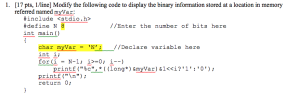 1. [17 pts, 1/line] Modify the following code to display the binary information stored at a location in memory referred named myVar: #inciude <stdio.h> #define N 8 int main0 //Enter the number of bits here char myVar/Declare variable here int i; printf ("%c", * ( (long*) &myVar) &1<<i? ' 1 ' : ' 0 ' ) ; printf ("n" return 0
What does the following code output? int x = 7, y = 10; X -= 30;...
 What does the following code output? int x = 7, y = 10; X -= 30; y *= 5; X += 32; y /= 4; cout << "y = " « y << " and x = " << x << "; " << endl; X -= 10; y /= 5; cout << "x = " << x < " and y = " << y « ";" << endl;
8. What is the S'rule in Gc for the following grammar after processing CHAIN(S)? (10 pts.)...
 8. What is the S'rule in Gc for the following grammar after processing CHAIN(S)? (10 pts.) S-S2 S.--> aS| bs|a|b|B B--> bbc C-CCC CHAIN(S) ={S, S, B, C}
this is a while array mystery from java. please help me to write the code for...
 this is a while array mystery from java. please help me to write
the code for this question to run it on eclipse !! I want the full
code to run this program !!
Consider the following method: public static void arrayMystery (int[] a) { for (int i = a. length - 1; i >= 1; i--) { if (a[i] > ali - 1] + 10) { ali - 1] = a[i - 1] + 5; Indicate in the right-hand...
this is a while array mystery from java. please help me to write
the code for this question to run it on eclipse !! I want the full
code to run this program !!
Consider the following method: public static void arrayMystery (int[] a) { for (int i = a. length - 1; i >= 1; i--) { if (a[i] > ali - 1] + 10) { ali - 1] = a[i - 1] + 5; Indicate in the right-hand...
 6. Write the MIPS assembly code that corresponds to the pseudo code below. Assume that the address for integer i is baseaddress+4 and the address for a[0] is baseaddress+8. Assume that the baseaddress is stored in $gp. The code initializes i to O; it then iterates from i-0 to i-9, setting a4i in each iteration. To make your code efficient, i must be loaded into a register at the start, and it must be updated in memory only after you've...
 Consider the following code: int w- 10; while (w>0) scanf("%d", &y); if(y>0){ V++i else The value stored in variable v at the end of the execution of the loop could best be described as the sum of all positive numbers scanned from the terminal the number of times the loop executed the sum of all non-positive numbers scanned from the terminal the number of positive integers scanned from the terminal the number of negative integers scanned from the terminal
 5. Suppose P(m,n) means “m>n”, where the universe of discourse for m and n is the set of POSITIVE integers. Find the truth value of each statement and explain your answer. NOTE: This is NOT exactly the same as the practice test. (a) (2 points) VxP(x,5) (b) (2 points) Vx3yP(x,y) (c) (2 points) ExWyP(x,y)
 In
PEP8 code.
assembly pep8 code.
30. Write an assembly language program that corresponds to the following C+ program #include <iostream> using namespace std; int num; int main() cin >> num: num = num/ 16; cout << "num = " << num << endl; return 0; 21 de
In
PEP8 code.
assembly pep8 code.
30. Write an assembly language program that corresponds to the following C+ program #include <iostream> using namespace std; int num; int main() cin >> num: num = num/ 16; cout << "num = " << num << endl; return 0; 21 de
 The sequence of the first twelve Lucas numbers is:
2,1,3,4,7,11,18,29,47 …
Please write a program for calculating the Lucas number
Ln given the number n. Print out the
results given:
a) n=2 ; b) n=5 and c) n=10
(**please answer in Python**)
Ln 2 1 (Ln-1 + Ln-2 if n= 0 if n = 1 if n >1
The sequence of the first twelve Lucas numbers is:
2,1,3,4,7,11,18,29,47 …
Please write a program for calculating the Lucas number
Ln given the number n. Print out the
results given:
a) n=2 ; b) n=5 and c) n=10
(**please answer in Python**)
Ln 2 1 (Ln-1 + Ln-2 if n= 0 if n = 1 if n >1
 1. [17 pts, 1/line] Modify the following code to display the binary information stored at a location in memory referred named myVar: #inciude <stdio.h> #define N 8 int main0 //Enter the number of bits here char myVar/Declare variable here int i; printf ("%c", * ( (long*) &myVar) &1<<i? ' 1 ' : ' 0 ' ) ; printf ("n" return 0
 What does the following code output? int x = 7, y = 10; X -= 30; y *= 5; X += 32; y /= 4; cout << "y = " « y << " and x = " << x << "; " << endl; X -= 10; y /= 5; cout << "x = " << x < " and y = " << y « ";" << endl;
 8. What is the S'rule in Gc for the following grammar after processing CHAIN(S)? (10 pts.) S-S2 S.--> aS| bs|a|b|B B--> bbc C-CCC CHAIN(S) ={S, S, B, C}
 this is a while array mystery from java. please help me to write
the code for this question to run it on eclipse !! I want the full
code to run this program !!
Consider the following method: public static void arrayMystery (int[] a) { for (int i = a. length - 1; i >= 1; i--) { if (a[i] > ali - 1] + 10) { ali - 1] = a[i - 1] + 5; Indicate in the right-hand...
this is a while array mystery from java. please help me to write
the code for this question to run it on eclipse !! I want the full
code to run this program !!
Consider the following method: public static void arrayMystery (int[] a) { for (int i = a. length - 1; i >= 1; i--) { if (a[i] > ali - 1] + 10) { ali - 1] = a[i - 1] + 5; Indicate in the right-hand...
Most questions answered within 3 hours.
-
Where is the error in this code sequence?
String s1 = "Hello";
String s2 = "ello";...
asked 11 months ago -
Financial data for Joel de Paris, Inc., for last year
follow:
Joel de Paris, Inc.
Balance...
asked 11 months ago -
Consider this reaction:
Al2(SO4)3 (aq)+ BaCl3
(aq) Al2Cl6 (aq)- +
3BaSO4(s) . What is the...
asked 11 months ago -
Suppose that Savneet is considering increasing her
recent random sample from 20 car rentals to 40...
asked 11 months ago -
Trucks arrive at an unloading terminal at an average rate of 120
per hour.
Trucks arrive...
asked 11 months ago -
Why are methanol and ethanol completely soluble in water while
octanol is not very little soluble....
asked 11 months ago -
A facilities manager at a university reads in a research report
that the mean amount of...
asked 11 months ago -
When the CuSO4 is rehydrated by adding water to the anhydrous
compound, is this an endothermic...
asked 11 months ago -
A ray of sunlight is passing from diamond into crown glass; the
angle of incidence is...
asked 11 months ago -
A block of mass 0.249 kg is placed on top of a light, vertical
spring of...
asked 11 months ago -
how do the kidneys compensate in the presences of acidosis
a) trigger hyperventilate
b) reserve acid...
asked 11 months ago -
Question 501 pts
The rental rate of capital to the firm increases. Which of the
following...
asked 11 months ago