
Homework Answers

Add Answer to:
When 3.50 g of propane 0 burns, 42.0 kcal of heat is produced. Use this information...
When a solution of NaOH is neutralized by hydrochloric acid, the solution gets hot. Calculate the...
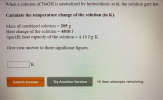 When a solution of NaOH is neutralized by hydrochloric acid, the solution gets hot. Calculate the temperature change of the solution (in K). Mass of combined solution = 205 g Heat change of the solution = 4510 J Specific heat capacity of the solution = 4.18 J/g.K Give your answer to three significant figures. K Submit Answer Try Another Version 10 item attempts remaining
part a and b How much heat energy, in kilojoules, is required to convert 42.0 g...
 part a and b
How much heat energy, in kilojoules, is required to convert 42.0 g of ice at 18.0 C to water at 25.0 C? Express your answer to three significant figures and include the appropriate units View Available Hint(s) 22.5 kJ Submit Previous Answers X Incorrect, Try Again, 2 attempts remaining Part B How long would it take for 1.50 mol of water at 100.0 C to be converted completely into steam if heat were added at a...
part a and b
How much heat energy, in kilojoules, is required to convert 42.0 g of ice at 18.0 C to water at 25.0 C? Express your answer to three significant figures and include the appropriate units View Available Hint(s) 22.5 kJ Submit Previous Answers X Incorrect, Try Again, 2 attempts remaining Part B How long would it take for 1.50 mol of water at 100.0 C to be converted completely into steam if heat were added at a...
Ethane burns in air to give H2O and CO2 2 C2H6(g) + 7 O2(g) + 4CO2(g)...
 Ethane burns in air to give H2O and CO2 2 C2H6(g) + 7 O2(g) + 4CO2(g) + 6 H2O(g) a. What volume of O2 (L) is required for complete reaction with 4.3 L of C2H6? Assume all gases are measured at the same temperature and pressure. Volume = b. What volume of H2O vapor (L) is produced in the complete reaction of 4.3 L of C2H6? Assume all gases are measured at the same temperature and pressure. Volume = Submit...
Hydrogen sulfide, H2S, is a foul-smelling gas. It burns to form sulfur dioxide 2H, S(g) + 302(g) → 2802(g) + 2H2O(g...
 Hydrogen sulfide, H2S, is a foul-smelling gas. It burns to form sulfur dioxide 2H, S(g) + 302(g) → 2802(g) + 2H2O(g); AH = -1036 kJ Calculate the enthalpy change to burn 36.5 g of hydrogen sulfide. CkJ Submit Answer Try Another Version 8 item attempts remaining
The solubility of Ni(OH)2 is measured and found to be 3.91*10-4 g/L. Use this information to...
 The solubility of Ni(OH)2 is measured and found to be 3.91*10-4 g/L. Use this information to calculate a Kp value for nickel(II) hydroxide. Ksp = Submit Answer Try Another Version 3 item attempts remaining Solid zinc sulfide and solid zinc phosphate are in equilibrium with a solution containing 1.30x10⁻² M potassium phosphate. Calculate the concentration of sulfide ion present in this solution. (sulfide] = M Submit Answer Try Another Version 3 item attempts remaining
Calculate the mass of 35.58 cm of zinc (density = 7.000 g/cm3). Give your answer to...
 Calculate the mass of 35.58 cm of zinc (density = 7.000 g/cm3). Give your answer to four significant figures. Mass g Submit Answer Try Another Version 10 item attempts remaining
Use standard reduction potentials to calculate the equilibrium constant for the reaction: Ca(4) Tel) C(s) +...
 Use standard reduction potentials to calculate the equilibrium constant for the reaction: Ca(4) Tel) C(s) + Hg2+ (aq) Hint: Carry at least 5 significant figures during intermediate calculations to avoid round off error when taking the antilogarithm. - Equilibrium constant: AGº for this reaction would be than zero. Submit Answer Try Another Version 3 item attempts remaining Enter electrons as '. Use smallest possible Integer coefficients. If a box is not needed, leave it blank Use a table of Standard...
Free Energy (kcal/mol) Reaction progress Use the reaction energy diagram above to answer the following questions....
 Free Energy (kcal/mol) Reaction progress Use the reaction energy diagram above to answer the following questions. Calculate the activation energy, AG *. for the step A to B kcal/mol Calculate the overall energy change, AG®, for the process B to C. kcal/mol Which step is faster. (a) A to B or (b) B to A? Submit Answer T ry Another Version 10 item attempts remaining
Acetylene burns in oxygen to give CO2 and H20 according to the equation below. 2 CH2(g)...
 Acetylene burns in oxygen to give CO2 and H20 according to the equation below. 2 CH2(g) +502(g) — 4CO2(g) + 2 H20(g) What volume of oxygen will react completely with 33 L CH?! 170L 13L 83 L 66L 33 L Submit Answer Try Another Version 2 item attempts remaining 1 PE pl
Refer 25 20 15 10 B C 0 Reaction progress Use the reaction energy diagram above...
 Refer 25 20 15 10 B C 0 Reaction progress Use the reaction energy diagram above to answer the following questions. Calculate the activation energy, AG , for the step C to B kcal/mol Calculate the overall energy change, AG, for the process B to A. kcal/mol Which step is faster, (a) B to A or (b) B to C Submit Answer Try Another Version 8 item attempts remaining A LO Free Energy (kcal/mol)
 When a solution of NaOH is neutralized by hydrochloric acid, the solution gets hot. Calculate the temperature change of the solution (in K). Mass of combined solution = 205 g Heat change of the solution = 4510 J Specific heat capacity of the solution = 4.18 J/g.K Give your answer to three significant figures. K Submit Answer Try Another Version 10 item attempts remaining
 part a and b
How much heat energy, in kilojoules, is required to convert 42.0 g of ice at 18.0 C to water at 25.0 C? Express your answer to three significant figures and include the appropriate units View Available Hint(s) 22.5 kJ Submit Previous Answers X Incorrect, Try Again, 2 attempts remaining Part B How long would it take for 1.50 mol of water at 100.0 C to be converted completely into steam if heat were added at a...
part a and b
How much heat energy, in kilojoules, is required to convert 42.0 g of ice at 18.0 C to water at 25.0 C? Express your answer to three significant figures and include the appropriate units View Available Hint(s) 22.5 kJ Submit Previous Answers X Incorrect, Try Again, 2 attempts remaining Part B How long would it take for 1.50 mol of water at 100.0 C to be converted completely into steam if heat were added at a...
 Ethane burns in air to give H2O and CO2 2 C2H6(g) + 7 O2(g) + 4CO2(g) + 6 H2O(g) a. What volume of O2 (L) is required for complete reaction with 4.3 L of C2H6? Assume all gases are measured at the same temperature and pressure. Volume = b. What volume of H2O vapor (L) is produced in the complete reaction of 4.3 L of C2H6? Assume all gases are measured at the same temperature and pressure. Volume = Submit...
 Hydrogen sulfide, H2S, is a foul-smelling gas. It burns to form sulfur dioxide 2H, S(g) + 302(g) → 2802(g) + 2H2O(g); AH = -1036 kJ Calculate the enthalpy change to burn 36.5 g of hydrogen sulfide. CkJ Submit Answer Try Another Version 8 item attempts remaining
 The solubility of Ni(OH)2 is measured and found to be 3.91*10-4 g/L. Use this information to calculate a Kp value for nickel(II) hydroxide. Ksp = Submit Answer Try Another Version 3 item attempts remaining Solid zinc sulfide and solid zinc phosphate are in equilibrium with a solution containing 1.30x10⁻² M potassium phosphate. Calculate the concentration of sulfide ion present in this solution. (sulfide] = M Submit Answer Try Another Version 3 item attempts remaining
 Calculate the mass of 35.58 cm of zinc (density = 7.000 g/cm3). Give your answer to four significant figures. Mass g Submit Answer Try Another Version 10 item attempts remaining
 Use standard reduction potentials to calculate the equilibrium constant for the reaction: Ca(4) Tel) C(s) + Hg2+ (aq) Hint: Carry at least 5 significant figures during intermediate calculations to avoid round off error when taking the antilogarithm. - Equilibrium constant: AGº for this reaction would be than zero. Submit Answer Try Another Version 3 item attempts remaining Enter electrons as '. Use smallest possible Integer coefficients. If a box is not needed, leave it blank Use a table of Standard...
 Free Energy (kcal/mol) Reaction progress Use the reaction energy diagram above to answer the following questions. Calculate the activation energy, AG *. for the step A to B kcal/mol Calculate the overall energy change, AG®, for the process B to C. kcal/mol Which step is faster. (a) A to B or (b) B to A? Submit Answer T ry Another Version 10 item attempts remaining
 Acetylene burns in oxygen to give CO2 and H20 according to the equation below. 2 CH2(g) +502(g) — 4CO2(g) + 2 H20(g) What volume of oxygen will react completely with 33 L CH?! 170L 13L 83 L 66L 33 L Submit Answer Try Another Version 2 item attempts remaining 1 PE pl
 Refer 25 20 15 10 B C 0 Reaction progress Use the reaction energy diagram above to answer the following questions. Calculate the activation energy, AG , for the step C to B kcal/mol Calculate the overall energy change, AG, for the process B to A. kcal/mol Which step is faster, (a) B to A or (b) B to C Submit Answer Try Another Version 8 item attempts remaining A LO Free Energy (kcal/mol)
Most questions answered within 3 hours.
-
Where is the error in this code sequence?
String s1 = "Hello";
String s2 = "ello";...
asked 11 months ago -
Financial data for Joel de Paris, Inc., for last year
follow:
Joel de Paris, Inc.
Balance...
asked 11 months ago -
Consider this reaction:
Al2(SO4)3 (aq)+ BaCl3
(aq) Al2Cl6 (aq)- +
3BaSO4(s) . What is the...
asked 11 months ago -
Suppose that Savneet is considering increasing her
recent random sample from 20 car rentals to 40...
asked 11 months ago -
Trucks arrive at an unloading terminal at an average rate of 120
per hour.
Trucks arrive...
asked 11 months ago -
Why are methanol and ethanol completely soluble in water while
octanol is not very little soluble....
asked 11 months ago -
A facilities manager at a university reads in a research report
that the mean amount of...
asked 11 months ago -
When the CuSO4 is rehydrated by adding water to the anhydrous
compound, is this an endothermic...
asked 11 months ago -
A ray of sunlight is passing from diamond into crown glass; the
angle of incidence is...
asked 11 months ago -
A block of mass 0.249 kg is placed on top of a light, vertical
spring of...
asked 11 months ago -
how do the kidneys compensate in the presences of acidosis
a) trigger hyperventilate
b) reserve acid...
asked 11 months ago -
Question 501 pts
The rental rate of capital to the firm increases. Which of the
following...
asked 11 months ago