
Homework Answers
Calculate the temperature change of the solution as follows:
E = mST
T = E/(mS) = 4510/(205*4.18)
T = 5.263 K
Therefore, the required answer is 5.263 K.
Please give good rating.
Add Answer to:
When a solution of NaOH is neutralized by hydrochloric acid, the solution gets hot. Calculate the...
When 0.630 g Mn is combined with enough hydrochloric acid to make 100.0 mL of solution...
When 0.630 g Mn is combined with enough hydrochloric acid to make 100.0 mL of solution in a coffee-cup calorimeter, all of the Mn reacts, raising the temperature of the solution from 23.6 ∘C to 28.5 ∘C. Find ΔHrxn for the reaction as written. (Assume that the specific heat capacity of the solution is 4.18 J/g∘C and the density is 1.00 g/mL.) Express your answer using three significant figures.
When 0.615 g Mn is combined with enough hydrochloric acid to make 100.0 mL of solution in a coffee-cup calorimeter
When 0.615 g Mn is combined with enough hydrochloric acid to make 100.0 mL of solution in a coffee-cup calorimeter, all of the Mn reacts, raising the temperature of the solution from 24.0 °C to 29.4°C. Find ΔHrxn for the reaction as written. (Assume that the specific heat capacity of the solution is 4.18 J/g °C and the density is 1.00 g/mL.) Express your answer using three significant figures.
When 0.650 g Mn is combined with enough hydrochloric acid to make 100.0 mL of solution...
 When 0.650 g Mn is combined with enough hydrochloric acid to make 100.0 mL of solution in a coffee-cup calorimeter, all of the Mn reacts, lowering the temperature of the solution from 29.0°C to 23.0°C. Find AHxn for the reaction as written. (Assume that the specific heat capacity of the solution is 4.18 J/g °C and the density is 1.00 g/mL.) O -212 kJ 0 -3.86 kJ -1.38 kJ O 3.86 kJ 212 kJ Submit Request Answer
FULL SCREEN PRINTER VERSION BACK NEXT Additional Problem 6.098 A dilute solution of hydrochloric acid with...
 FULL SCREEN PRINTER VERSION BACK NEXT Additional Problem 6.098 A dilute solution of hydrochloric acid with a mass of 608.38 g and containing 0.32862 mol of HCI was exactly neutralized in a calorimeter by the sodium hydroxide in 615.73 g of a comparably dilute solution. The temperature increased from 15.357 to 20.353 °C. The specific heat of the Ha solution was 4.031 ].g-1.0.1; that of the NaOH solution was 4.046 J-g-1.°C-1. The heat capacity of the calorimeter was 77.99 J.oC1...
4. The enthalpy change when a strong acid is neutralized by strong base is -57.62 kJ/mol....
 4. The enthalpy change when a strong acid is neutralized by strong base is -57.62 kJ/mol. If 1.7mL of 12.5 M HBr at 21.30°C is mixed with 750. mL of 0.135 M NaOH, also at 21.30°C, what is the maximum temperature reached by the resulting solution? (Assume that there is no heat loss to the container, that the specific heat of the final solution is 4.18 J/g. °C, and that the density of the final solution is that of water.)
1 of 16 Part A The addition of hydrochloric acid to a silver nitrate solution precipitates...
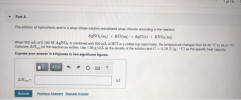 1 of 16 Part A The addition of hydrochloric acid to a silver nitrate solution precipitates silver chloride according to the reaction: AgNOs(ag) + HCl(ag) AgCI(s) HNOs(aq) When 500 mL of 0.100 M AgNO, is combined with 500 Calculate Δ Hrn for the reaction as written. Use 1.00 g/mL as the density of the solution and C = 4.18 J/ g- mL of HCl in a coffee-cup calorimeter, the temperature changes from 23.40 C to 24.21 C as the specifc...
Zinc metal reacts with hydrochloric acid according to the following balanced equation: Zn(s)+2HCl(aq)→ ZnCl2(aq)+H2(g) When 0.105...
Zinc metal reacts with hydrochloric acid according to the following balanced equation: Zn(s)+2HCl(aq)→ ZnCl2(aq)+H2(g) When 0.105 g of Zn(s) is combined with enough HCl to make 50.4 mL of solution in a coffee-cup calorimeter, all of the zinc reacts, raising the temperature of the solution from 22.2 ∘C to 24.7 ∘C. Find ΔHrxn for this reaction as written. (Use 1.00 g/mL for the density of the solution and 4.18 J/(g⋅∘C) as the specific heat capacity.) Express your answer in kilojoules...
A 100.0 mL of 0.50 M HCl at is reacted with 125.0mL of 0.50 M NaOH...
A 100.0 mL of 0.50 M HCl at is reacted with 125.0mL of 0.50 M NaOH in a calorimeter whose heat capacity is 500 J/C. What will the maximum temperature reached by the resulting solution if the initial temperature for the solution is 20.0°C? (Assume that the specific heat of the final solution is 4.18 J/g·°C, and that the density of the final solution is that of water.) The enthalpy change of HCl acid is neutralized by NaOH is –56...
Additional Problem 6.098 Your answer is partially correct. Try again. A dilute solution of hydrochloric acid...
 Additional Problem 6.098 Your answer is partially correct. Try again. A dilute solution of hydrochloric acid with a mass of 614.08 g and containing 0.30664 mol of HCl was exactly neutralized in a calorimeter by the sodium hydroxide in 618.91 g of a comparably dilute solution. The temperature increased from 16.663 to 19.946 °C. The specific heat of the HCl solution was 4.031 Jug-1.°C-1; that of the NaOH solution was 4.046 Jug-1.00-1. The heat capacity of the calorimeter was 77.99...
A 21.3 g sample of a metal was heated to 61.67°C. When the metal was placed...
 A 21.3 g sample of a metal was heated to 61.67°C. When the metal was placed into 17.8 g of water in a calorimeter, the temperature of the water increased from 25.00°C to 30.00°C. What is the specific heat of th metal? The specific heat of water is 4.18 J/g. °C). Specific heat- J/g °C) Submit Answer Try Another Version 10 item attempts remaining
 When 0.650 g Mn is combined with enough hydrochloric acid to make 100.0 mL of solution in a coffee-cup calorimeter, all of the Mn reacts, lowering the temperature of the solution from 29.0°C to 23.0°C. Find AHxn for the reaction as written. (Assume that the specific heat capacity of the solution is 4.18 J/g °C and the density is 1.00 g/mL.) O -212 kJ 0 -3.86 kJ -1.38 kJ O 3.86 kJ 212 kJ Submit Request Answer
 FULL SCREEN PRINTER VERSION BACK NEXT Additional Problem 6.098 A dilute solution of hydrochloric acid with a mass of 608.38 g and containing 0.32862 mol of HCI was exactly neutralized in a calorimeter by the sodium hydroxide in 615.73 g of a comparably dilute solution. The temperature increased from 15.357 to 20.353 °C. The specific heat of the Ha solution was 4.031 ].g-1.0.1; that of the NaOH solution was 4.046 J-g-1.°C-1. The heat capacity of the calorimeter was 77.99 J.oC1...
 4. The enthalpy change when a strong acid is neutralized by strong base is -57.62 kJ/mol. If 1.7mL of 12.5 M HBr at 21.30°C is mixed with 750. mL of 0.135 M NaOH, also at 21.30°C, what is the maximum temperature reached by the resulting solution? (Assume that there is no heat loss to the container, that the specific heat of the final solution is 4.18 J/g. °C, and that the density of the final solution is that of water.)
 1 of 16 Part A The addition of hydrochloric acid to a silver nitrate solution precipitates silver chloride according to the reaction: AgNOs(ag) + HCl(ag) AgCI(s) HNOs(aq) When 500 mL of 0.100 M AgNO, is combined with 500 Calculate Δ Hrn for the reaction as written. Use 1.00 g/mL as the density of the solution and C = 4.18 J/ g- mL of HCl in a coffee-cup calorimeter, the temperature changes from 23.40 C to 24.21 C as the specifc...
 Additional Problem 6.098 Your answer is partially correct. Try again. A dilute solution of hydrochloric acid with a mass of 614.08 g and containing 0.30664 mol of HCl was exactly neutralized in a calorimeter by the sodium hydroxide in 618.91 g of a comparably dilute solution. The temperature increased from 16.663 to 19.946 °C. The specific heat of the HCl solution was 4.031 Jug-1.°C-1; that of the NaOH solution was 4.046 Jug-1.00-1. The heat capacity of the calorimeter was 77.99...
 A 21.3 g sample of a metal was heated to 61.67°C. When the metal was placed into 17.8 g of water in a calorimeter, the temperature of the water increased from 25.00°C to 30.00°C. What is the specific heat of th metal? The specific heat of water is 4.18 J/g. °C). Specific heat- J/g °C) Submit Answer Try Another Version 10 item attempts remaining
Most questions answered within 3 hours.
-
Where is the error in this code sequence?
String s1 = "Hello";
String s2 = "ello";...
asked 10 months ago -
Financial data for Joel de Paris, Inc., for last year
follow:
Joel de Paris, Inc.
Balance...
asked 10 months ago -
Consider this reaction:
Al2(SO4)3 (aq)+ BaCl3
(aq) Al2Cl6 (aq)- +
3BaSO4(s) . What is the...
asked 10 months ago -
Suppose that Savneet is considering increasing her
recent random sample from 20 car rentals to 40...
asked 10 months ago -
Trucks arrive at an unloading terminal at an average rate of 120
per hour.
Trucks arrive...
asked 10 months ago -
Why are methanol and ethanol completely soluble in water while
octanol is not very little soluble....
asked 10 months ago -
A facilities manager at a university reads in a research report
that the mean amount of...
asked 10 months ago -
When the CuSO4 is rehydrated by adding water to the anhydrous
compound, is this an endothermic...
asked 10 months ago -
A ray of sunlight is passing from diamond into crown glass; the
angle of incidence is...
asked 10 months ago -
A block of mass 0.249 kg is placed on top of a light, vertical
spring of...
asked 10 months ago -
how do the kidneys compensate in the presences of acidosis
a) trigger hyperventilate
b) reserve acid...
asked 10 months ago -
Question 501 pts
The rental rate of capital to the firm increases. Which of the
following...
asked 10 months ago