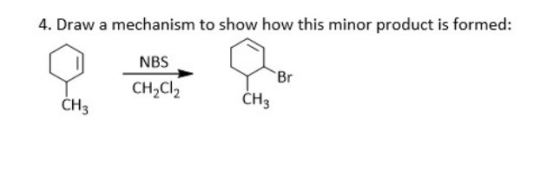
4. Draw a mechanism to show how this minor product is formed:
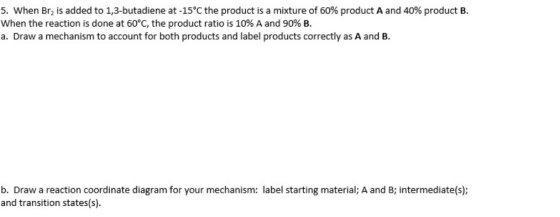
5. When Br2 is added to 1,3-butadiene at -15°C the product is a mixture of 60% product A and 40% product B When the reaction is done at 60°C, the product ratio is 10% A and 90% B
a. Draw a mechanism to account for both products and label products correctly as A and B.
b. Draw a reaction coordinate diagram for your mechanism: label starting material; A and B; intermediate(s); and transition states(s)
Homework Answers


(a) Draw a stepwise, detailed mechanism for the following reaction. Used curved arrows to show the...
 (a) Draw a stepwise, detailed mechanism for the following reaction. Used curved arrows to show the movement of electrons. Br CN NaCN DMF NaBr (b) Assign the configuration (Ror S) of the chiral centre in the substrate and product (c) List the bonds broken and formed in this reaction (d) Assume that this is an endothermic reaction. Draw an energy diagram for this reaction. Label the axes, reactants, products, E, and AH. Draw the structure for both transition states.
Draw the SN2 mechanism of the reaction between (S)-2-bromobutane and iodid ion. Show lone pairs, electron...
 Draw the SN2 mechanism of the reaction between (S)-2-bromobutane
and iodid ion. Show lone pairs, electron pushing arrows, 3-D view
to reflect appropriate stereochemistry, reactants, transition
states, and products. name the product. draw and completely label a
reaction energy diagram corresponding to the mechanism you have
drawn.
f. Draw the Sn2 mechanism of the reaction between (s)-2-bromobutane and iodide ion. Show lone pairs, electron pushing arrows, 3-D view to reflect appropriate stereochemistry, reactants, transition states, and products. Name the product....
Draw the SN2 mechanism of the reaction between (S)-2-bromobutane
and iodid ion. Show lone pairs, electron pushing arrows, 3-D view
to reflect appropriate stereochemistry, reactants, transition
states, and products. name the product. draw and completely label a
reaction energy diagram corresponding to the mechanism you have
drawn.
f. Draw the Sn2 mechanism of the reaction between (s)-2-bromobutane and iodide ion. Show lone pairs, electron pushing arrows, 3-D view to reflect appropriate stereochemistry, reactants, transition states, and products. Name the product....
The reaction below proceeds through an exothermic E2 mechanism. Draw the reaction coordinate diagram for this...
 The reaction below proceeds through an exothermic E2
mechanism. Draw the reaction coordinate diagram for this reaction,
and label all activation energies, delta Gs, and transition states.
Draw the structures of the starting materials, products, and any
interediates onto your chart where they belong
NaH Br
The reaction below proceeds through an exothermic E2
mechanism. Draw the reaction coordinate diagram for this reaction,
and label all activation energies, delta Gs, and transition states.
Draw the structures of the starting materials, products, and any
interediates onto your chart where they belong
NaH Br
12. Show the kinetic and thermodynamic product formed in the reaction of 1,3-dibutene with Br2 and...
 12. Show the kinetic and thermodynamic product formed in the
reaction of 1,3-dibutene with Br2 and draw an energy diagram for
both products. Show both products on the same graph with energy on
the Y axis and reaction coordinates on the X axis. (4 points)
12. Show the kinetic and thermodynamic product formed in the reaction of 1,3-dibutene with Bry and draw an energy diagram for both products. Show both products on the same graph with energy on the Y...
12. Show the kinetic and thermodynamic product formed in the
reaction of 1,3-dibutene with Br2 and draw an energy diagram for
both products. Show both products on the same graph with energy on
the Y axis and reaction coordinates on the X axis. (4 points)
12. Show the kinetic and thermodynamic product formed in the reaction of 1,3-dibutene with Bry and draw an energy diagram for both products. Show both products on the same graph with energy on the Y...
11. Show the product and use arrows to show the mechanism for the Nucleophilic Aromatic Substitution...
 11. Show the product and use arrows to show the mechanism for the Nucleophilic Aromatic Substitution Reaction below. Assume benzyne is an intermediate. Just write B: to representa strong base reacting with the aromatic ring. (5 points) strong base NH 12. Show the kinetic and thermodynamic product formed in the reaction of 1,3-dibutene with Brzand draw an energy diagram for both products. Show both products on the same graph with energy on the Y axis and reaction coordinates on the...
20) Part 1: Provide a step-by-step mechanism (using arrows to show electron movement) to show how...
 20) Part 1: Provide a step-by-step mechanism (using arrows to show electron movement) to show how the below reaction occurs. Be sure to draw ALL intermediates and movement of electrons to appropriately justify the given product. NOTE: It is not necessary for you to add other reagents that are not shown OR include other possible products that can be formed under the given reaction conditions. (4 points) CI OH + H2O Part B: Clearly draw and fully label an energy...
with energy* 1 of 1 Show the kinetic and thermodynamic product formed in the reaction of...
 with energy*
1 of 1 Show the kinetic and thermodynamic product formed in the reaction of 1,3-dibutene wit! Br2 and draw an energy diagram for both products. Show both products on the same graph w energy on the Y axis and reaction coordinates on the X axis.' Br2 ether buta-1,3-diene
with energy*
1 of 1 Show the kinetic and thermodynamic product formed in the reaction of 1,3-dibutene wit! Br2 and draw an energy diagram for both products. Show both products on the same graph w energy on the Y axis and reaction coordinates on the X axis.' Br2 ether buta-1,3-diene
Draw the major and minor product(s) that are expected for the following reaction
 Question 32 Draw the major and minor product(s) that are expected for the following reaction. If only one product is formed, draw it as the major product, and select no reaction for the minor product. Draw all of the minor products if more than one will form in the following reaction. Draw the major product:Draw the minor product(s):Question 31 Draw the major and minor product(s) that are expected for the following reaction. If only one product is formed, draw it as the major...
2. Complete the El reaction and answer the following questions Yoon 14 a. Draw a mechanism...
 2. Complete the El reaction and answer the following questions Yoon 14 a. Draw a mechanism of the reaction above. b. Draw an energy diagram of the reaction. Provide the structures of the starting material, intermediates product, and all transition states.
Draw the SN1 mechanism of the reaction between (R)-3-methylhexane and ethanol. Show lone pairs, electron pushing...
 Draw the SN1 mechanism of the reaction between (R)-3-methylhexane
and ethanol. Show lone pairs, electron pushing arrows, 3-D view to
reflect appropriate stereochemistry, reactants,intermediates, and
products. name the product. draw and completely label a reaction
energy diagram corresponding to the mechanism you have drawn.
B. Draw the Snl mechanism of the reaction between (R)-3-bromo-3-methylhexane and ethanol. Show lone pairs, electron pushing arrows, 3-D view to reflect appropriate stereochemistry, reactants, intermediates, and products. You do not have to show transition states....
Draw the SN1 mechanism of the reaction between (R)-3-methylhexane
and ethanol. Show lone pairs, electron pushing arrows, 3-D view to
reflect appropriate stereochemistry, reactants,intermediates, and
products. name the product. draw and completely label a reaction
energy diagram corresponding to the mechanism you have drawn.
B. Draw the Snl mechanism of the reaction between (R)-3-bromo-3-methylhexane and ethanol. Show lone pairs, electron pushing arrows, 3-D view to reflect appropriate stereochemistry, reactants, intermediates, and products. You do not have to show transition states....
 (a) Draw a stepwise, detailed mechanism for the following reaction. Used curved arrows to show the movement of electrons. Br CN NaCN DMF NaBr (b) Assign the configuration (Ror S) of the chiral centre in the substrate and product (c) List the bonds broken and formed in this reaction (d) Assume that this is an endothermic reaction. Draw an energy diagram for this reaction. Label the axes, reactants, products, E, and AH. Draw the structure for both transition states.
 Draw the SN2 mechanism of the reaction between (S)-2-bromobutane
and iodid ion. Show lone pairs, electron pushing arrows, 3-D view
to reflect appropriate stereochemistry, reactants, transition
states, and products. name the product. draw and completely label a
reaction energy diagram corresponding to the mechanism you have
drawn.
f. Draw the Sn2 mechanism of the reaction between (s)-2-bromobutane and iodide ion. Show lone pairs, electron pushing arrows, 3-D view to reflect appropriate stereochemistry, reactants, transition states, and products. Name the product....
Draw the SN2 mechanism of the reaction between (S)-2-bromobutane
and iodid ion. Show lone pairs, electron pushing arrows, 3-D view
to reflect appropriate stereochemistry, reactants, transition
states, and products. name the product. draw and completely label a
reaction energy diagram corresponding to the mechanism you have
drawn.
f. Draw the Sn2 mechanism of the reaction between (s)-2-bromobutane and iodide ion. Show lone pairs, electron pushing arrows, 3-D view to reflect appropriate stereochemistry, reactants, transition states, and products. Name the product....
 The reaction below proceeds through an exothermic E2
mechanism. Draw the reaction coordinate diagram for this reaction,
and label all activation energies, delta Gs, and transition states.
Draw the structures of the starting materials, products, and any
interediates onto your chart where they belong
NaH Br
The reaction below proceeds through an exothermic E2
mechanism. Draw the reaction coordinate diagram for this reaction,
and label all activation energies, delta Gs, and transition states.
Draw the structures of the starting materials, products, and any
interediates onto your chart where they belong
NaH Br
 12. Show the kinetic and thermodynamic product formed in the
reaction of 1,3-dibutene with Br2 and draw an energy diagram for
both products. Show both products on the same graph with energy on
the Y axis and reaction coordinates on the X axis. (4 points)
12. Show the kinetic and thermodynamic product formed in the reaction of 1,3-dibutene with Bry and draw an energy diagram for both products. Show both products on the same graph with energy on the Y...
12. Show the kinetic and thermodynamic product formed in the
reaction of 1,3-dibutene with Br2 and draw an energy diagram for
both products. Show both products on the same graph with energy on
the Y axis and reaction coordinates on the X axis. (4 points)
12. Show the kinetic and thermodynamic product formed in the reaction of 1,3-dibutene with Bry and draw an energy diagram for both products. Show both products on the same graph with energy on the Y...
 11. Show the product and use arrows to show the mechanism for the Nucleophilic Aromatic Substitution Reaction below. Assume benzyne is an intermediate. Just write B: to representa strong base reacting with the aromatic ring. (5 points) strong base NH 12. Show the kinetic and thermodynamic product formed in the reaction of 1,3-dibutene with Brzand draw an energy diagram for both products. Show both products on the same graph with energy on the Y axis and reaction coordinates on the...
 20) Part 1: Provide a step-by-step mechanism (using arrows to show electron movement) to show how the below reaction occurs. Be sure to draw ALL intermediates and movement of electrons to appropriately justify the given product. NOTE: It is not necessary for you to add other reagents that are not shown OR include other possible products that can be formed under the given reaction conditions. (4 points) CI OH + H2O Part B: Clearly draw and fully label an energy...
 with energy*
1 of 1 Show the kinetic and thermodynamic product formed in the reaction of 1,3-dibutene wit! Br2 and draw an energy diagram for both products. Show both products on the same graph w energy on the Y axis and reaction coordinates on the X axis.' Br2 ether buta-1,3-diene
with energy*
1 of 1 Show the kinetic and thermodynamic product formed in the reaction of 1,3-dibutene wit! Br2 and draw an energy diagram for both products. Show both products on the same graph w energy on the Y axis and reaction coordinates on the X axis.' Br2 ether buta-1,3-diene
 2. Complete the El reaction and answer the following questions Yoon 14 a. Draw a mechanism of the reaction above. b. Draw an energy diagram of the reaction. Provide the structures of the starting material, intermediates product, and all transition states.
 Draw the SN1 mechanism of the reaction between (R)-3-methylhexane
and ethanol. Show lone pairs, electron pushing arrows, 3-D view to
reflect appropriate stereochemistry, reactants,intermediates, and
products. name the product. draw and completely label a reaction
energy diagram corresponding to the mechanism you have drawn.
B. Draw the Snl mechanism of the reaction between (R)-3-bromo-3-methylhexane and ethanol. Show lone pairs, electron pushing arrows, 3-D view to reflect appropriate stereochemistry, reactants, intermediates, and products. You do not have to show transition states....
Draw the SN1 mechanism of the reaction between (R)-3-methylhexane
and ethanol. Show lone pairs, electron pushing arrows, 3-D view to
reflect appropriate stereochemistry, reactants,intermediates, and
products. name the product. draw and completely label a reaction
energy diagram corresponding to the mechanism you have drawn.
B. Draw the Snl mechanism of the reaction between (R)-3-bromo-3-methylhexane and ethanol. Show lone pairs, electron pushing arrows, 3-D view to reflect appropriate stereochemistry, reactants, intermediates, and products. You do not have to show transition states....
Most questions answered within 3 hours.
-
Where is the error in this code sequence?
String s1 = "Hello";
String s2 = "ello";...
asked 11 months ago -
Financial data for Joel de Paris, Inc., for last year
follow:
Joel de Paris, Inc.
Balance...
asked 11 months ago -
Consider this reaction:
Al2(SO4)3 (aq)+ BaCl3
(aq) Al2Cl6 (aq)- +
3BaSO4(s) . What is the...
asked 11 months ago -
Suppose that Savneet is considering increasing her
recent random sample from 20 car rentals to 40...
asked 11 months ago -
Trucks arrive at an unloading terminal at an average rate of 120
per hour.
Trucks arrive...
asked 11 months ago -
Why are methanol and ethanol completely soluble in water while
octanol is not very little soluble....
asked 11 months ago -
A facilities manager at a university reads in a research report
that the mean amount of...
asked 11 months ago -
When the CuSO4 is rehydrated by adding water to the anhydrous
compound, is this an endothermic...
asked 11 months ago -
A ray of sunlight is passing from diamond into crown glass; the
angle of incidence is...
asked 11 months ago -
A block of mass 0.249 kg is placed on top of a light, vertical
spring of...
asked 11 months ago -
how do the kidneys compensate in the presences of acidosis
a) trigger hyperventilate
b) reserve acid...
asked 11 months ago -
Question 501 pts
The rental rate of capital to the firm increases. Which of the
following...
asked 11 months ago