Homework Answers

If want to ask anything, just ask me.
Add Answer to:
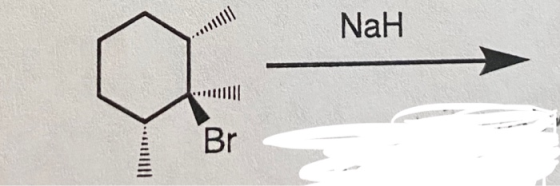
The reaction below proceeds through an exothermic E2
mechanism. Draw the reaction coordinate diagram for this...
Draw a labelled reaction coordinate diagram for the both SN reactions. Label the activation energy (free...
Draw a labelled reaction coordinate diagram for the both SN reactions. Label the activation energy (free energy of activation) and give the approximate structures of the intimal state, the transition states, the intermediate and product at the correct points along the reaction coordinate. Also, can you decide on the basis of the kinetic expression whether the t-butyl chloride-hydroxide ion reaction proceeds by a one-step or a two-step mechanism? Explain why observed kinetic expression is consistent with the mechanism you chose.
2. Draw a labeled reaction-energy diagram (graph of potential energy versus reaction coordinate) for a three-step...
 2. Draw a labeled reaction-energy diagram (graph of potential energy versus reaction coordinate) for a three-step overall exothermic reaction with the A. first step being the rate-determining step B. third step being the rate-determining step Label each graph with the following: reactants (r), transition states (ts.), intermediates (int.), products (p). activation energies (Ea), and overall standard heat of reaction (AH). (Note: Each subscript, x, needs to be a number that refers to the appropriate primary mechanistic step. For example, Ea,...
2) Draw a reaction coordinate diagram for the following reaction. Be sure to label any transition...
 2) Draw a reaction coordinate diagram for the following reaction. Be sure to label any transition states or intermediates. (4 points) NaSH Br SH
Draw a reaction-energy diagram (energy in kJ/mol) for the last step of a free radical substitution...
Draw a reaction-energy diagram (energy in kJ/mol) for the last step of a free radical substitution mechanism. Label correctly the: - axis (with units of measures, if applicable); - energy levels of reactants, products, transition states and intermediates (if applicable); - activation energy (or energies, if applicable); - heat of reaction (including its sign).
Draw a reaction-energy diagram (energy in kJ/mol) for the last step of a free radical substitution...
 Draw a reaction-energy diagram (energy in kJ/mol) for the last step of a free radical substitution mechanism. Label correctly the: - axis (with units of measures, if applicable); - energy levels of reactants, products, transition states and intermediates (if applicable); - activation energy (or energies, if applicable); - heat of reaction (including its sign).
Press Esc to exit full screen Consider the reaction below. 6. CH3OH Br a. Give a complete curved-arrow reaction mechanism b. Draw the reaction-coordinate diagram for this reaction Draw the transition...
 Press Esc to exit full screen Consider the reaction below. 6. CH3OH Br a. Give a complete curved-arrow reaction mechanism b. Draw the reaction-coordinate diagram for this reaction Draw the transition state for the carbocation rearrangement. c. d. What is the driving force for this carbocation rearrangement?
Press Esc to exit full screen Consider the reaction below. 6. CH3OH Br a. Give a complete curved-arrow reaction mechanism b. Draw the reaction-coordinate diagram for this reaction Draw the transition state for...
Press Esc to exit full screen Consider the reaction below. 6. CH3OH Br a. Give a complete curved-arrow reaction mechanism b. Draw the reaction-coordinate diagram for this reaction Draw the transition state for the carbocation rearrangement. c. d. What is the driving force for this carbocation rearrangement?
Press Esc to exit full screen Consider the reaction below. 6. CH3OH Br a. Give a complete curved-arrow reaction mechanism b. Draw the reaction-coordinate diagram for this reaction Draw the transition state for...
5) The diagram below represents the energy diagram for the reaction of 1-butyl chloride with water....
 5) The diagram below represents the energy diagram for the reaction of 1-butyl chloride with water. On the diagram, draw and indicate the position of each of the following: (0.9 points) a) structures of reactants, products, and intermediates (indicate the position of each on the diagram) b) indicate the positions of all transition states (label as "TS") c) indicate the activation energy of the rate-determining step (label as Ea) Energy Reaction Coordinate 6) Below is an energy diagram that represents...
4. Draw a mechanism to show how this minor product is formed:
 4. Draw a mechanism to show how this minor product is formed: 5. When Br2 is added to 1,3-butadiene at -15°C the product is a mixture of 60% product A and 40% product B When the reaction is done at 60°C, the product ratio is 10% A and 90% B a. Draw a mechanism to account for both products and label products correctly as A and B. b. Draw a reaction coordinate diagram for your mechanism: label starting material; A and B; intermediate(s);...
Draw the mechanism for the below reaction. Then, draw a reaction coordinate diagram for your mechanism....
 Draw the mechanism for the below reaction. Then, draw a reaction
coordinate diagram for your mechanism.
НО НО Hао® H2о
Draw the mechanism for the below reaction. Then, draw a reaction
coordinate diagram for your mechanism.
НО НО Hао® H2о
9) Circle the correct answer for each of the questions below. e. Which reacts faster in...
 9) Circle the correct answer for each of the questions below. e. Which reacts faster in an Syl reaction? a. Which reacts faster in an Sy2 reaction? CHs CH, CH,CHCHCH, or CH,CH,CCHy Br Br Br b. Which reacts faster in an El reaction? d. Which reacts faster in an E2 reaction? Br Br 10)2-bromobutane will react with OCH, in the present of dimethylsulfoxide, DMSO, as a solvent to create 1-butene and 2-butene by an elimination reaction A) Write the chemical...
 2. Draw a labeled reaction-energy diagram (graph of potential energy versus reaction coordinate) for a three-step overall exothermic reaction with the A. first step being the rate-determining step B. third step being the rate-determining step Label each graph with the following: reactants (r), transition states (ts.), intermediates (int.), products (p). activation energies (Ea), and overall standard heat of reaction (AH). (Note: Each subscript, x, needs to be a number that refers to the appropriate primary mechanistic step. For example, Ea,...
 2) Draw a reaction coordinate diagram for the following reaction. Be sure to label any transition states or intermediates. (4 points) NaSH Br SH
 Draw a reaction-energy diagram (energy in kJ/mol) for the last step of a free radical substitution mechanism. Label correctly the: - axis (with units of measures, if applicable); - energy levels of reactants, products, transition states and intermediates (if applicable); - activation energy (or energies, if applicable); - heat of reaction (including its sign).
 Press Esc to exit full screen Consider the reaction below. 6. CH3OH Br a. Give a complete curved-arrow reaction mechanism b. Draw the reaction-coordinate diagram for this reaction Draw the transition state for the carbocation rearrangement. c. d. What is the driving force for this carbocation rearrangement?
Press Esc to exit full screen Consider the reaction below. 6. CH3OH Br a. Give a complete curved-arrow reaction mechanism b. Draw the reaction-coordinate diagram for this reaction Draw the transition state for...
Press Esc to exit full screen Consider the reaction below. 6. CH3OH Br a. Give a complete curved-arrow reaction mechanism b. Draw the reaction-coordinate diagram for this reaction Draw the transition state for the carbocation rearrangement. c. d. What is the driving force for this carbocation rearrangement?
Press Esc to exit full screen Consider the reaction below. 6. CH3OH Br a. Give a complete curved-arrow reaction mechanism b. Draw the reaction-coordinate diagram for this reaction Draw the transition state for...
 5) The diagram below represents the energy diagram for the reaction of 1-butyl chloride with water. On the diagram, draw and indicate the position of each of the following: (0.9 points) a) structures of reactants, products, and intermediates (indicate the position of each on the diagram) b) indicate the positions of all transition states (label as "TS") c) indicate the activation energy of the rate-determining step (label as Ea) Energy Reaction Coordinate 6) Below is an energy diagram that represents...
 4. Draw a mechanism to show how this minor product is formed: 5. When Br2 is added to 1,3-butadiene at -15°C the product is a mixture of 60% product A and 40% product B When the reaction is done at 60°C, the product ratio is 10% A and 90% B a. Draw a mechanism to account for both products and label products correctly as A and B. b. Draw a reaction coordinate diagram for your mechanism: label starting material; A and B; intermediate(s);...
 Draw the mechanism for the below reaction. Then, draw a reaction
coordinate diagram for your mechanism.
НО НО Hао® H2о
Draw the mechanism for the below reaction. Then, draw a reaction
coordinate diagram for your mechanism.
НО НО Hао® H2о
 9) Circle the correct answer for each of the questions below. e. Which reacts faster in an Syl reaction? a. Which reacts faster in an Sy2 reaction? CHs CH, CH,CHCHCH, or CH,CH,CCHy Br Br Br b. Which reacts faster in an El reaction? d. Which reacts faster in an E2 reaction? Br Br 10)2-bromobutane will react with OCH, in the present of dimethylsulfoxide, DMSO, as a solvent to create 1-butene and 2-butene by an elimination reaction A) Write the chemical...
Most questions answered within 3 hours.
-
Where is the error in this code sequence?
String s1 = "Hello";
String s2 = "ello";...
asked 10 months ago -
Financial data for Joel de Paris, Inc., for last year
follow:
Joel de Paris, Inc.
Balance...
asked 10 months ago -
Consider this reaction:
Al2(SO4)3 (aq)+ BaCl3
(aq) Al2Cl6 (aq)- +
3BaSO4(s) . What is the...
asked 10 months ago -
Suppose that Savneet is considering increasing her
recent random sample from 20 car rentals to 40...
asked 10 months ago -
Trucks arrive at an unloading terminal at an average rate of 120
per hour.
Trucks arrive...
asked 10 months ago -
Why are methanol and ethanol completely soluble in water while
octanol is not very little soluble....
asked 10 months ago -
A facilities manager at a university reads in a research report
that the mean amount of...
asked 10 months ago -
When the CuSO4 is rehydrated by adding water to the anhydrous
compound, is this an endothermic...
asked 10 months ago -
A ray of sunlight is passing from diamond into crown glass; the
angle of incidence is...
asked 10 months ago -
A block of mass 0.249 kg is placed on top of a light, vertical
spring of...
asked 10 months ago -
how do the kidneys compensate in the presences of acidosis
a) trigger hyperventilate
b) reserve acid...
asked 10 months ago -
Question 501 pts
The rental rate of capital to the firm increases. Which of the
following...
asked 10 months ago