
Homework Answers
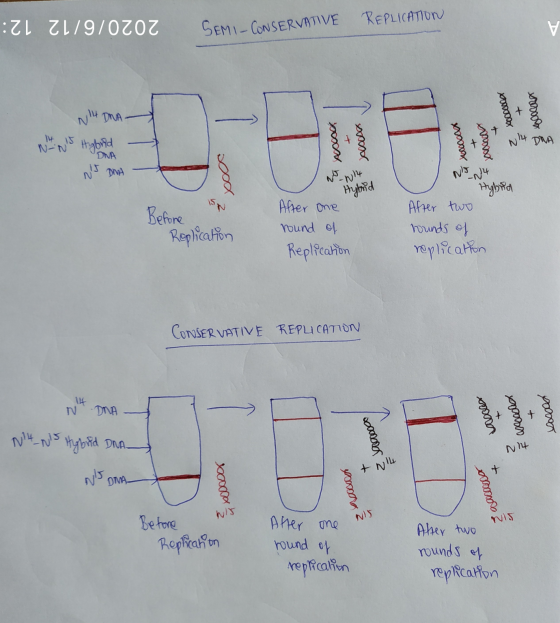
In semi-conservative replication, each strand of parent DNA (N15) acts a template for the synthesis of its complementary strand (N14) and is integrated into the daughter DNA double helix to produce a N15-N14 hybrid DNA.
But in the conservative replication, the parent DNA strands (N15) act as templates but are not integrated into the daughter strands (N14). They produce two DNA duplexes, one with two original strands and another with two newly synthesized strands.
Add Answer to:
In the late 1950s, Meselson and Stahl grew bacteria in a medium containing "heavy" nitrogen (^15...
In a famous experiment, Matthew Meselson and Franklin Stahl grew E.coli cells in a medium containing...
 In a famous experiment, Matthew Meselson and Franklin Stahl grew E.coli cells in a medium containing only the "her isotope of nitrogen, SN. These cells were then transferred to a medium with the "light" isotope of nitrogen, "N. The results of the experiment supported the hypothesis of semiconservative replication, which was proposed by Watson and Crick. Heavy DNA ('N DNA), hybrid DNA, and light DNA (N DNA) can be separated by centrifugation. If cells containing 1SN DNA are transferred to...
QUESTION 27 The Meselson and Stahl experiment was used to compare the conservative, semiconservative and dispersive...
 QUESTION 27 The Meselson and Stahl experiment was used to compare the conservative, semiconservative and dispersive models of DNA replication. They cultured E. coli cells for several generations in a medium containing heavy nitrogen, 15 N. They then transferred the bacteria to a medium containing a lighter nitrogen isotope, 14 N. Samples were taken after the first round of DNA replication; another sample was taken after the second round of replication. They extracted DNA and centrifuged each sample. Explain (in...
i dont understand 46 at all Question 46 In the late 1950s, Meselson and Stahl grow...
 i dont understand 46 at all
Question 46 In the late 1950s, Meselson and Stahl grow bacteria in a medium containing "heavy nitrogen (N) and then transferred them to a medium containing different amount of time for growth and cell division and then isolated DNA and subjected it to density gradient centrifugation 0/1 point . They allowed mo 14N DNA 14N 1SN hybrid DNA STICHE 15N DNA pod A. B. C. D. E. Which of the results in the figure...
i dont understand 46 at all
Question 46 In the late 1950s, Meselson and Stahl grow bacteria in a medium containing "heavy nitrogen (N) and then transferred them to a medium containing different amount of time for growth and cell division and then isolated DNA and subjected it to density gradient centrifugation 0/1 point . They allowed mo 14N DNA 14N 1SN hybrid DNA STICHE 15N DNA pod A. B. C. D. E. Which of the results in the figure...
How did Meselson and Stahl distinguish between semiconservative and conservative replication in their experiment? a After...
How did Meselson and Stahl distinguish between semiconservative and conservative replication in their experiment? a After two rounds of replication, only mixed DNA molecules were present in the gradient. b After one round of replication, only mixed DNA molecules were present in the gradient. c After one round of replication, only heavy DNA molecules were present in the gradient. d After one round of replication, only mixed DNA strands were present in alkaline gradients.
Please explain which one I missed, I got a 8/10. Might be the last question that...
 Please explain which one I missed, I got a 8/10. Might be the
last question that I missed!
ament Quiz -U01-202020 Fund of Biology | The Meselson-Stahl experiment demonstrated that DNA replication produces two DNA molecules each composed of _? Select one a One Old stand of nucleotides and One new strand of nucleotides b. A varying number of strands of old and new nucleotides Two strands of old and new nucleotides mixed d. Two new strands of nucleotides e....
Please explain which one I missed, I got a 8/10. Might be the
last question that I missed!
ament Quiz -U01-202020 Fund of Biology | The Meselson-Stahl experiment demonstrated that DNA replication produces two DNA molecules each composed of _? Select one a One Old stand of nucleotides and One new strand of nucleotides b. A varying number of strands of old and new nucleotides Two strands of old and new nucleotides mixed d. Two new strands of nucleotides e....
Matthew Meselson and Franklin Stahl performed an experiment using heavy isotopes and bacteria to determine which...
Matthew Meselson and Franklin Stahl performed an experiment using heavy isotopes and bacteria to determine which model DNA follows to replicate. Their results are evidence supporting which DNA replication model below? a. The parent DNA molecule is broken into its singular nucleotides from which new nucleotides are copied and then all nucleotides to come back together as one larger DNA molecule. b. The parent DNA is mixed into each of the daughter strands such that both daughter molecules contain a...
Please need help answering question A the pages of background information are posted thanks Read page...
 Please need help answering question A the pages of background
information are posted thanks
Read page 196-197 and figure 6.20. regarding Meselson and
Stahl’s experiment regarding DNA replication. And Answer the
following question
If you are using this radioactive technique in mouse cells,
what would happen in each phase of G1, S, G2, mitosis and meiosis
assuming that you are grown cells in 15N medium for many
generations and cells in G1are then switched to 14N medium?
G1
S
G2...
Please need help answering question A the pages of background
information are posted thanks
Read page 196-197 and figure 6.20. regarding Meselson and
Stahl’s experiment regarding DNA replication. And Answer the
following question
If you are using this radioactive technique in mouse cells,
what would happen in each phase of G1, S, G2, mitosis and meiosis
assuming that you are grown cells in 15N medium for many
generations and cells in G1are then switched to 14N medium?
G1
S
G2...
áctica #8 - Estructura del Ácido Nucléico, Rep... Help Save & Exit Submit Light Half-heavy Heavy...
 áctica #8 - Estructura del Ácido Nucléico, Rep... Help Save & Exit Submit Light Half-heavy Heavy McGraw-Hill Education ellook ferences Suppose that, as in the Meselson-Stahl experiment, E. coll is grown for many generations in heavy nitrogen (N) precursors, then shifted to light nitrogen (14N) precursors for 1 or 2 generations. Select the test tube that best corresponds to the positions that DNA would be expected to migrate in the following hypothetical situations. (Not all letters may be used, and...
In the classic paper that demonstrated the semi-conservative replication of DNA, Meselson and Stahl began by...
 In the classic paper that demonstrated the semi-conservative
replication of DNA, Meselson and Stahl began by showing that DNA
itself will form a band when subjected to equilibrium
sedimentation. They mixed randomly fragmented E coli DNA with a
solution of CsCl so that the final solution had a density of 1.71
g/ml. As shortn in Figure Q8-2, with increasing length of
centrifugation at 70,000 times gravity, the DNA, which was
initially dispersed throughout the centrifuge tube, became
concentrated over time...
In the classic paper that demonstrated the semi-conservative
replication of DNA, Meselson and Stahl began by showing that DNA
itself will form a band when subjected to equilibrium
sedimentation. They mixed randomly fragmented E coli DNA with a
solution of CsCl so that the final solution had a density of 1.71
g/ml. As shortn in Figure Q8-2, with increasing length of
centrifugation at 70,000 times gravity, the DNA, which was
initially dispersed throughout the centrifuge tube, became
concentrated over time...
4. In a lake governed by the food web shown in the image to the right, 500 brown trout are added from fisheries. Which of the following outcomes would most likely be expected? A. Tadpole populat...
 4. In a lake governed by the food web shown in the image to the right, 500 brown trout are added from fisheries. Which of the following outcomes would most likely be expected? A. Tadpole population will increase B. Duck population will decrease C. Algae population will increase D. Lilly Pad population will decrease E. Caddis Fly larvae will increase 5. Which of the following pieces of evidence most strongly supports a common ancestor of all life on Earth? A....
 In a famous experiment, Matthew Meselson and Franklin Stahl grew E.coli cells in a medium containing only the "her isotope of nitrogen, SN. These cells were then transferred to a medium with the "light" isotope of nitrogen, "N. The results of the experiment supported the hypothesis of semiconservative replication, which was proposed by Watson and Crick. Heavy DNA ('N DNA), hybrid DNA, and light DNA (N DNA) can be separated by centrifugation. If cells containing 1SN DNA are transferred to...
 QUESTION 27 The Meselson and Stahl experiment was used to compare the conservative, semiconservative and dispersive models of DNA replication. They cultured E. coli cells for several generations in a medium containing heavy nitrogen, 15 N. They then transferred the bacteria to a medium containing a lighter nitrogen isotope, 14 N. Samples were taken after the first round of DNA replication; another sample was taken after the second round of replication. They extracted DNA and centrifuged each sample. Explain (in...
 i dont understand 46 at all
Question 46 In the late 1950s, Meselson and Stahl grow bacteria in a medium containing "heavy nitrogen (N) and then transferred them to a medium containing different amount of time for growth and cell division and then isolated DNA and subjected it to density gradient centrifugation 0/1 point . They allowed mo 14N DNA 14N 1SN hybrid DNA STICHE 15N DNA pod A. B. C. D. E. Which of the results in the figure...
i dont understand 46 at all
Question 46 In the late 1950s, Meselson and Stahl grow bacteria in a medium containing "heavy nitrogen (N) and then transferred them to a medium containing different amount of time for growth and cell division and then isolated DNA and subjected it to density gradient centrifugation 0/1 point . They allowed mo 14N DNA 14N 1SN hybrid DNA STICHE 15N DNA pod A. B. C. D. E. Which of the results in the figure...
 Please explain which one I missed, I got a 8/10. Might be the
last question that I missed!
ament Quiz -U01-202020 Fund of Biology | The Meselson-Stahl experiment demonstrated that DNA replication produces two DNA molecules each composed of _? Select one a One Old stand of nucleotides and One new strand of nucleotides b. A varying number of strands of old and new nucleotides Two strands of old and new nucleotides mixed d. Two new strands of nucleotides e....
Please explain which one I missed, I got a 8/10. Might be the
last question that I missed!
ament Quiz -U01-202020 Fund of Biology | The Meselson-Stahl experiment demonstrated that DNA replication produces two DNA molecules each composed of _? Select one a One Old stand of nucleotides and One new strand of nucleotides b. A varying number of strands of old and new nucleotides Two strands of old and new nucleotides mixed d. Two new strands of nucleotides e....
 Please need help answering question A the pages of background
information are posted thanks
Read page 196-197 and figure 6.20. regarding Meselson and
Stahl’s experiment regarding DNA replication. And Answer the
following question
If you are using this radioactive technique in mouse cells,
what would happen in each phase of G1, S, G2, mitosis and meiosis
assuming that you are grown cells in 15N medium for many
generations and cells in G1are then switched to 14N medium?
G1
S
G2...
Please need help answering question A the pages of background
information are posted thanks
Read page 196-197 and figure 6.20. regarding Meselson and
Stahl’s experiment regarding DNA replication. And Answer the
following question
If you are using this radioactive technique in mouse cells,
what would happen in each phase of G1, S, G2, mitosis and meiosis
assuming that you are grown cells in 15N medium for many
generations and cells in G1are then switched to 14N medium?
G1
S
G2...
 áctica #8 - Estructura del Ácido Nucléico, Rep... Help Save & Exit Submit Light Half-heavy Heavy McGraw-Hill Education ellook ferences Suppose that, as in the Meselson-Stahl experiment, E. coll is grown for many generations in heavy nitrogen (N) precursors, then shifted to light nitrogen (14N) precursors for 1 or 2 generations. Select the test tube that best corresponds to the positions that DNA would be expected to migrate in the following hypothetical situations. (Not all letters may be used, and...
 In the classic paper that demonstrated the semi-conservative
replication of DNA, Meselson and Stahl began by showing that DNA
itself will form a band when subjected to equilibrium
sedimentation. They mixed randomly fragmented E coli DNA with a
solution of CsCl so that the final solution had a density of 1.71
g/ml. As shortn in Figure Q8-2, with increasing length of
centrifugation at 70,000 times gravity, the DNA, which was
initially dispersed throughout the centrifuge tube, became
concentrated over time...
In the classic paper that demonstrated the semi-conservative
replication of DNA, Meselson and Stahl began by showing that DNA
itself will form a band when subjected to equilibrium
sedimentation. They mixed randomly fragmented E coli DNA with a
solution of CsCl so that the final solution had a density of 1.71
g/ml. As shortn in Figure Q8-2, with increasing length of
centrifugation at 70,000 times gravity, the DNA, which was
initially dispersed throughout the centrifuge tube, became
concentrated over time...
 4. In a lake governed by the food web shown in the image to the right, 500 brown trout are added from fisheries. Which of the following outcomes would most likely be expected? A. Tadpole population will increase B. Duck population will decrease C. Algae population will increase D. Lilly Pad population will decrease E. Caddis Fly larvae will increase 5. Which of the following pieces of evidence most strongly supports a common ancestor of all life on Earth? A....
Most questions answered within 3 hours.
-
Where is the error in this code sequence?
String s1 = "Hello";
String s2 = "ello";...
asked 11 months ago -
Financial data for Joel de Paris, Inc., for last year
follow:
Joel de Paris, Inc.
Balance...
asked 11 months ago -
Consider this reaction:
Al2(SO4)3 (aq)+ BaCl3
(aq) Al2Cl6 (aq)- +
3BaSO4(s) . What is the...
asked 11 months ago -
Suppose that Savneet is considering increasing her
recent random sample from 20 car rentals to 40...
asked 11 months ago -
Trucks arrive at an unloading terminal at an average rate of 120
per hour.
Trucks arrive...
asked 11 months ago -
Why are methanol and ethanol completely soluble in water while
octanol is not very little soluble....
asked 11 months ago -
A facilities manager at a university reads in a research report
that the mean amount of...
asked 11 months ago -
When the CuSO4 is rehydrated by adding water to the anhydrous
compound, is this an endothermic...
asked 11 months ago -
A ray of sunlight is passing from diamond into crown glass; the
angle of incidence is...
asked 11 months ago -
A block of mass 0.249 kg is placed on top of a light, vertical
spring of...
asked 11 months ago -
how do the kidneys compensate in the presences of acidosis
a) trigger hyperventilate
b) reserve acid...
asked 11 months ago -
Question 501 pts
The rental rate of capital to the firm increases. Which of the
following...
asked 11 months ago