
Homework Answers
Add Answer to:
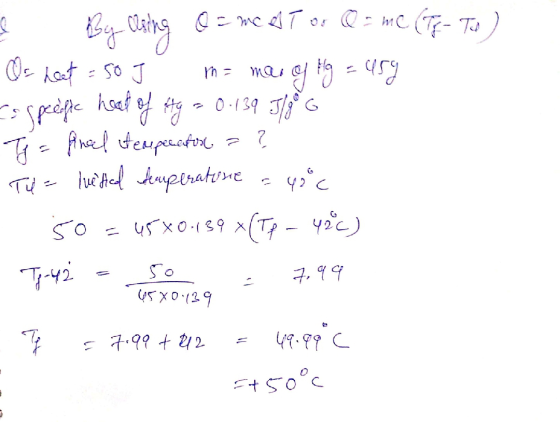
Calculate the final temperature (Tf) when 45.0 g of Hg receive 50.0 J of heat (q)...
The specific heat of copper is 0.385 J/gC . Calculate the final temperature when 25.0 g of copper metal at 100C is adde...
The specific heat of copper is 0.385 J/gC . Calculate the final temperature when 25.0 g of copper metal at 100C is added to 50 mL of water at 20 C
Calculate the final temperature of the water from the following heat transfer experiment. 33 g of...
Calculate the final temperature of the water from the following heat transfer experiment. 33 g of water at an initial temperature of 44 oC (Celsius) is added to 100.0 g of water at 100.0oC. The experiment is performed in an insulated container to prevent heat loss to the surroundings. Specific heat of water = 4.184 J/(g oC) State your answers in degrees celsius (C) with 3 significant figures. Tf =
A hot lump of 42.0 g of aluminum at an initial temperature of 90.5 °C is...
A hot lump of 42.0 g of aluminum at an initial temperature of 90.5 °C is placed in 50.0 mL H2O initially at 25.0 °C and allowed to reach thermal equilibrium. What is the final temperature of the aluminum and water, given that the specific heat of aluminum is 0.903 J/(g·°C)? Assume no heat is lost to surroundings.
Calculate the final temperature of 6.84 g of praseodymium (specific heat capacity = 0.193 J g-1...
Calculate the final temperature of 6.84 g of praseodymium (specific heat capacity = 0.193 J g-1 °C-1) initially at 26.8 °C that releases 11.3 J of energy into the surroundings. A)14.3°C B)18.2 °C C)21.6 °C D)23.8 °C E)8.17 °C
4. Calculate the heat change in a system (q) when 12.0 g of water is heated...
 4. Calculate the heat change in a system (q) when 12.0 g of water is heated from 20.0 °C to 100.0 °C. 5. A 295 g aluminum engine at an initial temperature of 3.00 °C absorbs 85.0 kJ of heat. What is the final temperature of the engine? The specific heat capacity for aluminum is 0.900 J/(g K).
Calculate the amount of heat (in loules) that must be added to 50.0 g of water...
 Calculate the amount of heat (in loules) that must be added to 50.0 g of water to increase the temperature from 26.3C to 52.70. The specific heat of water is 4.18 J/g C An 50.0 g iron nail was heated in a blacksmith forge until it glowed cherry red. It was then dropped into a calorimeter containing 50.0 g of water at room temperature (21.5°C) and swirled gently until the temperature reached its maximum. The final temperature was 26.0 C....
A hot lump of 32.3 g of copper at an initial temperature of 96.5°C is placed...
 A
hot lump of 32.3 g of copper at an initial temperature of 96.5°C is
placed in 50.0 mL H2O initially at 25.0°C and allowed to reach
thermal equilibrium. What is the final temperature of the copper
and water given that the specific heat of copper is 0.385J/g°C and
the specific heat of water is 4.184J/g°C?
4. A hot lump of 32.3 g of copper at an initial temperature of 96.5°C is placed in 50.0 mL H20 initially at 25.0°C...
A
hot lump of 32.3 g of copper at an initial temperature of 96.5°C is
placed in 50.0 mL H2O initially at 25.0°C and allowed to reach
thermal equilibrium. What is the final temperature of the copper
and water given that the specific heat of copper is 0.385J/g°C and
the specific heat of water is 4.184J/g°C?
4. A hot lump of 32.3 g of copper at an initial temperature of 96.5°C is placed in 50.0 mL H20 initially at 25.0°C...
A hot lump of 35.6 g of copper at an initial temperature of 86.3 C is placed in 50.0 mL initially at 25.0 °C and allowed...
A hot lump of 35.6 g of copper at an initial temperature of 86.3 C is placed in 50.0 mL initially at 25.0 °C and allowed to reach thermal equilibrium. What is the final temperature of the copper and water, given that the specific heat of copper is 0.385 J/(gxC). Assume no heat is lost to surroundings.
4. Heat transfer: q = mass x Cs x ΔT and –qreaction = +qsolution a. A...
4. Heat transfer: q = mass x Cs x ΔT and –qreaction = +qsolution a. A piece of metal with a mass of 8.6 g was heated to 100.0°C and dropped into a coffee cup calorimeter containing 402.4 g of water at 25.0°C. If the temperature of the water and the metal at thermal equilibrium is 26.4°C, what is the specific heat of this metal in J/g°C? b. How much heat energy must be added in order to boil a...
521.8 J of heat was added to 8.00 g of water. The final temperature of the...
521.8 J of heat was added to 8.00 g of water. The final temperature of the water was measured to be 64.2oC. What was the initial temperature of the water? (specific heat capacity of water = 4.184 J/goC)
 4. Calculate the heat change in a system (q) when 12.0 g of water is heated from 20.0 °C to 100.0 °C. 5. A 295 g aluminum engine at an initial temperature of 3.00 °C absorbs 85.0 kJ of heat. What is the final temperature of the engine? The specific heat capacity for aluminum is 0.900 J/(g K).
 Calculate the amount of heat (in loules) that must be added to 50.0 g of water to increase the temperature from 26.3C to 52.70. The specific heat of water is 4.18 J/g C An 50.0 g iron nail was heated in a blacksmith forge until it glowed cherry red. It was then dropped into a calorimeter containing 50.0 g of water at room temperature (21.5°C) and swirled gently until the temperature reached its maximum. The final temperature was 26.0 C....
 A
hot lump of 32.3 g of copper at an initial temperature of 96.5°C is
placed in 50.0 mL H2O initially at 25.0°C and allowed to reach
thermal equilibrium. What is the final temperature of the copper
and water given that the specific heat of copper is 0.385J/g°C and
the specific heat of water is 4.184J/g°C?
4. A hot lump of 32.3 g of copper at an initial temperature of 96.5°C is placed in 50.0 mL H20 initially at 25.0°C...
A
hot lump of 32.3 g of copper at an initial temperature of 96.5°C is
placed in 50.0 mL H2O initially at 25.0°C and allowed to reach
thermal equilibrium. What is the final temperature of the copper
and water given that the specific heat of copper is 0.385J/g°C and
the specific heat of water is 4.184J/g°C?
4. A hot lump of 32.3 g of copper at an initial temperature of 96.5°C is placed in 50.0 mL H20 initially at 25.0°C...
Most questions answered within 3 hours.
-
Where is the error in this code sequence?
String s1 = "Hello";
String s2 = "ello";...
asked 10 months ago -
Financial data for Joel de Paris, Inc., for last year
follow:
Joel de Paris, Inc.
Balance...
asked 10 months ago -
Consider this reaction:
Al2(SO4)3 (aq)+ BaCl3
(aq) Al2Cl6 (aq)- +
3BaSO4(s) . What is the...
asked 10 months ago -
Suppose that Savneet is considering increasing her
recent random sample from 20 car rentals to 40...
asked 10 months ago -
Trucks arrive at an unloading terminal at an average rate of 120
per hour.
Trucks arrive...
asked 10 months ago -
Why are methanol and ethanol completely soluble in water while
octanol is not very little soluble....
asked 10 months ago -
A facilities manager at a university reads in a research report
that the mean amount of...
asked 10 months ago -
When the CuSO4 is rehydrated by adding water to the anhydrous
compound, is this an endothermic...
asked 10 months ago -
A ray of sunlight is passing from diamond into crown glass; the
angle of incidence is...
asked 10 months ago -
A block of mass 0.249 kg is placed on top of a light, vertical
spring of...
asked 10 months ago -
how do the kidneys compensate in the presences of acidosis
a) trigger hyperventilate
b) reserve acid...
asked 10 months ago -
Question 501 pts
The rental rate of capital to the firm increases. Which of the
following...
asked 10 months ago