

Homework Answers

Add Answer to:
Q8 (a). For the beam as shown in Figure 8a, determine the reaction forces at A...
For the beam shown in Figure A2: (a) Determine the static indeterminacy of the beam. (b)...
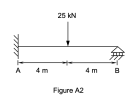 For the beam shown in Figure A2:
(a) Determine the static indeterminacy of the beam.
(b) Using the flexibility method, and taking the support
reaction at B as the redundant, express the compatibility condition
for the displacement at B.
(c) Using the results of (b), determine the support reaction at
B
25 kN A 4 m 4 Figure A2
For the beam shown in Figure A2:
(a) Determine the static indeterminacy of the beam.
(b) Using the flexibility method, and taking the support
reaction at B as the redundant, express the compatibility condition
for the displacement at B.
(c) Using the results of (b), determine the support reaction at
B
25 kN A 4 m 4 Figure A2
Analyse the beam shown in Figure 4 using the stiffiness method. Node D is fixed and...
 Analyse the beam shown in Figure 4 using the stiffiness method. Node D is fixed and node 2 and 3 are rollers. A uniform distributed load of 1 kN/m is acting on member 1 . And a load of 10 kN is acting at the middle of member2. EI is constant for all members a) Identify the force vector of the structure; [4 marks] b) Identify the displacement vector of the structure; [2 marks] c) Determine the stiffness matrices of...
2. For the beam and loading shown in the following figure: (a) find all the reaction...
 2. For the beam and loading shown in the following figure: (a) find all the reaction forces, (b) draw the shear and bending moment diagrams and (c) determine the maximum absolute value of the shear and the bending moment. 25 kN m 40 kN 401N 0.61 1.S 0.6 m
3.1.5312506 For the forces acting on the beam shown in Figure 3.1e, determine the location of...
 3.1.5312506 For the forces acting on the beam shown in Figure 3.1e, determine the location of the equivalent resultant force with reference to point Din m. Given p = 1.5,9 = 2,r=3.5, W1 = 40 and w2 = 60. (Note: Prefix the value with negative sign "-" if the location is to the left of the reference point. E.g. if the location of the equivalent resultant force is located between points A and C, or to the left of point...
8. The cantilever beam in Figure Q8 subjects to concentrated loading. The cross section geometry gives...
 8. The cantilever beam in Figure Q8 subjects to concentrated loading. The cross section geometry gives the second moment of area / 100 x 10 m. The longitudinal geometry of the beam: a 2 m, b 1 m. The material of the beam: Young's modulus E 200 GPa. The loading: concentrated force P 10 KN. (a) Determine the reactions to the beam at the fixed end. (b) Determine the rotation angle at point x-a (c) (Determine the deflection at the...
3.1.0639365 For the forces acting on the beam shown in Figure 3.1g, determine the location of...
 3.1.0639365 For the forces acting on the beam shown in Figure 3.1g, determine the location of the equivalent resultant force with reference to point A in m. Given / = 1.8, w1 = 15, w2 = 8, P1 = 8 and P2 = 16. (Note: Prefix the value with negative sign "-"if the location is to the left of the reference point. E.g. if the location of the equivalent resultant is located between points A and B, or to the...
Using force method , determine the reactions of the supports for the beam shown in Figure...
 Using force method , determine the reactions of the
supports for the beam shown in Figure ( 5 ) . Then draw shear and
bending moment diagrams for the beam El is constant Use conjugate
beam method to determine deflections ,
6 m 50 KN 200 kN. 9 m - 3 m Fig. (5) BEST WISHES
Using force method , determine the reactions of the
supports for the beam shown in Figure ( 5 ) . Then draw shear and
bending moment diagrams for the beam El is constant Use conjugate
beam method to determine deflections ,
6 m 50 KN 200 kN. 9 m - 3 m Fig. (5) BEST WISHES
SAN4701 JAN/FEB 2015 QUESTION 1 The truss shown in Figure 1 is hinged at C, B and D It is acted upon at node A by a ver...
 SAN4701 JAN/FEB 2015 QUESTION 1 The truss shown in Figure 1 is hinged at C, B and D It is acted upon at node A by a vertically downward force of 3 kN and a honzontal force of 5 kN as shown in Figure 1 Use the method of strffness matrix and analyse for the following (a) Displacement at node A (16) (b) Reaction at the supports (c) Member forces (15) EA 300 x 103 kN and is constant for...
1. Determine the forces in members DF and FE of the double-pitch roof truss shown. State...
 1. Determine the forces in members DF and FE of the double-pitch
roof truss shown. State whether each of those members is in tension
or compression.
2. For the given loading, determine the zero-force members in
each of the truss shown.
1. Determine the forces in members DF and FE of the double-pitch roof truss shown. State whether each of those members is in tension or compression. - 4m 4m 4m 3m 3m KV 6 m 0.75 kN 6m 6...
1. Determine the forces in members DF and FE of the double-pitch
roof truss shown. State whether each of those members is in tension
or compression.
2. For the given loading, determine the zero-force members in
each of the truss shown.
1. Determine the forces in members DF and FE of the double-pitch roof truss shown. State whether each of those members is in tension or compression. - 4m 4m 4m 3m 3m KV 6 m 0.75 kN 6m 6...
For the loading shown in the below figure, knowing that wo 2 kN/m, the length of the beam is L 2 ...
 For the loading shown in the below figure, knowing that wo 2 kN/m, the length of the beam is L 2 m, and the bending rigidity EI-204 kN-m2, a) Find the deflection equation for the beam by integration. Clearly specify the conditions to determine the constants of integration b) Find the vertical force needed at point A to prevent vertical displacement at point A (v(0)-0) c) Find the moment needed at point A to have zero slope at point A...
 For the beam shown in Figure A2:
(a) Determine the static indeterminacy of the beam.
(b) Using the flexibility method, and taking the support
reaction at B as the redundant, express the compatibility condition
for the displacement at B.
(c) Using the results of (b), determine the support reaction at
B
25 kN A 4 m 4 Figure A2
For the beam shown in Figure A2:
(a) Determine the static indeterminacy of the beam.
(b) Using the flexibility method, and taking the support
reaction at B as the redundant, express the compatibility condition
for the displacement at B.
(c) Using the results of (b), determine the support reaction at
B
25 kN A 4 m 4 Figure A2
 Analyse the beam shown in Figure 4 using the stiffiness method. Node D is fixed and node 2 and 3 are rollers. A uniform distributed load of 1 kN/m is acting on member 1 . And a load of 10 kN is acting at the middle of member2. EI is constant for all members a) Identify the force vector of the structure; [4 marks] b) Identify the displacement vector of the structure; [2 marks] c) Determine the stiffness matrices of...
 2. For the beam and loading shown in the following figure: (a) find all the reaction forces, (b) draw the shear and bending moment diagrams and (c) determine the maximum absolute value of the shear and the bending moment. 25 kN m 40 kN 401N 0.61 1.S 0.6 m
 3.1.5312506 For the forces acting on the beam shown in Figure 3.1e, determine the location of the equivalent resultant force with reference to point Din m. Given p = 1.5,9 = 2,r=3.5, W1 = 40 and w2 = 60. (Note: Prefix the value with negative sign "-" if the location is to the left of the reference point. E.g. if the location of the equivalent resultant force is located between points A and C, or to the left of point...
 8. The cantilever beam in Figure Q8 subjects to concentrated loading. The cross section geometry gives the second moment of area / 100 x 10 m. The longitudinal geometry of the beam: a 2 m, b 1 m. The material of the beam: Young's modulus E 200 GPa. The loading: concentrated force P 10 KN. (a) Determine the reactions to the beam at the fixed end. (b) Determine the rotation angle at point x-a (c) (Determine the deflection at the...
 3.1.0639365 For the forces acting on the beam shown in Figure 3.1g, determine the location of the equivalent resultant force with reference to point A in m. Given / = 1.8, w1 = 15, w2 = 8, P1 = 8 and P2 = 16. (Note: Prefix the value with negative sign "-"if the location is to the left of the reference point. E.g. if the location of the equivalent resultant is located between points A and B, or to the...
 Using force method , determine the reactions of the
supports for the beam shown in Figure ( 5 ) . Then draw shear and
bending moment diagrams for the beam El is constant Use conjugate
beam method to determine deflections ,
6 m 50 KN 200 kN. 9 m - 3 m Fig. (5) BEST WISHES
Using force method , determine the reactions of the
supports for the beam shown in Figure ( 5 ) . Then draw shear and
bending moment diagrams for the beam El is constant Use conjugate
beam method to determine deflections ,
6 m 50 KN 200 kN. 9 m - 3 m Fig. (5) BEST WISHES
 SAN4701 JAN/FEB 2015 QUESTION 1 The truss shown in Figure 1 is hinged at C, B and D It is acted upon at node A by a vertically downward force of 3 kN and a honzontal force of 5 kN as shown in Figure 1 Use the method of strffness matrix and analyse for the following (a) Displacement at node A (16) (b) Reaction at the supports (c) Member forces (15) EA 300 x 103 kN and is constant for...
 1. Determine the forces in members DF and FE of the double-pitch
roof truss shown. State whether each of those members is in tension
or compression.
2. For the given loading, determine the zero-force members in
each of the truss shown.
1. Determine the forces in members DF and FE of the double-pitch roof truss shown. State whether each of those members is in tension or compression. - 4m 4m 4m 3m 3m KV 6 m 0.75 kN 6m 6...
1. Determine the forces in members DF and FE of the double-pitch
roof truss shown. State whether each of those members is in tension
or compression.
2. For the given loading, determine the zero-force members in
each of the truss shown.
1. Determine the forces in members DF and FE of the double-pitch roof truss shown. State whether each of those members is in tension or compression. - 4m 4m 4m 3m 3m KV 6 m 0.75 kN 6m 6...
 For the loading shown in the below figure, knowing that wo 2 kN/m, the length of the beam is L 2 m, and the bending rigidity EI-204 kN-m2, a) Find the deflection equation for the beam by integration. Clearly specify the conditions to determine the constants of integration b) Find the vertical force needed at point A to prevent vertical displacement at point A (v(0)-0) c) Find the moment needed at point A to have zero slope at point A...
Most questions answered within 3 hours.
-
Where is the error in this code sequence?
String s1 = "Hello";
String s2 = "ello";...
asked 10 months ago -
Financial data for Joel de Paris, Inc., for last year
follow:
Joel de Paris, Inc.
Balance...
asked 10 months ago -
Consider this reaction:
Al2(SO4)3 (aq)+ BaCl3
(aq) Al2Cl6 (aq)- +
3BaSO4(s) . What is the...
asked 10 months ago -
Suppose that Savneet is considering increasing her
recent random sample from 20 car rentals to 40...
asked 10 months ago -
Trucks arrive at an unloading terminal at an average rate of 120
per hour.
Trucks arrive...
asked 10 months ago -
Why are methanol and ethanol completely soluble in water while
octanol is not very little soluble....
asked 10 months ago -
A facilities manager at a university reads in a research report
that the mean amount of...
asked 10 months ago -
When the CuSO4 is rehydrated by adding water to the anhydrous
compound, is this an endothermic...
asked 10 months ago -
A ray of sunlight is passing from diamond into crown glass; the
angle of incidence is...
asked 10 months ago -
A block of mass 0.249 kg is placed on top of a light, vertical
spring of...
asked 10 months ago -
how do the kidneys compensate in the presences of acidosis
a) trigger hyperventilate
b) reserve acid...
asked 10 months ago -
Question 501 pts
The rental rate of capital to the firm increases. Which of the
following...
asked 10 months ago