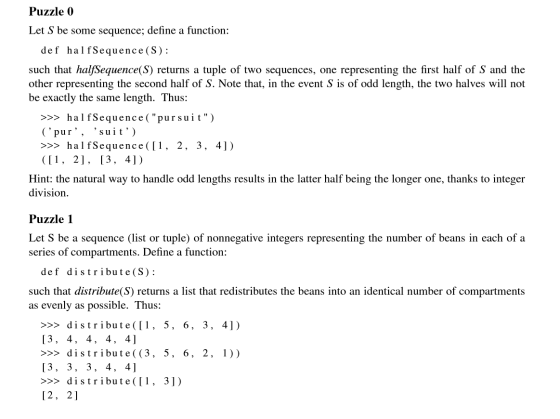
This exercise consists of puzzles, each which can be solved with a single short function de?nition.
Homework Answers
Request Answer!
We need at least 10 more requests to produce the answer.
0 / 10 have requested this problem solution
The more requests, the faster the answer.
Add Answer to:
This exercise consists of puzzles, each which can be solved with
a single short function de?nition....
Number 4 please and thank you Complete the Function (4) The isslice function returns True if...
 Number
4 please and thank you
Complete the Function (4) The isslice function returns True if its first argument is a subsequence o s hrst argument is a subsequence of its second argument, for any sequence type. So, for example: >>> isslice('bam', "bimb amboo") True >>> isslice ([21,22), list (range (10))) False >>> isslice ([0,0,0).[0,0,0]) True Unfortunately, the definition is incomplete. Fill in the blanks to complete the definition. def isslice(x, S): return -----([x==s [ _____) for i in range(_____)...
Number
4 please and thank you
Complete the Function (4) The isslice function returns True if its first argument is a subsequence o s hrst argument is a subsequence of its second argument, for any sequence type. So, for example: >>> isslice('bam', "bimb amboo") True >>> isslice ([21,22), list (range (10))) False >>> isslice ([0,0,0).[0,0,0]) True Unfortunately, the definition is incomplete. Fill in the blanks to complete the definition. def isslice(x, S): return -----([x==s [ _____) for i in range(_____)...
Define a function called collapse() which takes a list as input. Each element of the list...
Define a function called collapse() which takes a list as input. Each element of the list will either be an integer, or a list of integers. The function should modify the input list by replacing all of the elements which themselves are lists with the sum of their elements. For example: Test Result vals = [1, 2, 3, 4, 5] collapse(vals) print(vals) [1, 2, 3, 4, 5] vals = [1, [2, 3], 4, 5] collapse(vals) print(vals) [1, 5, 4, 5]...
Define the get_list_of_lists() function which is passed a list of strings as a parameter. An example...
Define the get_list_of_lists() function which is passed a list of strings as a parameter. An example parameter list is: ["4 3 1 12 2 12 3 12 4 3", "4 3 1 12 2 12 3 12 4 3", "4 3 1 12 2 6"] The function returns a list of lists of tuples. For each element of the parameter list, e.g., "4 3 1 12 2 12" the function creates a list of tuples, e.g., [("4", 3), ("1", 12),...
Write a function count_vowels(s) that takes a string as an argument and returns the number of...
Write a function count_vowels(s) that takes a string as an argument and returns the number of vowels ('a', 'e', 'i' 'o', 'u') in the string. Should you use a for or while loop? (Implement this as a function, not as a class with a method.) Be sure to include unittest test cases to demonstrate that your code works properly, e.g Part 2: last_occurance(target, sequence) Write a function last_occurance(target, sequence) that takes two arguments: 1. target: A target item to find...
Question 1a - Increasing Numbers in List - First Occurence(3 points) Write a function numIncreasing1(L) that...
 Question 1a - Increasing Numbers in List - First Occurence(3 points) Write a function numIncreasing1(L) that takes as input a list of numbers and returns a list of the first sequence within that is increasing order, and has a length of at least 2. If no increasing sequential numbers are found, (ie. the input list is in descending order) then naturally a list of just the first value is returned. Increasing sequence means for a number to be valid it...
in this problem I have a problem understanding the exact steps, can they be solved and...
 in this problem I have a problem understanding the
exact steps, can they be solved and simplified in a clearer and
smoother wayTo understand it .
Q/ How can I prove (in detailes) that the following examples match their definitions mentioned with each of them? 1. Definition 1.4[42]: (G-algebra) Let X be a nonempty set. Then, a family A of subsets of X is called a o-algebra if (1) XE 4. (2) if A € A, then A = X...
in this problem I have a problem understanding the
exact steps, can they be solved and simplified in a clearer and
smoother wayTo understand it .
Q/ How can I prove (in detailes) that the following examples match their definitions mentioned with each of them? 1. Definition 1.4[42]: (G-algebra) Let X be a nonempty set. Then, a family A of subsets of X is called a o-algebra if (1) XE 4. (2) if A € A, then A = X...
Write a function decompressed(count_tuples) that takes a list of counts of '0's and '1's as defined...
 Write a function decompressed(count_tuples)
that takes a list of counts of '0's and '1's as defined above and
returns the expanded (un-compressed) string. You may assume that
the first value of count_tuples has a count that is
greater than or equal to zero and all other counts are greater than
zero.
Comments to show how to figure this out would be greatly
appreciated
A data file in which particular characters often occur multiple times in a row can be compressed...
Write a function decompressed(count_tuples)
that takes a list of counts of '0's and '1's as defined above and
returns the expanded (un-compressed) string. You may assume that
the first value of count_tuples has a count that is
greater than or equal to zero and all other counts are greater than
zero.
Comments to show how to figure this out would be greatly
appreciated
A data file in which particular characters often occur multiple times in a row can be compressed...
1 [Run Lengths] Write a function (in Python and numpy) with the following specification def run_lenths(n,...
1 [Run Lengths] Write a function (in Python and numpy) with the following specification def run_lenths(n, p): """Return a list of the run lengths in n tosses of a coin whose heads probability is p. Arguments: n--Number of tosses (a positive int), p--The probability of observing heads for any given toss (float between 0 and 1). """ For example, if the simulated sequence of coin tosses is HTTHHTHHHTTHHTTTTH, then the list of run lengths the function returns will be [1,...
def append_length(my_list): """ Append the length to a list Finish this function which gets the length...
def append_length(my_list): """ Append the length to a list Finish this function which gets the length of a list, then append the length (as an integer) to the list. For example, if the parameter my_list is [0,1,2,3], after running this function, a 4 will be appended to this list: [0, 1, 2, 3, 4] This function does not have any explicit return value. Micro-credential(s): - Applying basic operations/operators (including len(), concatenation, repetition and in operator) to lists - Adding an...
Let S be a sequence of n distinct integers stored in an array as array elements...
Let S be a sequence of n distinct integers stored in an array as array elements S[1], S[2], · · · , S[n]. Use the technique of dynamic programming to find the length of a longest ascending subsequence of entries in S. For example, if the entries of S are 11, 17, 5, 8, 6, 4, 7, 12, 3, then one longest ascending subsequence is 5, 6, 7, 12. Specifically: (a) define a proper function and find the recurrence for...
 Number
4 please and thank you
Complete the Function (4) The isslice function returns True if its first argument is a subsequence o s hrst argument is a subsequence of its second argument, for any sequence type. So, for example: >>> isslice('bam', "bimb amboo") True >>> isslice ([21,22), list (range (10))) False >>> isslice ([0,0,0).[0,0,0]) True Unfortunately, the definition is incomplete. Fill in the blanks to complete the definition. def isslice(x, S): return -----([x==s [ _____) for i in range(_____)...
Number
4 please and thank you
Complete the Function (4) The isslice function returns True if its first argument is a subsequence o s hrst argument is a subsequence of its second argument, for any sequence type. So, for example: >>> isslice('bam', "bimb amboo") True >>> isslice ([21,22), list (range (10))) False >>> isslice ([0,0,0).[0,0,0]) True Unfortunately, the definition is incomplete. Fill in the blanks to complete the definition. def isslice(x, S): return -----([x==s [ _____) for i in range(_____)...
 Question 1a - Increasing Numbers in List - First Occurence(3 points) Write a function numIncreasing1(L) that takes as input a list of numbers and returns a list of the first sequence within that is increasing order, and has a length of at least 2. If no increasing sequential numbers are found, (ie. the input list is in descending order) then naturally a list of just the first value is returned. Increasing sequence means for a number to be valid it...
 in this problem I have a problem understanding the
exact steps, can they be solved and simplified in a clearer and
smoother wayTo understand it .
Q/ How can I prove (in detailes) that the following examples match their definitions mentioned with each of them? 1. Definition 1.4[42]: (G-algebra) Let X be a nonempty set. Then, a family A of subsets of X is called a o-algebra if (1) XE 4. (2) if A € A, then A = X...
in this problem I have a problem understanding the
exact steps, can they be solved and simplified in a clearer and
smoother wayTo understand it .
Q/ How can I prove (in detailes) that the following examples match their definitions mentioned with each of them? 1. Definition 1.4[42]: (G-algebra) Let X be a nonempty set. Then, a family A of subsets of X is called a o-algebra if (1) XE 4. (2) if A € A, then A = X...
 Write a function decompressed(count_tuples)
that takes a list of counts of '0's and '1's as defined above and
returns the expanded (un-compressed) string. You may assume that
the first value of count_tuples has a count that is
greater than or equal to zero and all other counts are greater than
zero.
Comments to show how to figure this out would be greatly
appreciated
A data file in which particular characters often occur multiple times in a row can be compressed...
Write a function decompressed(count_tuples)
that takes a list of counts of '0's and '1's as defined above and
returns the expanded (un-compressed) string. You may assume that
the first value of count_tuples has a count that is
greater than or equal to zero and all other counts are greater than
zero.
Comments to show how to figure this out would be greatly
appreciated
A data file in which particular characters often occur multiple times in a row can be compressed...
Most questions answered within 3 hours.
-
Where is the error in this code sequence?
String s1 = "Hello";
String s2 = "ello";...
asked 10 months ago -
Financial data for Joel de Paris, Inc., for last year
follow:
Joel de Paris, Inc.
Balance...
asked 10 months ago -
Consider this reaction:
Al2(SO4)3 (aq)+ BaCl3
(aq) Al2Cl6 (aq)- +
3BaSO4(s) . What is the...
asked 10 months ago -
Suppose that Savneet is considering increasing her
recent random sample from 20 car rentals to 40...
asked 10 months ago -
Trucks arrive at an unloading terminal at an average rate of 120
per hour.
Trucks arrive...
asked 10 months ago -
Why are methanol and ethanol completely soluble in water while
octanol is not very little soluble....
asked 10 months ago -
A facilities manager at a university reads in a research report
that the mean amount of...
asked 10 months ago -
When the CuSO4 is rehydrated by adding water to the anhydrous
compound, is this an endothermic...
asked 10 months ago -
A ray of sunlight is passing from diamond into crown glass; the
angle of incidence is...
asked 10 months ago -
A block of mass 0.249 kg is placed on top of a light, vertical
spring of...
asked 10 months ago -
how do the kidneys compensate in the presences of acidosis
a) trigger hyperventilate
b) reserve acid...
asked 10 months ago -
Question 501 pts
The rental rate of capital to the firm increases. Which of the
following...
asked 10 months ago