
Homework Answers
Add Answer to:
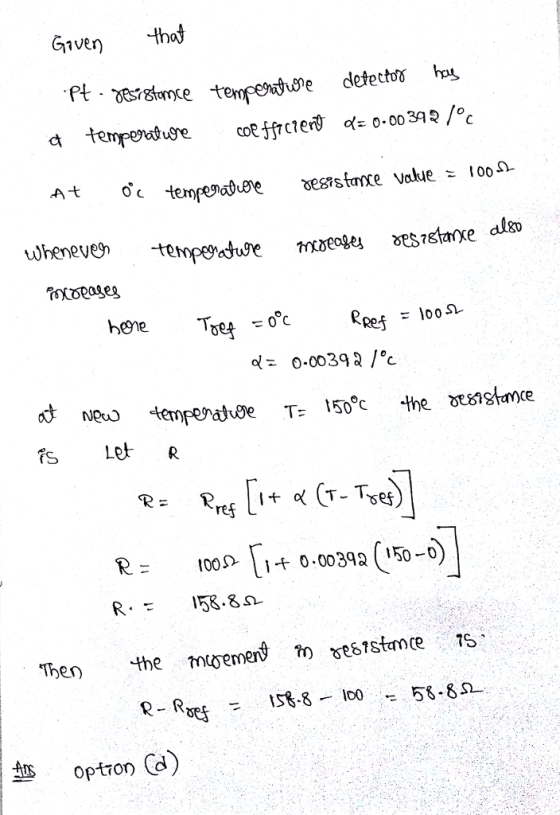
392/ C A popular 4.-Pt resistance temperature detectors have a temperature coefficient ? 0.00 Pt RTDreference...
The resistance of a RTD, RT, at a given temperature T is given by the following equation
 (a) The resistance of a RTD, RT, at a given temperature T is given by the following equation: RT = R0 (1 + αT) where R0 is the resistance of the RTD at the reference temperature 0°C, α is the temperature coefficient at 0 °C. It is found that the resistance of the RTD are 130 Ω and 150 Ω at 10°C and at 50°C respectively. Calculate: (i) the temperature coefficient a, and (ii) the resistance of the RTD at 0°C, R0.(b) The RTD in part...
The temperature coefficient of resistance α in equation R(T)=R0[1+α(T−T0)] equals the temperature coefficient of resistivity α...
The temperature coefficient of resistance α in equation R(T)=R0[1+α(T−T0)] equals the temperature coefficient of resistivity α in equation ρ(T)=ρ0[1+α(T−T0)] only if the coefficient of thermal expansion is small. A cylindrical column of mercury is in a vertical glass tube. At 20 ∘C, the length of the mercury column is 12.0 cm. The diameter of the mercury column is 1.6 mm and doesn't change with temperature because glass has a small coefficient of thermal expansion. The coefficient of volume expansion of...
In order to double its resistance, by how much would you have to increase the temperature...
 In order to double its resistance, by how much would you have to increase the temperature of a piece of the following? (a) copper (The temperature coefficient of resistance for copper is 3.9 x 10⁻³ (oc)-1.) oC (b) Nichrome (The temperature coefficient of resistance for Nichrome is 4.0 x 10⁻⁴ (°c)-1.) OC
Temperature Measurement Chapter 4 IT02 Curriculum Manual Enter the total change in the resistance of the...
 Temperature Measurement Chapter 4 IT02 Curriculum Manual Enter the total change in the resistance of the RTD Transducer over the 4.5a temperature range 20-50°C in 4.5b Is the resistance/temperature characteristic lincar? Yes or No 4.5e Enter your estimated (extrapolated) resistance of the RTD Transducer from the graph at 0°C. During the exercise, the current flowing was of the order of ImA. Since the applied voltage was +5V, the total circuit resistance was therefore of the order of Skn (which you...
Resistance in metals increases with increasing temperature according to the equation, ρ(T) = ρo(1 + α(T - To)) where α is the temperature coefficient of resistivity and ρo is the resistivity at temperature To. For a particular wire α = 1.5 × 10⁻³ 1/°C and
 Resistance in metals increases with increasing temperature according to the equation, ρ(T) = ρo(1 + α(T - To)) where α is the temperature coefficient of resistivity and ρo is the resistivity at temperature To. For a particular wire α = 1.5 × 10⁻³ 1/°C and the resistivity is ρo = 8.5 × 10⁻⁷ Ω⋅m at To = 125 °C.
4. (30 pt) A laboratory freezer maintains biological samples at -80 °C. The laboratory air temperature...
 4. (30 pt) A laboratory freezer maintains biological samples at -80 °C. The laboratory air temperature is 18 °C. Heat transfers from the lab air to the freezer contents through the freezer walls at a rate of 0.05 kW. Electricity costs $0.12/kWh. a) Identify the relevant cycle for this problem, and draw a schematic of the system that clearly shows where each energy flow comes from and goes to. (2 pt) b) How much cooling must the freezer supply to...
3 WA 017 A copper wire has a resistance of 0.455 2 at 20.0°C, and an...
 3 WA 017 A copper wire has a resistance of 0.455 2 at 20.0°C, and an iron wire has a resistance of 0.494 n at the same temperature. At what temperature are their resistances equal? The temperature coefficient of resistivity for copper is 3.90 x 10 (oc) and for iron it is 5.00 x 10 (Pc)- -34 What is the expression that gives the temperature dependence of resistance? Both materials go through the same temperature difference. How can you use...
help resolve 5. (10 pts.) The temperature of a copper wire (a = 3.9 x 10-'K')...
 help resolve
5. (10 pts.) The temperature of a copper wire (a = 3.9 x 10-'K') with a resistance of 100 is increased by 25 K (a) The resistance will increase or decrease? (b) What is the resistance after temperature increased by 25 K? 6. (10 pts.) A copper wire has a radius 0.5 mm and free electron density 8.5 x 10 and it carries current 1.8 A. Calculate the current density and the drift velocity of the copper wire....
help resolve
5. (10 pts.) The temperature of a copper wire (a = 3.9 x 10-'K') with a resistance of 100 is increased by 25 K (a) The resistance will increase or decrease? (b) What is the resistance after temperature increased by 25 K? 6. (10 pts.) A copper wire has a radius 0.5 mm and free electron density 8.5 x 10 and it carries current 1.8 A. Calculate the current density and the drift velocity of the copper wire....
Please show claer solve for ( a,c,d,e ) of this qustion. mm, electrical resistance per unit...
 Please show claer solve for ( a,c,d,e ) of this qustion.
mm, electrical resistance per unit length An electrical transmission line (diameter: D=5 r=0.002 Ω/m) carries an electric current (1-100 A), dissipating an electrical power per unit length inr. On a windy day, the line is subjected to air flow (air temperature: T. -10C, air velocity V 50 km/hr) T, 10°C V 50 km/hr T, =? 1 -100 A air elec electrical line We would like to determine the surface...
Please show claer solve for ( a,c,d,e ) of this qustion.
mm, electrical resistance per unit length An electrical transmission line (diameter: D=5 r=0.002 Ω/m) carries an electric current (1-100 A), dissipating an electrical power per unit length inr. On a windy day, the line is subjected to air flow (air temperature: T. -10C, air velocity V 50 km/hr) T, 10°C V 50 km/hr T, =? 1 -100 A air elec electrical line We would like to determine the surface...
1. Thermistors a) sense large changes in temperature b) cannot sense any change in temperature c)...
1. Thermistors a) sense large changes in temperature b) cannot sense any change in temperature c) sense small changes in temperature d) have a positive temperature coefficient of resistance 2. Thermistors follows which law for small variations a) Charle's law b) Ohm's Law c) NTC's law
 In order to double its resistance, by how much would you have to increase the temperature of a piece of the following? (a) copper (The temperature coefficient of resistance for copper is 3.9 x 10⁻³ (oc)-1.) oC (b) Nichrome (The temperature coefficient of resistance for Nichrome is 4.0 x 10⁻⁴ (°c)-1.) OC
 Temperature Measurement Chapter 4 IT02 Curriculum Manual Enter the total change in the resistance of the RTD Transducer over the 4.5a temperature range 20-50°C in 4.5b Is the resistance/temperature characteristic lincar? Yes or No 4.5e Enter your estimated (extrapolated) resistance of the RTD Transducer from the graph at 0°C. During the exercise, the current flowing was of the order of ImA. Since the applied voltage was +5V, the total circuit resistance was therefore of the order of Skn (which you...
 4. (30 pt) A laboratory freezer maintains biological samples at -80 °C. The laboratory air temperature is 18 °C. Heat transfers from the lab air to the freezer contents through the freezer walls at a rate of 0.05 kW. Electricity costs $0.12/kWh. a) Identify the relevant cycle for this problem, and draw a schematic of the system that clearly shows where each energy flow comes from and goes to. (2 pt) b) How much cooling must the freezer supply to...
 3 WA 017 A copper wire has a resistance of 0.455 2 at 20.0°C, and an iron wire has a resistance of 0.494 n at the same temperature. At what temperature are their resistances equal? The temperature coefficient of resistivity for copper is 3.90 x 10 (oc) and for iron it is 5.00 x 10 (Pc)- -34 What is the expression that gives the temperature dependence of resistance? Both materials go through the same temperature difference. How can you use...
 help resolve
5. (10 pts.) The temperature of a copper wire (a = 3.9 x 10-'K') with a resistance of 100 is increased by 25 K (a) The resistance will increase or decrease? (b) What is the resistance after temperature increased by 25 K? 6. (10 pts.) A copper wire has a radius 0.5 mm and free electron density 8.5 x 10 and it carries current 1.8 A. Calculate the current density and the drift velocity of the copper wire....
help resolve
5. (10 pts.) The temperature of a copper wire (a = 3.9 x 10-'K') with a resistance of 100 is increased by 25 K (a) The resistance will increase or decrease? (b) What is the resistance after temperature increased by 25 K? 6. (10 pts.) A copper wire has a radius 0.5 mm and free electron density 8.5 x 10 and it carries current 1.8 A. Calculate the current density and the drift velocity of the copper wire....
 Please show claer solve for ( a,c,d,e ) of this qustion.
mm, electrical resistance per unit length An electrical transmission line (diameter: D=5 r=0.002 Ω/m) carries an electric current (1-100 A), dissipating an electrical power per unit length inr. On a windy day, the line is subjected to air flow (air temperature: T. -10C, air velocity V 50 km/hr) T, 10°C V 50 km/hr T, =? 1 -100 A air elec electrical line We would like to determine the surface...
Please show claer solve for ( a,c,d,e ) of this qustion.
mm, electrical resistance per unit length An electrical transmission line (diameter: D=5 r=0.002 Ω/m) carries an electric current (1-100 A), dissipating an electrical power per unit length inr. On a windy day, the line is subjected to air flow (air temperature: T. -10C, air velocity V 50 km/hr) T, 10°C V 50 km/hr T, =? 1 -100 A air elec electrical line We would like to determine the surface...
Most questions answered within 3 hours.
-
Where is the error in this code sequence?
String s1 = "Hello";
String s2 = "ello";...
asked 11 months ago -
Financial data for Joel de Paris, Inc., for last year
follow:
Joel de Paris, Inc.
Balance...
asked 11 months ago -
Consider this reaction:
Al2(SO4)3 (aq)+ BaCl3
(aq) Al2Cl6 (aq)- +
3BaSO4(s) . What is the...
asked 11 months ago -
Suppose that Savneet is considering increasing her
recent random sample from 20 car rentals to 40...
asked 11 months ago -
Trucks arrive at an unloading terminal at an average rate of 120
per hour.
Trucks arrive...
asked 11 months ago -
Why are methanol and ethanol completely soluble in water while
octanol is not very little soluble....
asked 11 months ago -
A facilities manager at a university reads in a research report
that the mean amount of...
asked 11 months ago -
When the CuSO4 is rehydrated by adding water to the anhydrous
compound, is this an endothermic...
asked 11 months ago -
A ray of sunlight is passing from diamond into crown glass; the
angle of incidence is...
asked 11 months ago -
A block of mass 0.249 kg is placed on top of a light, vertical
spring of...
asked 11 months ago -
how do the kidneys compensate in the presences of acidosis
a) trigger hyperventilate
b) reserve acid...
asked 11 months ago -
Question 501 pts
The rental rate of capital to the firm increases. Which of the
following...
asked 11 months ago