The resistance of a RTD, RT, at a given temperature T is given by the following equation
(a) The resistance of a RTD, RT, at a given temperature T is given by the following equation:
RT = R0 (1 + αT)
where R0 is the resistance of the RTD at the reference temperature 0°C, α is the temperature coefficient at 0 °C.
It is found that the resistance of the RTD are 130 Ω and 150 Ω at 10°C and at 50°C respectively. Calculate:
(i) the temperature coefficient a, and
(ii) the resistance of the RTD at 0°C, R0.
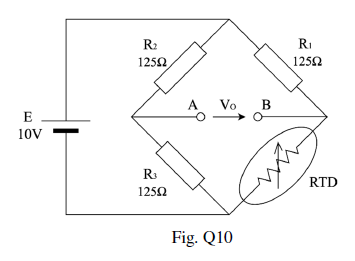
(b) The RTD in part (a) is used in the bridge circuit as shown in Fig. 210. Determine:
(i) at which temperature the bridge will balance,
(ii) the output voltage V0. at 100°C, and
(iii) the type of instrument most suitable for the measurement of V0.
Homework Answers


Add Answer to:
The resistance of a RTD, RT, at a given temperature T is given by the following equation
The resistance of an RTD is measured with a DMM that produces an excitation current of...
The resistance of an RTD is measured with a DMM that produces an excitation current of 5mA. The measured resistance is 92.5Ω. Find the temperature of the RTD if it has the following parameters: R0 = 100Ω, T0 = 0°C, α0 = 0.00385 C-1. Also, find the power dissipated in the RTD during the measurement. What is the smallest value of dissipation constant such that the temperature measurement error due to self heating is less than 0.5°C?
An RTD forms one arm of a Wheatstone bridge, as shown in Figure below.
 An RTD forms one arm of a Wheatstone bridge, as shown in Figure below. The RTD in a balanced is used to measure a constant temperature, with the bridge operated mode. The RTD has a resistance of 25 V at a temperature of 0°C, and a thermal coefficient of resistance, α= 0.003925°C, The value of the variable resistance R1 must be set to 37 V to balance the bridge circuit. (1) Determine the temperature of the RTD. (2) Compare this circuit to the...
Laboratory measurements of an RTD produce the following data. If T0 is chosen as 20°C, estimate...
Laboratory measurements of an RTD produce the following data. If T0 is chosen as 20°C, estimate R0 and α0 for the device under test. Temperature (°C) Resistance (Ω) 0 890 100 1440
Problem 3 For the given measurement system, which measures temperature using an RTD, of type PT100,...
 Problem 3 For the given measurement system, which measures temperature using an RTD, of type PT100, that is 100 Ohms at 0 C. If R2-R3 1000 Ohms, R1 110, At what temperature the bridge will be balanced, knowing that RTD is approximated with the given 1. equation Rold(1+0.004(change in temperature)) Rew= 2. If the amplifier has a gain of 10; determine accepted RA values of Rf and Rin RS N If the output of the amplifire is limited from -2.5...
Temperature Measurement Chapter 4 IT02 Curriculum Manual Enter the total change in the resistance of the...
 Temperature Measurement Chapter 4 IT02 Curriculum Manual Enter the total change in the resistance of the RTD Transducer over the 4.5a temperature range 20-50°C in 4.5b Is the resistance/temperature characteristic lincar? Yes or No 4.5e Enter your estimated (extrapolated) resistance of the RTD Transducer from the graph at 0°C. During the exercise, the current flowing was of the order of ImA. Since the applied voltage was +5V, the total circuit resistance was therefore of the order of Skn (which you...
The temperature coefficient of resistance α in equation R(T)=R0[1+α(T−T0)] equals the temperature coefficient of resistivity α...
The temperature coefficient of resistance α in equation R(T)=R0[1+α(T−T0)] equals the temperature coefficient of resistivity α in equation ρ(T)=ρ0[1+α(T−T0)] only if the coefficient of thermal expansion is small. A cylindrical column of mercury is in a vertical glass tube. At 20 ∘C, the length of the mercury column is 12.0 cm. The diameter of the mercury column is 1.6 mm and doesn't change with temperature because glass has a small coefficient of thermal expansion. The coefficient of volume expansion of...
Resistance in metals increases with increasing temperature according to the equation, ρ(T) = ρo(1 + α(T - To)) where α is the temperature coefficient of resistivity and ρo is the resistivity at temperature To. For a particular wire α = 1.5 × 10⁻³ 1/°C and
 Resistance in metals increases with increasing temperature according to the equation, ρ(T) = ρo(1 + α(T - To)) where α is the temperature coefficient of resistivity and ρo is the resistivity at temperature To. For a particular wire α = 1.5 × 10⁻³ 1/°C and the resistivity is ρo = 8.5 × 10⁻⁷ Ω⋅m at To = 125 °C.
The material constant B is to be determined for a particular thermistor using the circuit below. The thermistor has a resistance of 60 k at 25C. The reference resistor in the circuit, R1, has a resi...
 The material constant B is to be determined for a particular
thermistor using the circuit below. The thermistor has a resistance
of 60 k at 25C. The reference resistor in the circuit, R1, has a
resistance of 130.5 k 2. The dissipation constant is 0.09mW/C. The
voltage source used for the measurement is constant at 1.564 V. The
thermistor is to be used at emperatures ranging from 100 to 150C.
Determine the value of B
Thermistors mple2 :The material constant...
The material constant B is to be determined for a particular
thermistor using the circuit below. The thermistor has a resistance
of 60 k at 25C. The reference resistor in the circuit, R1, has a
resistance of 130.5 k 2. The dissipation constant is 0.09mW/C. The
voltage source used for the measurement is constant at 1.564 V. The
thermistor is to be used at emperatures ranging from 100 to 150C.
Determine the value of B
Thermistors mple2 :The material constant...
Electrical Instrumentation and Measurements
 1. (a) i. Briefly explain the three (3) main functions of instruments and give examples each. ii. Explain loading effects in a measurement system.(b) A Maxwell bridge in Fig 1 below is used to measure an inductive impedance. The bridge constants at balance are:R1 = 235 kΩ, C1 = 0.012 µF, R2 = 2.5 kΩ, R3 = 50 kΩFind the series equivalent of the unknown impedance. 2. (a) The power input to a 3-phase induction...
Classify following transducers (self-generator, modulator or modifier): i. a rotary potentiometer (resistance change) for angle measurement...
Classify following transducers (self-generator, modulator or modifier): i. a rotary potentiometer (resistance change) for angle measurement ii. a diode for temperature (voltage drop upon temperature) iii. a florescence-based sensor for radiation (emitting visible light upon incident radiation ray) iv. a mercury-in-glass (expansion in glass) thermometer v. a Bourdon tube (shape change) for pressure
 Problem 3 For the given measurement system, which measures temperature using an RTD, of type PT100, that is 100 Ohms at 0 C. If R2-R3 1000 Ohms, R1 110, At what temperature the bridge will be balanced, knowing that RTD is approximated with the given 1. equation Rold(1+0.004(change in temperature)) Rew= 2. If the amplifier has a gain of 10; determine accepted RA values of Rf and Rin RS N If the output of the amplifire is limited from -2.5...
 Temperature Measurement Chapter 4 IT02 Curriculum Manual Enter the total change in the resistance of the RTD Transducer over the 4.5a temperature range 20-50°C in 4.5b Is the resistance/temperature characteristic lincar? Yes or No 4.5e Enter your estimated (extrapolated) resistance of the RTD Transducer from the graph at 0°C. During the exercise, the current flowing was of the order of ImA. Since the applied voltage was +5V, the total circuit resistance was therefore of the order of Skn (which you...
 The material constant B is to be determined for a particular
thermistor using the circuit below. The thermistor has a resistance
of 60 k at 25C. The reference resistor in the circuit, R1, has a
resistance of 130.5 k 2. The dissipation constant is 0.09mW/C. The
voltage source used for the measurement is constant at 1.564 V. The
thermistor is to be used at emperatures ranging from 100 to 150C.
Determine the value of B
Thermistors mple2 :The material constant...
The material constant B is to be determined for a particular
thermistor using the circuit below. The thermistor has a resistance
of 60 k at 25C. The reference resistor in the circuit, R1, has a
resistance of 130.5 k 2. The dissipation constant is 0.09mW/C. The
voltage source used for the measurement is constant at 1.564 V. The
thermistor is to be used at emperatures ranging from 100 to 150C.
Determine the value of B
Thermistors mple2 :The material constant...
Most questions answered within 3 hours.
-
Where is the error in this code sequence?
String s1 = "Hello";
String s2 = "ello";...
asked 11 months ago -
Financial data for Joel de Paris, Inc., for last year
follow:
Joel de Paris, Inc.
Balance...
asked 11 months ago -
Consider this reaction:
Al2(SO4)3 (aq)+ BaCl3
(aq) Al2Cl6 (aq)- +
3BaSO4(s) . What is the...
asked 11 months ago -
Suppose that Savneet is considering increasing her
recent random sample from 20 car rentals to 40...
asked 11 months ago -
Trucks arrive at an unloading terminal at an average rate of 120
per hour.
Trucks arrive...
asked 11 months ago -
Why are methanol and ethanol completely soluble in water while
octanol is not very little soluble....
asked 11 months ago -
A facilities manager at a university reads in a research report
that the mean amount of...
asked 11 months ago -
When the CuSO4 is rehydrated by adding water to the anhydrous
compound, is this an endothermic...
asked 11 months ago -
A ray of sunlight is passing from diamond into crown glass; the
angle of incidence is...
asked 11 months ago -
A block of mass 0.249 kg is placed on top of a light, vertical
spring of...
asked 11 months ago -
how do the kidneys compensate in the presences of acidosis
a) trigger hyperventilate
b) reserve acid...
asked 11 months ago -
Question 501 pts
The rental rate of capital to the firm increases. Which of the
following...
asked 11 months ago