
Homework Answers
Add Answer to:
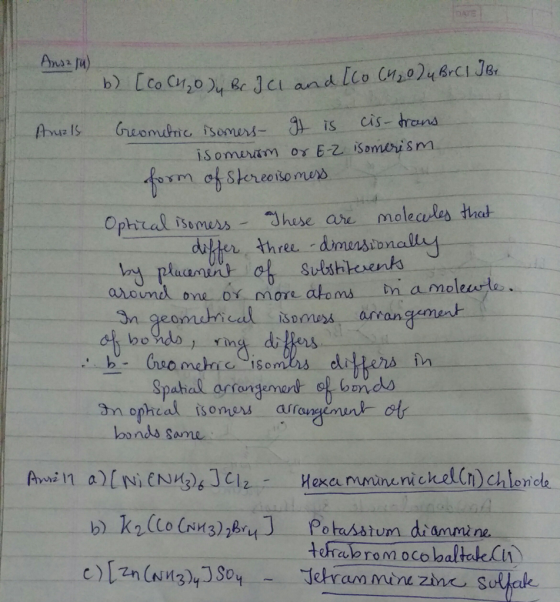
Circle the pairs of compounds that are isomers of each other: (a) [Co(en)_3]Cl_3 and [Co(en)_3]Br_3 (b)...
Provide the coordination isomers of [Cr(en)3][ Co(CN)6] and name each structure.
Provide the coordination isomers of [Cr(en)3][ Co(CN)6] and name each structure.
21. Which of the following are coordination isomers? (a) cis-[CoCl2(en)2]Cl and trans-[CoCl2(en)2]Cl (b) [Cr(NH3)[Fe(CN) ] and...
 21. Which of the following are coordination isomers? (a) cis-[CoCl2(en)2]Cl and trans-[CoCl2(en)2]Cl (b) [Cr(NH3)[Fe(CN) ] and [Fe(NH3)6][Cr(CN)] (c) [CoBr(NH3)sSO4 and [CrSO4(NH3)s]Br (d) [Co(NO2)(NH3)s]Cl2 and [Cr(ONO)(NH3)s] Cl2 (e) Both (b) and (c) Review your answer (CIRCLE): Are you (1) confident; (2) somewhat confident; or (3) unsure/guessing?
21. Which of the following are coordination isomers? (a) cis-[CoCl2(en)2]Cl and trans-[CoCl2(en)2]Cl (b) [Cr(NH3)[Fe(CN) ] and [Fe(NH3)6][Cr(CN)] (c) [CoBr(NH3)sSO4 and [CrSO4(NH3)s]Br (d) [Co(NO2)(NH3)s]Cl2 and [Cr(ONO)(NH3)s] Cl2 (e) Both (b) and (c) Review your answer (CIRCLE):...
21. Which of the following are coordination isomers? (a) cis-[CoCl2(en)2]Cl and trans-[CoCl2(en)2]Cl (b) [Cr(NH3)[Fe(CN) ] and [Fe(NH3)6][Cr(CN)] (c) [CoBr(NH3)sSO4 and [CrSO4(NH3)s]Br (d) [Co(NO2)(NH3)s]Cl2 and [Cr(ONO)(NH3)s] Cl2 (e) Both (b) and (c) Review your answer (CIRCLE): Are you (1) confident; (2) somewhat confident; or (3) unsure/guessing?
21. Which of the following are coordination isomers? (a) cis-[CoCl2(en)2]Cl and trans-[CoCl2(en)2]Cl (b) [Cr(NH3)[Fe(CN) ] and [Fe(NH3)6][Cr(CN)] (c) [CoBr(NH3)sSO4 and [CrSO4(NH3)s]Br (d) [Co(NO2)(NH3)s]Cl2 and [Cr(ONO)(NH3)s] Cl2 (e) Both (b) and (c) Review your answer (CIRCLE):...
Write the chemical names for the following compounds (if the metal is in a complex ion,...
Write the chemical names for the following compounds (if the metal is in a complex ion, be sure to include its oxidation number!) a. Rb[AgF4] b. fac-[Re(bpy)(CO)3Cl] c. [Co(NH3)5(H2O)]SO4 d. [Ag(NH3)2][PF6] e. mer-[Fe(H2O)3I3] f. trans-[CoCl2(en)2]Cl g. [Ni(bpy)3](NO3)2 h. Mo(CO)6 2. Sketch all optical and/or geometric isomers of the following: a. [Pt(NH3)3Cl3] + b. [PtCl2(en)2] 2+ c. Pt(NH3)2Cl2
ANSWER ALL QUESTIONS PLEASE 1. What are the characteristic electron configurations of transition metals? 2. What is...
ANSWER ALL QUESTIONS PLEASE 1. What are the characteristic electron configurations of transition metals? 2. What is the general trend in atomic size across a transition metal series? 3. Which electrons, 3d or 4s, have the lowest ionization energies in a transition metal? 4. What is the general trend of the reducing strength across a transition metal series? 5. Why do transition metals have similar chemical properties? 6. Name four transition metals that are essential to the biological system. 1. Write the...
What is the coordination number for each of the following complexes or compounds? [Co(NH3)4Cl2]+ [Ca(EDTA)]2− [Pt(NH3)4]2+...
 What is the coordination number for each of the following
complexes or compounds?
[Co(NH3)4Cl2]+
[Ca(EDTA)]2−
[Pt(NH3)4]2+
Na[Ag(CN)2]
Enter the coordination numbers, in the order that the complexes
are listed, as four integers separated by commas (e.g.,
1,2,3,4).
What is the charge on each of the following complex ions?
hexaaquairon(II), [Fe(H2O)6]?
tris(carbonato)aluminate(III), [Al(CO3)3]?
amminepentachloroplatinate(IV), [Pt(NH3)Cl5]?
Express the charges numerically, in the order that the complexes
are listed, separated by commas. For a nonzero charge, be sure to
include the sign (e.g.,...
What is the coordination number for each of the following
complexes or compounds?
[Co(NH3)4Cl2]+
[Ca(EDTA)]2−
[Pt(NH3)4]2+
Na[Ag(CN)2]
Enter the coordination numbers, in the order that the complexes
are listed, as four integers separated by commas (e.g.,
1,2,3,4).
What is the charge on each of the following complex ions?
hexaaquairon(II), [Fe(H2O)6]?
tris(carbonato)aluminate(III), [Al(CO3)3]?
amminepentachloroplatinate(IV), [Pt(NH3)Cl5]?
Express the charges numerically, in the order that the complexes
are listed, separated by commas. For a nonzero charge, be sure to
include the sign (e.g.,...
Date: 1117 mework 10 - Ch. 21-23 A) CN B)NO c)r D) CO Name: E ) en 24. Place the ligands, CN-, Br., H2O, and OH-in o...
 Date: 1117 mework 10 - Ch. 21-23 A) CN B)NO c)r D) CO Name: E ) en 24. Place the ligands, CN-, Br., H2O, and OH-in order from least to greatest according ability to split the d orbital energy level. A) CN-, OH, H2O, Br- C) Br,H20, CN-, OH- B) Br., OH, H2O, CN- D) None of the above 25. The charge on the central metal ion in (Cr(NH3)(CO3)2+ is A)-1. B) 0. C) 1. D) 3. E) 5 26....
2. For each of the following compounds, 1) write the formal oxidation state of the transition...
2. For each of the following compounds, 1) write the formal oxidation state of the transition metal and 2) the corresponding number of d electrons. 3) State whether or not each one is likely to be stable enough to be characterized. (a) [Re(CO)5] (b) [Cr(η6 -C6H6)2] (c) [Mo(CO)3(PPh3)3] (d) [Fe(η2 -C2H4)(CO)4] (e) [Zr(η5 -C5H5)Cl(OH)] (f) [Co(η5 -C5H5)2] 3. Identify the first-row transition metal (M) that follows the 18-electron rule for each of the following compounds (show how you arrived at...
2. For each of the following compounds, 1) write the formal oxidation state of the transition met...
2. For each of the following compounds, 1) write the formal oxidation state of the transition metal and 2) the corresponding number of d electrons. 3) State whether or not each one is likely to be stable enough to be characterized. (a) [Re(CO)5] (b) [Cr(η6 -C6H6)2] (c) [Mo(CO)3(PPh3)3] (d) [Fe(η2 -C2H4)(CO)4] (e) [Zr(η5 -C5H5)Cl(OH)] (f) [Co(η5 -C5H5)2] 3. Identify the first-row transition metal (M) that follows the 18-electron rule for each of the following compounds (show how you arrived at...
 21. Which of the following are coordination isomers? (a) cis-[CoCl2(en)2]Cl and trans-[CoCl2(en)2]Cl (b) [Cr(NH3)[Fe(CN) ] and [Fe(NH3)6][Cr(CN)] (c) [CoBr(NH3)sSO4 and [CrSO4(NH3)s]Br (d) [Co(NO2)(NH3)s]Cl2 and [Cr(ONO)(NH3)s] Cl2 (e) Both (b) and (c) Review your answer (CIRCLE): Are you (1) confident; (2) somewhat confident; or (3) unsure/guessing?
21. Which of the following are coordination isomers? (a) cis-[CoCl2(en)2]Cl and trans-[CoCl2(en)2]Cl (b) [Cr(NH3)[Fe(CN) ] and [Fe(NH3)6][Cr(CN)] (c) [CoBr(NH3)sSO4 and [CrSO4(NH3)s]Br (d) [Co(NO2)(NH3)s]Cl2 and [Cr(ONO)(NH3)s] Cl2 (e) Both (b) and (c) Review your answer (CIRCLE):...
21. Which of the following are coordination isomers? (a) cis-[CoCl2(en)2]Cl and trans-[CoCl2(en)2]Cl (b) [Cr(NH3)[Fe(CN) ] and [Fe(NH3)6][Cr(CN)] (c) [CoBr(NH3)sSO4 and [CrSO4(NH3)s]Br (d) [Co(NO2)(NH3)s]Cl2 and [Cr(ONO)(NH3)s] Cl2 (e) Both (b) and (c) Review your answer (CIRCLE): Are you (1) confident; (2) somewhat confident; or (3) unsure/guessing?
21. Which of the following are coordination isomers? (a) cis-[CoCl2(en)2]Cl and trans-[CoCl2(en)2]Cl (b) [Cr(NH3)[Fe(CN) ] and [Fe(NH3)6][Cr(CN)] (c) [CoBr(NH3)sSO4 and [CrSO4(NH3)s]Br (d) [Co(NO2)(NH3)s]Cl2 and [Cr(ONO)(NH3)s] Cl2 (e) Both (b) and (c) Review your answer (CIRCLE):...
 What is the coordination number for each of the following
complexes or compounds?
[Co(NH3)4Cl2]+
[Ca(EDTA)]2−
[Pt(NH3)4]2+
Na[Ag(CN)2]
Enter the coordination numbers, in the order that the complexes
are listed, as four integers separated by commas (e.g.,
1,2,3,4).
What is the charge on each of the following complex ions?
hexaaquairon(II), [Fe(H2O)6]?
tris(carbonato)aluminate(III), [Al(CO3)3]?
amminepentachloroplatinate(IV), [Pt(NH3)Cl5]?
Express the charges numerically, in the order that the complexes
are listed, separated by commas. For a nonzero charge, be sure to
include the sign (e.g.,...
What is the coordination number for each of the following
complexes or compounds?
[Co(NH3)4Cl2]+
[Ca(EDTA)]2−
[Pt(NH3)4]2+
Na[Ag(CN)2]
Enter the coordination numbers, in the order that the complexes
are listed, as four integers separated by commas (e.g.,
1,2,3,4).
What is the charge on each of the following complex ions?
hexaaquairon(II), [Fe(H2O)6]?
tris(carbonato)aluminate(III), [Al(CO3)3]?
amminepentachloroplatinate(IV), [Pt(NH3)Cl5]?
Express the charges numerically, in the order that the complexes
are listed, separated by commas. For a nonzero charge, be sure to
include the sign (e.g.,...
 Date: 1117 mework 10 - Ch. 21-23 A) CN B)NO c)r D) CO Name: E ) en 24. Place the ligands, CN-, Br., H2O, and OH-in order from least to greatest according ability to split the d orbital energy level. A) CN-, OH, H2O, Br- C) Br,H20, CN-, OH- B) Br., OH, H2O, CN- D) None of the above 25. The charge on the central metal ion in (Cr(NH3)(CO3)2+ is A)-1. B) 0. C) 1. D) 3. E) 5 26....
Most questions answered within 3 hours.
-
Where is the error in this code sequence?
String s1 = "Hello";
String s2 = "ello";...
asked 11 months ago -
Financial data for Joel de Paris, Inc., for last year
follow:
Joel de Paris, Inc.
Balance...
asked 11 months ago -
Consider this reaction:
Al2(SO4)3 (aq)+ BaCl3
(aq) Al2Cl6 (aq)- +
3BaSO4(s) . What is the...
asked 11 months ago -
Suppose that Savneet is considering increasing her
recent random sample from 20 car rentals to 40...
asked 11 months ago -
Trucks arrive at an unloading terminal at an average rate of 120
per hour.
Trucks arrive...
asked 11 months ago -
Why are methanol and ethanol completely soluble in water while
octanol is not very little soluble....
asked 11 months ago -
A facilities manager at a university reads in a research report
that the mean amount of...
asked 11 months ago -
When the CuSO4 is rehydrated by adding water to the anhydrous
compound, is this an endothermic...
asked 11 months ago -
A ray of sunlight is passing from diamond into crown glass; the
angle of incidence is...
asked 11 months ago -
A block of mass 0.249 kg is placed on top of a light, vertical
spring of...
asked 11 months ago -
how do the kidneys compensate in the presences of acidosis
a) trigger hyperventilate
b) reserve acid...
asked 11 months ago -
Question 501 pts
The rental rate of capital to the firm increases. Which of the
following...
asked 11 months ago