
Homework Answers
Add Answer to:
answer all parts please
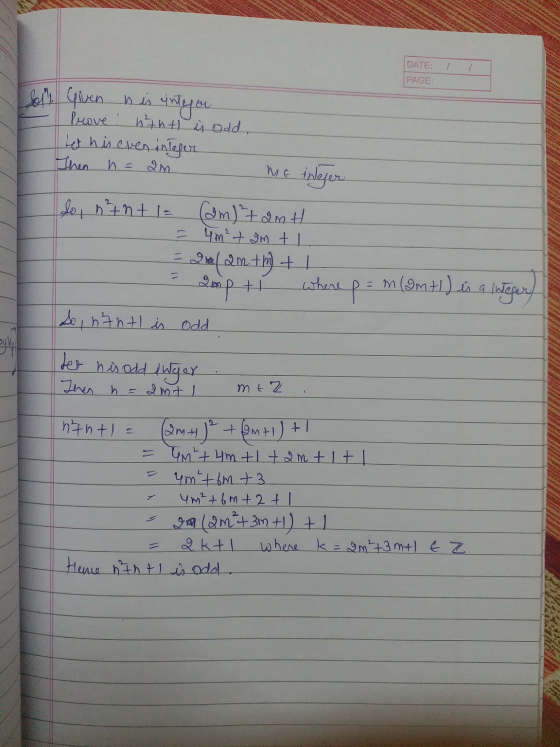
1. (12 points) Prove that if n is an integer, then na...
1 For each of the following pairs of numbers a and b, calculate and find integers...
 1 For each of the following pairs of numbers a and b, calculate and find integers r and s such ged (a; b) by Eucledian algorithm that gcd(a; b) = ra + sb. ia= 203, b-91 ii a = 21, b=8 2 Prove that for n 2 1,2+2+2+2* +...+2 -2n+1 -2 3 Prove that Vn 2 1,8" -3 is divisible by 5. 4 Prove that + n(n+1) = nnīYn E N where N is the set of all positive integers....
need help with Discrete Math. answer all parts please write clear! i will rate fast Use...
 need help with Discrete Math.
answer all parts please write clear! i will rate fast
Use the Extended Euclidean Algorithm to find: the greatest common divisor of 180 and 73. integers m and n such that 180m + 73n-ged(180,73)
need help with Discrete Math.
answer all parts please write clear! i will rate fast
Use the Extended Euclidean Algorithm to find: the greatest common divisor of 180 and 73. integers m and n such that 180m + 73n-ged(180,73)
Please show question 1 (all parts). Thank you! 1. Using the Euclidean algorithm to find the...
 Please show question 1 (all parts). Thank
you!
1. Using the Euclidean algorithm to find the ged of following pairs. Write down the ged as a linear combination of given pairs (a) 524 and 148 in Z (b)33 + 2r +1 and 2 +1 in Zs[] (c) 3 +2r +1 and 1 n Z[] 2. Compute 42001 in Z5 3. Use principal of induction show that 10" 1 mod 9 4. Show that every odd integer is congruent to 1...
Please show question 1 (all parts). Thank
you!
1. Using the Euclidean algorithm to find the ged of following pairs. Write down the ged as a linear combination of given pairs (a) 524 and 148 in Z (b)33 + 2r +1 and 2 +1 in Zs[] (c) 3 +2r +1 and 1 n Z[] 2. Compute 42001 in Z5 3. Use principal of induction show that 10" 1 mod 9 4. Show that every odd integer is congruent to 1...
Prove using mathematical induction that for every positive integer n, = 1/i(i+1) = n/n+1. 2) Suppose...
 Prove using mathematical induction that for every positive integer n, = 1/i(i+1) = n/n+1. 2) Suppose r is a real number other than 1. Prove using mathematical induction that for every nonnegative integer n, = 1-r^n+1/1-r. 3) Prove using mathematical induction that for every nonnegative integer n, 1 + i+i! = (n+1)!. 4) Prove using mathematical induction that for every integer n>4, n!>2^n. 5) Prove using mathematical induction that for every positive integer n, 7 + 5 + 3 +.......
PROBLEM 1 For each of the following pairs of integers, use the Euclidean Algorithm to find...
 PROBLEM 1 For each of the following pairs of integers, use the Euclidean Algorithm to find ged(a,b), and to write gcd(a,b) as a linear combination of a and b, i.e. find integers m and n such that gcd(a,b) = am + bn. (a) a = 36, b = 60. (b) a = 12628, b = 21361. (c) a = 901, b = -935. (d) a = 72, b = 714. (e) a = -36, b = -60.
1. (12 points tota1) Using induction, prove that the nuinber of nodes, N, in a perfect...
1. (12 points tota1) Using induction, prove that the nuinber of nodes, N, in a perfect binary tree is odd.
2,3,4,5,6 please 2. Use the Euclidean algorithm to find the following: a gcd(100, 101) b. ged(2482,...
 2,3,4,5,6 please
2. Use the Euclidean algorithm to find the following: a gcd(100, 101) b. ged(2482, 7633) 3. Prove that if a = bq+r, then ged(a, b) = ged(b,r). such that sa tb ged(a,b) for the following pairs 4. Use Bézout's theorem to find 8 and a. 33, 44 b. 101, 203 c. 10001, 13422 5. Prove by induction that if p is prime and plaja... An, then pla, for at least one Q. (Hint: use n = 2 as...
2,3,4,5,6 please
2. Use the Euclidean algorithm to find the following: a gcd(100, 101) b. ged(2482, 7633) 3. Prove that if a = bq+r, then ged(a, b) = ged(b,r). such that sa tb ged(a,b) for the following pairs 4. Use Bézout's theorem to find 8 and a. 33, 44 b. 101, 203 c. 10001, 13422 5. Prove by induction that if p is prime and plaja... An, then pla, for at least one Q. (Hint: use n = 2 as...
Please answer ALL parts and please show ALL work. 1. Prove that if 5 | na...
 Please answer ALL parts and please show ALL work.
1. Prove that if 5 | na then 5 n. 2. Use mathematical induction to prove that 8i(31 – 3) = (2n - 2)4n(n + 1). 3. Let a1 = 29, 02 = 103 and for n > 3, an = 7an-1 – 10an-2. Find a closed formula for an. (Show your work).
Please answer ALL parts and please show ALL work.
1. Prove that if 5 | na then 5 n. 2. Use mathematical induction to prove that 8i(31 – 3) = (2n - 2)4n(n + 1). 3. Let a1 = 29, 02 = 103 and for n > 3, an = 7an-1 – 10an-2. Find a closed formula for an. (Show your work).
For an integer n > 0, consider the positive integer F. = 22 +1. (a) Use...
 For an integer n > 0, consider the positive integer F. = 22 +1. (a) Use induction to prove that F. ends in digit 7 whenever n 2 is an integer (b) Use induction to prove that F= 2 + IT- Fholds for all neN. (c) Use (b) to prove that ged(F, F.) = 1 holds for all distinct nonnegative integers m, na (d) Use (e) to give a quick proof that there must be infinitely many primes! That is...
please answer questions #7-13 7. Use a direct proof to show every odd integer is the...
 please answer questions #7-13
7. Use a direct proof to show every odd integer is the difference of two squares. [Hint: Find the difference of squares ofk+1 and k where k is a positive integer. Prove or disprove that the products of two irrational numbers is irrational. Use proof by contraposition to show that ifx ty 22 where x and y are real numbers then x 21ory 21 8. 9. 10. Prove that if n is an integer and 3n...
please answer questions #7-13
7. Use a direct proof to show every odd integer is the difference of two squares. [Hint: Find the difference of squares ofk+1 and k where k is a positive integer. Prove or disprove that the products of two irrational numbers is irrational. Use proof by contraposition to show that ifx ty 22 where x and y are real numbers then x 21ory 21 8. 9. 10. Prove that if n is an integer and 3n...
 1 For each of the following pairs of numbers a and b, calculate and find integers r and s such ged (a; b) by Eucledian algorithm that gcd(a; b) = ra + sb. ia= 203, b-91 ii a = 21, b=8 2 Prove that for n 2 1,2+2+2+2* +...+2 -2n+1 -2 3 Prove that Vn 2 1,8" -3 is divisible by 5. 4 Prove that + n(n+1) = nnīYn E N where N is the set of all positive integers....
 need help with Discrete Math.
answer all parts please write clear! i will rate fast
Use the Extended Euclidean Algorithm to find: the greatest common divisor of 180 and 73. integers m and n such that 180m + 73n-ged(180,73)
need help with Discrete Math.
answer all parts please write clear! i will rate fast
Use the Extended Euclidean Algorithm to find: the greatest common divisor of 180 and 73. integers m and n such that 180m + 73n-ged(180,73)
 Please show question 1 (all parts). Thank
you!
1. Using the Euclidean algorithm to find the ged of following pairs. Write down the ged as a linear combination of given pairs (a) 524 and 148 in Z (b)33 + 2r +1 and 2 +1 in Zs[] (c) 3 +2r +1 and 1 n Z[] 2. Compute 42001 in Z5 3. Use principal of induction show that 10" 1 mod 9 4. Show that every odd integer is congruent to 1...
Please show question 1 (all parts). Thank
you!
1. Using the Euclidean algorithm to find the ged of following pairs. Write down the ged as a linear combination of given pairs (a) 524 and 148 in Z (b)33 + 2r +1 and 2 +1 in Zs[] (c) 3 +2r +1 and 1 n Z[] 2. Compute 42001 in Z5 3. Use principal of induction show that 10" 1 mod 9 4. Show that every odd integer is congruent to 1...
 Prove using mathematical induction that for every positive integer n, = 1/i(i+1) = n/n+1. 2) Suppose r is a real number other than 1. Prove using mathematical induction that for every nonnegative integer n, = 1-r^n+1/1-r. 3) Prove using mathematical induction that for every nonnegative integer n, 1 + i+i! = (n+1)!. 4) Prove using mathematical induction that for every integer n>4, n!>2^n. 5) Prove using mathematical induction that for every positive integer n, 7 + 5 + 3 +.......
 PROBLEM 1 For each of the following pairs of integers, use the Euclidean Algorithm to find ged(a,b), and to write gcd(a,b) as a linear combination of a and b, i.e. find integers m and n such that gcd(a,b) = am + bn. (a) a = 36, b = 60. (b) a = 12628, b = 21361. (c) a = 901, b = -935. (d) a = 72, b = 714. (e) a = -36, b = -60.
 2,3,4,5,6 please
2. Use the Euclidean algorithm to find the following: a gcd(100, 101) b. ged(2482, 7633) 3. Prove that if a = bq+r, then ged(a, b) = ged(b,r). such that sa tb ged(a,b) for the following pairs 4. Use Bézout's theorem to find 8 and a. 33, 44 b. 101, 203 c. 10001, 13422 5. Prove by induction that if p is prime and plaja... An, then pla, for at least one Q. (Hint: use n = 2 as...
2,3,4,5,6 please
2. Use the Euclidean algorithm to find the following: a gcd(100, 101) b. ged(2482, 7633) 3. Prove that if a = bq+r, then ged(a, b) = ged(b,r). such that sa tb ged(a,b) for the following pairs 4. Use Bézout's theorem to find 8 and a. 33, 44 b. 101, 203 c. 10001, 13422 5. Prove by induction that if p is prime and plaja... An, then pla, for at least one Q. (Hint: use n = 2 as...
 Please answer ALL parts and please show ALL work.
1. Prove that if 5 | na then 5 n. 2. Use mathematical induction to prove that 8i(31 – 3) = (2n - 2)4n(n + 1). 3. Let a1 = 29, 02 = 103 and for n > 3, an = 7an-1 – 10an-2. Find a closed formula for an. (Show your work).
Please answer ALL parts and please show ALL work.
1. Prove that if 5 | na then 5 n. 2. Use mathematical induction to prove that 8i(31 – 3) = (2n - 2)4n(n + 1). 3. Let a1 = 29, 02 = 103 and for n > 3, an = 7an-1 – 10an-2. Find a closed formula for an. (Show your work).
 For an integer n > 0, consider the positive integer F. = 22 +1. (a) Use induction to prove that F. ends in digit 7 whenever n 2 is an integer (b) Use induction to prove that F= 2 + IT- Fholds for all neN. (c) Use (b) to prove that ged(F, F.) = 1 holds for all distinct nonnegative integers m, na (d) Use (e) to give a quick proof that there must be infinitely many primes! That is...
 please answer questions #7-13
7. Use a direct proof to show every odd integer is the difference of two squares. [Hint: Find the difference of squares ofk+1 and k where k is a positive integer. Prove or disprove that the products of two irrational numbers is irrational. Use proof by contraposition to show that ifx ty 22 where x and y are real numbers then x 21ory 21 8. 9. 10. Prove that if n is an integer and 3n...
please answer questions #7-13
7. Use a direct proof to show every odd integer is the difference of two squares. [Hint: Find the difference of squares ofk+1 and k where k is a positive integer. Prove or disprove that the products of two irrational numbers is irrational. Use proof by contraposition to show that ifx ty 22 where x and y are real numbers then x 21ory 21 8. 9. 10. Prove that if n is an integer and 3n...
Most questions answered within 3 hours.
-
Where is the error in this code sequence?
String s1 = "Hello";
String s2 = "ello";...
asked 10 months ago -
Financial data for Joel de Paris, Inc., for last year
follow:
Joel de Paris, Inc.
Balance...
asked 10 months ago -
Consider this reaction:
Al2(SO4)3 (aq)+ BaCl3
(aq) Al2Cl6 (aq)- +
3BaSO4(s) . What is the...
asked 10 months ago -
Suppose that Savneet is considering increasing her
recent random sample from 20 car rentals to 40...
asked 10 months ago -
Trucks arrive at an unloading terminal at an average rate of 120
per hour.
Trucks arrive...
asked 10 months ago -
Why are methanol and ethanol completely soluble in water while
octanol is not very little soluble....
asked 10 months ago -
A facilities manager at a university reads in a research report
that the mean amount of...
asked 10 months ago -
When the CuSO4 is rehydrated by adding water to the anhydrous
compound, is this an endothermic...
asked 10 months ago -
A ray of sunlight is passing from diamond into crown glass; the
angle of incidence is...
asked 10 months ago -
A block of mass 0.249 kg is placed on top of a light, vertical
spring of...
asked 10 months ago -
how do the kidneys compensate in the presences of acidosis
a) trigger hyperventilate
b) reserve acid...
asked 10 months ago -
Question 501 pts
The rental rate of capital to the firm increases. Which of the
following...
asked 10 months ago