
Homework Answers
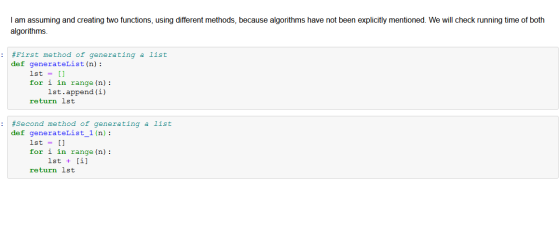
I am assuming and creating two functions, using different methods, because algorithms have not been explicitly mentioned. We will check running time of both algorithms.
#First method of generating a list
def generateList(n):
lst = []
for i in range(n):
lst.append(i)
return lst
#Second method of generating a list
def generateList_1(n):
lst = []
for i in range(n):
lst + [i]
return lst
T
import time
alg1_times = []
alg2_times = []
N = 100000
for i in range(1000, N,10):
start = time.process_time()
lst = generateList(i)
end = time.process_time()
alg1_times.append(end - start)
for i in range(1000, N,10):
start = time.process_time()
lst = generateList_1(i)
end = time.process_time()
alg2_times.append(end - start)
print (len(alg1_times))
print("Some durations from alg1 from last: ")
print(alg1_times[:-50:-1])
print("Some durations from alg2 from last: ")
print(alg2_times[:-50:-1])
![Testing timing of above algorithms... import time alg1_times = [] alg2_times = [] N = 100000 for i in range (1000, N, 10): st](http://img.homeworklib.com/questions/fe60ab90-f564-11eb-bfc5-7b7cfc2e8765.png?x-oss-process=image/resize,w_560)
Add Answer to:
import time # get a time at the start point start = time.process_time() # your algorithm...
Below is a linear time complexity algorithm Max-Min-VER1 to find the biggest and smallest element a...
Below is a linear time complexity algorithm Max-Min-VER1 to find the biggest and smallest element a given list. Input: A is a given list Output: two integers Example: Given A = {1, 5, 9, -3}. It returns -3 (the smallest element), and 9 (the biggest element) Max-Min-VER1(A, n) Line 1: large ← A[0] Line 2: for I from 1 to n - 1 do Line 3: large ← Math.max(large, A[I]) Line 4: small ← A[0] Line 5: for I from...
2. Here is a sorting algorithm that I like to use. Given an unsorted list of...
 2. Here is a sorting algorithm that I like to use. Given an unsorted list of size n, let Xx represent the data in location k of the unsorted list. Compare xi to X2 and switch if necessary so that they are in sorted order, smallest first. Compare Xn-1 and Xn and switch if necessary so that they are in sorted order, smallest first. • Compare x3 with its left neighbors, switching if necessary so that the 3 first entries...
Please do in Java with the code available for copy :) Write a computer program that...
Please do in Java with the code available for copy :) Write a computer program that prompts the user for one number, n for the number of items in the array to sort, and create and sort 1000 different arrays of this size timing the run to get an average time to sort an array of this size. Then do the following: Initiate a variable running_time to 0 Create a for loop that iterates 1000 times. In the body of...
Please help complete the items marked TODO in the code and get the tests to pass:...
Please help complete the items marked TODO in the code and get the tests to pass: import java.util.ArrayList; import java.util.LinkedList; import java.util.List; import org.junit.After; import org.junit.Before; import org.junit.Test; public class TestPerformance { // TODO run test and record running times for SIZE = 10, 100, 1000, 10000, ... // (choose in conjunction with REPS below up to an upper limit where the clock // running time is in the tens of seconds) // TODO (optional) refactor to DRY // TODO...
Please help complete the items marked TODO in the code and get the tests to pass:...
Please help complete the items marked TODO in the code and get the tests to pass: Someone already answered it, but it was incorrect! import java.util.ArrayList; import java.util.LinkedList; import java.util.List; import org.junit.After; import org.junit.Before; import org.junit.Test; public class TestPerformance { // TODO run test and record running times for SIZE = 10, 100, 1000, 10000, ... // (choose in conjunction with REPS below up to an upper limit where the clock // running time is in the tens of seconds)...
1 (15 pts) Implement recursive, memoized, and dynamic programming Fibonacci and study their performances using different...
 1 (15 pts) Implement recursive, memoized, and dynamic programming Fibonacci and study their performances using different problem instans You can choose to look at the perfor- mance by either timing the functions or counting the basic operations (in code) Provide your results below, and submit your code. Also, describe the pros and cons of your choice of performance metric Note: If you decide to use timing, the standard way to time an algorithm is to run the same problem 100...
(V). Given the following algorithm, answer relevant questions. Algorithm 1 An algorithm 1: procedure WHATISTHIS(21,22,...,n: a...
 (V). Given the following algorithm, answer relevant questions. Algorithm 1 An algorithm 1: procedure WHATISTHIS(21,22,...,n: a list of n integers) for i = 2 to n do c= j=i-1 while (j > 0) do if ra; then break end if 4j+1 = a; j= j-1 end while j+1 = 1 end for 14: return 0.02. 1, 15: end procedure Answer the following questions: (1) Run the algorithm with input (41, 02, 03, 04) = (3, 0, 1,6). Record the values...
(15 points) Consider the algorithm for insertion sort shown below. The input to this algorithm is...
 (15 points) Consider the algorithm for insertion sort shown below. The input to this algorithm is an earray A. You must assume that indexing begins at 1. 1: for j = 2: A.length do key = A i=j-1 while i > 0 and A[i] > key do Ali + 1] = Ai i=i-1 7: A[i+1] = key (a) Follow this algorithm for A[1..4) =< 7,9,6,8 >. Specifically, please indicate the contents of the array after each iteration of the outer...
import java.util.List; import java.util.ArrayList; import java.util.LinkedList; public class ListPractice { private static final int[]...
 import java.util.List;
import java.util.ArrayList;
import java.util.LinkedList;
public class ListPractice {
private static final int[] arr = new int[100000];
public static void main(String[] args) {
for(int i=0; i<100000;
i++)
arr[i] =
i;
//TODO comment out this line
LinkedList<Integer> list =
new LinkedList<Integer>();
//TODO uncomment this line
//List<Integer> list = new
ArrayList<Integer>();
//TODO change the rest of the...
import java.util.List;
import java.util.ArrayList;
import java.util.LinkedList;
public class ListPractice {
private static final int[] arr = new int[100000];
public static void main(String[] args) {
for(int i=0; i<100000;
i++)
arr[i] =
i;
//TODO comment out this line
LinkedList<Integer> list =
new LinkedList<Integer>();
//TODO uncomment this line
//List<Integer> list = new
ArrayList<Integer>();
//TODO change the rest of the...
Algorithm performance Give the order of magnitude Theta () for the following algorithm. Explain why your...
 Algorithm performance Give the order of magnitude Theta () for the following algorithm. Explain why your answer is correct. GET VALUES for A_1, A_2, .. ., A_n, and B_1, B_2, .. ., B_n Get value of n i = 1/* set i equal to 1 */DO WHILE (i lessthanorequalto n)/* for each of the n values in A */j = 1/* set j equal to 1 */DO WHILE (j lessthanorequalto n)/* Do n times *1 IF Ai = Bj THEN...
 2. Here is a sorting algorithm that I like to use. Given an unsorted list of size n, let Xx represent the data in location k of the unsorted list. Compare xi to X2 and switch if necessary so that they are in sorted order, smallest first. Compare Xn-1 and Xn and switch if necessary so that they are in sorted order, smallest first. • Compare x3 with its left neighbors, switching if necessary so that the 3 first entries...
 1 (15 pts) Implement recursive, memoized, and dynamic programming Fibonacci and study their performances using different problem instans You can choose to look at the perfor- mance by either timing the functions or counting the basic operations (in code) Provide your results below, and submit your code. Also, describe the pros and cons of your choice of performance metric Note: If you decide to use timing, the standard way to time an algorithm is to run the same problem 100...
 (V). Given the following algorithm, answer relevant questions. Algorithm 1 An algorithm 1: procedure WHATISTHIS(21,22,...,n: a list of n integers) for i = 2 to n do c= j=i-1 while (j > 0) do if ra; then break end if 4j+1 = a; j= j-1 end while j+1 = 1 end for 14: return 0.02. 1, 15: end procedure Answer the following questions: (1) Run the algorithm with input (41, 02, 03, 04) = (3, 0, 1,6). Record the values...
 (15 points) Consider the algorithm for insertion sort shown below. The input to this algorithm is an earray A. You must assume that indexing begins at 1. 1: for j = 2: A.length do key = A i=j-1 while i > 0 and A[i] > key do Ali + 1] = Ai i=i-1 7: A[i+1] = key (a) Follow this algorithm for A[1..4) =< 7,9,6,8 >. Specifically, please indicate the contents of the array after each iteration of the outer...
 import java.util.List;
import java.util.ArrayList;
import java.util.LinkedList;
public class ListPractice {
private static final int[] arr = new int[100000];
public static void main(String[] args) {
for(int i=0; i<100000;
i++)
arr[i] =
i;
//TODO comment out this line
LinkedList<Integer> list =
new LinkedList<Integer>();
//TODO uncomment this line
//List<Integer> list = new
ArrayList<Integer>();
//TODO change the rest of the...
import java.util.List;
import java.util.ArrayList;
import java.util.LinkedList;
public class ListPractice {
private static final int[] arr = new int[100000];
public static void main(String[] args) {
for(int i=0; i<100000;
i++)
arr[i] =
i;
//TODO comment out this line
LinkedList<Integer> list =
new LinkedList<Integer>();
//TODO uncomment this line
//List<Integer> list = new
ArrayList<Integer>();
//TODO change the rest of the...
 Algorithm performance Give the order of magnitude Theta () for the following algorithm. Explain why your answer is correct. GET VALUES for A_1, A_2, .. ., A_n, and B_1, B_2, .. ., B_n Get value of n i = 1/* set i equal to 1 */DO WHILE (i lessthanorequalto n)/* for each of the n values in A */j = 1/* set j equal to 1 */DO WHILE (j lessthanorequalto n)/* Do n times *1 IF Ai = Bj THEN...
Most questions answered within 3 hours.
-
Where is the error in this code sequence?
String s1 = "Hello";
String s2 = "ello";...
asked 10 months ago -
Financial data for Joel de Paris, Inc., for last year
follow:
Joel de Paris, Inc.
Balance...
asked 10 months ago -
Consider this reaction:
Al2(SO4)3 (aq)+ BaCl3
(aq) Al2Cl6 (aq)- +
3BaSO4(s) . What is the...
asked 10 months ago -
Suppose that Savneet is considering increasing her
recent random sample from 20 car rentals to 40...
asked 10 months ago -
Trucks arrive at an unloading terminal at an average rate of 120
per hour.
Trucks arrive...
asked 10 months ago -
Why are methanol and ethanol completely soluble in water while
octanol is not very little soluble....
asked 10 months ago -
A facilities manager at a university reads in a research report
that the mean amount of...
asked 10 months ago -
When the CuSO4 is rehydrated by adding water to the anhydrous
compound, is this an endothermic...
asked 10 months ago -
A ray of sunlight is passing from diamond into crown glass; the
angle of incidence is...
asked 10 months ago -
A block of mass 0.249 kg is placed on top of a light, vertical
spring of...
asked 10 months ago -
how do the kidneys compensate in the presences of acidosis
a) trigger hyperventilate
b) reserve acid...
asked 10 months ago -
Question 501 pts
The rental rate of capital to the firm increases. Which of the
following...
asked 10 months ago