Homework Answers
Add Answer to:
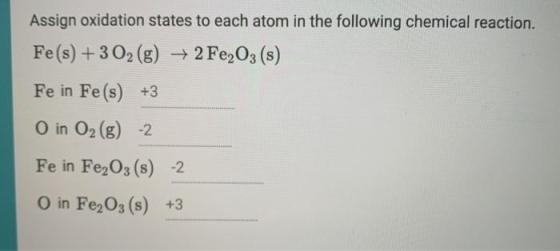
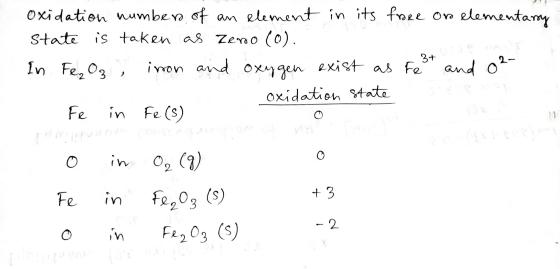
Assign oxidation states to each atom in the following chemical reaction. Fe(s) + 3 02 (g)...
Below is a set of redox reactions. Assign oxidation numbers below each atom. Also determine the...
Below is a set of redox reactions. Assign oxidation numbers below each atom. Also determine the substance that is reduced, the substance that is oxidized, the oxidizing agent, and the reducing agent. (Note: Don’t worry about the stoichiometric coefficients; they don’t affect your calculation of oxidation states.) Atom/s that is/are reduced: Atom/s that is/are oxidized: Reducing agent: Oxidizing agent: Reactions Given: 2 C2H6(g) + 7 O2(g) → 4 CO2(g) + 6 H2O(g) C2H4(g) + 3O2(g) → 2 CO2(g) + 2...
Assign oxidation numbers to each atom in the reaction. Note that oxidation numbers are assigned per...
 Assign oxidation numbers to each atom in the reaction. Note that oxidation numbers are assigned per atom and are NOT affected by the coefficients in the equation. Enter a plus or minus sign followed by a number (i.e., +3, -1) or a 0. Fe(s) + 6HCl(aq) 2 FeCl,(s) + 3H2 Reactant side Product side Fe: Fe: H: H: CI: CI:
Assign oxidation states to each atom in each of the following species. Part A Cl2 Express...
Assign oxidation states to each atom in each of the following species. Part A Cl2 Express your answer as a signed integer. the oxidation state of Cl = SubmitMy AnswersGive Up Part B Fe3+ Express your answer as a signed integer. the oxidation state of Fe = SubmitMy AnswersGive Up Part C CuCl2 Express your answer as signed integers separated by a comma. the oxidation states of Cu, Cl = SubmitMy AnswersGive Up Part D CH4 Express your answer as...
Assign oxidation states to each atom in each ion or compound: 6.1) I2 : The oxi...
Assign oxidation states to each atom in each ion or compound: 6.1) I2 : The oxi state of I is:________ 6.2) CH4 : The oxi state of C is:________, the oxi state of H is:__________ 6.3) Fe3+ : The oxi state of Fe is:________ 6.4) HSO4 - : the oxi state of H is:________, oxi state of S is:________, oxi state of O is:________
Assign oxidation states to each atom in each of the following species. Express your answer as...
Assign oxidation states to each atom in each of the following species. Express your answer as a signed integer and use commas to separate them for compounds. O2 Li+ CuCl2 CO Cr2O72 HSO4 CuCl2
Given the following chemical reaction and standard thermodynamic quantities in the table, FeO(s) + Fe(s) +...
Given the following chemical reaction and standard thermodynamic quantities in the table, FeO(s) + Fe(s) + O2(g) → Fe2O3(s) FeO(s) Fe(s) O2(g) Fe2O3(s) ∆H°f (kJ/mol) −271.9 0 0 −822.16 ∆S° (J/mol∙K) 60.75 27.15 205.0 89.96 at 298 K, ∆G° for this reaction is [ Select ] ["‒490 kJ", "‒611 kJ", "59.9 kJ", "59926 kJ"] , and the reaction is ...
1.) In each part, assign the oxidation state (oxidation number) of each atom in the following...
 1.) In each part, assign the oxidation state (oxidation number) of each atom in the following molecul ons: a. i.) Na:SO ) NaNO k.) KCIO 1.) SOCI: (S is central atom) m.) CIF -Z b.) C2H2 c.) C2H d.) CCl e.) HO f.) HCO, g.) PO,3 h.) LiBr n.) B2H o.) HS p.) CN
You are given the following thermodynamic data. 2 Fe(s) + 3/2 O2(g) → Fe2O3(s) ΔH° =...
You are given the following thermodynamic data. 2 Fe(s) + 3/2 O2(g) → Fe2O3(s) ΔH° = -823 kJ 3 Fe(s) + 2 O2(g) → Fe3O4(s) ΔH° = -1120. kJ Calculate the ΔH° for the following reaction. 3 Fe2O3(s) → 2 Fe3O4(s) + ½ O2(g)
Assign oxidation states to the central atom in each of the following structures, where the red...
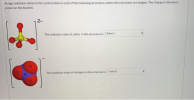 Assign oxidation states to the central atom in each of the following structures, where the red atoms are oxygen. The charge on the ion is shown on the bracket The oxidation state of sulfur in this structure is [Select The oxidation state of nitrogen in this structure is Select
Write unbalanced oxidation half-reaction for the following process. Mn3+(aq)→MnO2(s)+Mn2+(aq) Express your answer as a chemical equation....
Write unbalanced oxidation half-reaction for the following process. Mn3+(aq)→MnO2(s)+Mn2+(aq) Express your answer as a chemical equation. Identify all of the phases in your answer. Write unbalanced oxidation half-reaction for the following process. Fe2O3(s)+CO(g)→Fe(s)+CO2(g) Express your answer as a chemical equation. Identify all of the phases in your answer. Write unbalanced reduction half-reaction for the following process. Fe2O3(s)+CO(g)→Fe(s)+CO2(g) Express your answer as a chemical equation. Identify all of the phases in your answer.
 Assign oxidation numbers to each atom in the reaction. Note that oxidation numbers are assigned per atom and are NOT affected by the coefficients in the equation. Enter a plus or minus sign followed by a number (i.e., +3, -1) or a 0. Fe(s) + 6HCl(aq) 2 FeCl,(s) + 3H2 Reactant side Product side Fe: Fe: H: H: CI: CI:
 1.) In each part, assign the oxidation state (oxidation number) of each atom in the following molecul ons: a. i.) Na:SO ) NaNO k.) KCIO 1.) SOCI: (S is central atom) m.) CIF -Z b.) C2H2 c.) C2H d.) CCl e.) HO f.) HCO, g.) PO,3 h.) LiBr n.) B2H o.) HS p.) CN
 Assign oxidation states to the central atom in each of the following structures, where the red atoms are oxygen. The charge on the ion is shown on the bracket The oxidation state of sulfur in this structure is [Select The oxidation state of nitrogen in this structure is Select
Most questions answered within 3 hours.
-
Where is the error in this code sequence?
String s1 = "Hello";
String s2 = "ello";...
asked 10 months ago -
Financial data for Joel de Paris, Inc., for last year
follow:
Joel de Paris, Inc.
Balance...
asked 10 months ago -
Consider this reaction:
Al2(SO4)3 (aq)+ BaCl3
(aq) Al2Cl6 (aq)- +
3BaSO4(s) . What is the...
asked 10 months ago -
Suppose that Savneet is considering increasing her
recent random sample from 20 car rentals to 40...
asked 10 months ago -
Trucks arrive at an unloading terminal at an average rate of 120
per hour.
Trucks arrive...
asked 10 months ago -
Why are methanol and ethanol completely soluble in water while
octanol is not very little soluble....
asked 10 months ago -
A facilities manager at a university reads in a research report
that the mean amount of...
asked 10 months ago -
When the CuSO4 is rehydrated by adding water to the anhydrous
compound, is this an endothermic...
asked 10 months ago -
A ray of sunlight is passing from diamond into crown glass; the
angle of incidence is...
asked 10 months ago -
A block of mass 0.249 kg is placed on top of a light, vertical
spring of...
asked 10 months ago -
how do the kidneys compensate in the presences of acidosis
a) trigger hyperventilate
b) reserve acid...
asked 10 months ago -
Question 501 pts
The rental rate of capital to the firm increases. Which of the
following...
asked 10 months ago