
Homework Answers

As per Chegg norms
All the best
Any queries plzz comment
Add Answer to:
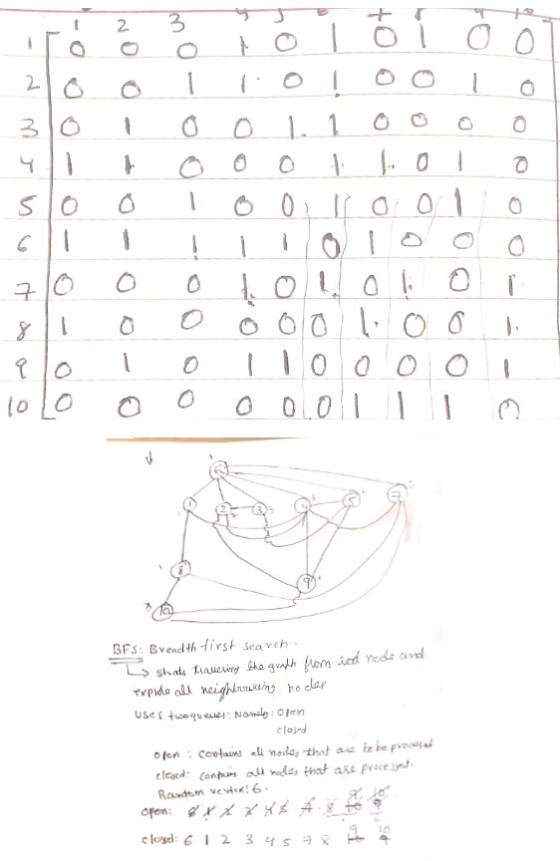
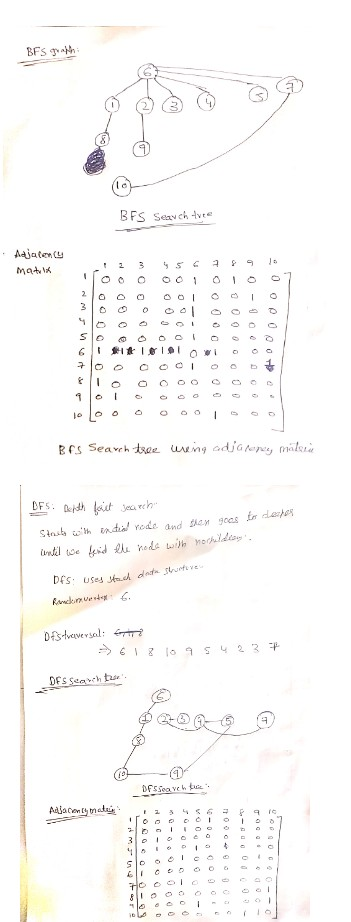
Consider these adjacency matrices and answer the questions below (for each graph being represented): 5000101010 Jo...
Give the adjacency matrix representation and the adjacency lists representation for the graph G_1. Assume that...
 Give the adjacency matrix representation and the adjacency lists representation for the graph G_1. Assume that vertices (e.g., in adjacency lists) are ordered alphabetically. For the following problems, assume that vertices are ordered alphabetically in the adjacency lists (thus you will visit adjacent vertices in alphabetical order). Execute a Breadth-First Search on the graph G_1, starting on vertex a. Specifiy the visit times for each node of the graph. Execute a Depth-First Search on the graph G_1 starting on vertex...
4&5 0 1 2 3 1. Draw the undirected graph that corresponds to this adjacency matrix...
 4&5
0 1 2 3 1. Draw the undirected graph that corresponds to this adjacency matrix 0 0 1 1 0 1 1 1 1 0 1 1 1 2 1 1 1 0 1 3 1 0 1 1 0 1 2. Given the following directed graph, how would you represent it with an adjacency list? 3. We've seen two ways to store graphs - adjacency matrices, and adjacency lists. For a directed graph like the one shown above,...
4&5
0 1 2 3 1. Draw the undirected graph that corresponds to this adjacency matrix 0 0 1 1 0 1 1 1 1 0 1 1 1 2 1 1 1 0 1 3 1 0 1 1 0 1 2. Given the following directed graph, how would you represent it with an adjacency list? 3. We've seen two ways to store graphs - adjacency matrices, and adjacency lists. For a directed graph like the one shown above,...
CSC 430 GRAPH PROJECT Implement a graph class using an adjacency matrix or an adjacency list....
CSC 430 GRAPH PROJECT Implement a graph class using an adjacency matrix or an adjacency list. The class should have a constructor, a copy constructor, a destructor and all the methods necessary to add/delete vertices, add/delete edges… Write a menu-driven program to THOROUGHLY check your class and all the functions included in your program. You can choose the data type. Allow the user to continue with operations as long as he/she wants to. Your program should check if an operation...
1. Consider the directed graph on the right side of the following page and complete the...
 1. Consider the directed graph on the right side of the following page and complete the exercises below. When conducting a search, be very careful (since a small error early on can result in a large deduction of marks), and whenever you have a "choice" of which adjacent vertex to consider, you must consider the vertices in numerical order from least to greatest. (10 marks total) a. Provide an adjacency list representation of this graph. b. Compute the depth-first search...
Consider the following directed graph for each of the problems: 1. Perform a breadth-first search on...
 Consider the following directed graph for each of the
problems:
1. Perform a breadth-first search on the graph assuming that the
vertices and adjacency lists
are listed in alphabetical order. Show the breadth-first search
tree that is generated.
2. Perform a depth-first search on the graph assuming that the
vertices and adjacency lists
are listed in alphabetical order. Classify each edge as tree, back
or cross edge. Label each
vertex with its start and finish time.
3. Remove all the...
Consider the following directed graph for each of the
problems:
1. Perform a breadth-first search on the graph assuming that the
vertices and adjacency lists
are listed in alphabetical order. Show the breadth-first search
tree that is generated.
2. Perform a depth-first search on the graph assuming that the
vertices and adjacency lists
are listed in alphabetical order. Classify each edge as tree, back
or cross edge. Label each
vertex with its start and finish time.
3. Remove all the...
Lab 11 Adjacency Matrix Graph Objective: Create a class which constructs an adjacency matrix representation of...
 Lab 11
Adjacency Matrix Graph
Objective:
Create a class which constructs an adjacency matrix
representation of a graph and performs a few graph operations.
Write an Adjacency Matrix Graph class which has the
following:
Two constructors:
Default which makes the matrix of a pre-defined size
Parameterized which takes in a non-negative or 0 size and
creates an empty matrix
addEdge: this method returns nothing and takes in two string
parameters and a weight. The two integer parameters correspond to
the...
Lab 11
Adjacency Matrix Graph
Objective:
Create a class which constructs an adjacency matrix
representation of a graph and performs a few graph operations.
Write an Adjacency Matrix Graph class which has the
following:
Two constructors:
Default which makes the matrix of a pre-defined size
Parameterized which takes in a non-negative or 0 size and
creates an empty matrix
addEdge: this method returns nothing and takes in two string
parameters and a weight. The two integer parameters correspond to
the...
6) Below is an adjacency matrix for an undirected graph, size n- 8. Vertices are labeled...
 6) Below is an adjacency matrix for an undirected graph, size n- 8. Vertices are labeled 1 to 8 Rows are labeled 1 through 8, top to bottom. Columns are labeled 1 through 8, left to right. Column labels to the right: 1 2 345 6 78 Row labels are below this: 1 0 0 1 000 0 0 2 0 0 101 1 00 (See a drippy heart?) 3 1 1 0 1 01 0 0 4 0 0...
hello there ,, can anyone give the solution of this Assuming a graph is represented as an adjacency matrix, write the ps...
hello there ,, can anyone give the solution of this Assuming a graph is represented as an adjacency matrix, write the pseudocode for an algorithm that can determine if any path exists between two vertices. The algorithm would accept as input: The nxn adjacency matrix for an undirected, unweighted graph A source vertex A destination vertex Returning as output: A boolean value indicating whether there is a path between the source and destination. You can use anything for variable/function names...
3. (8 points-7+1) Figure 4 shows an undirected graph G. Assume that the adjacency list lists the ...
 3. (8 points-7+1) Figure 4 shows an undirected graph G. Assume that the adjacency list lists the edges in alphabetical order. Figure 3: Graph for P3 (a) Apply depth first search (DFS) to graph G, and show the discovery and finish times of each vertex. In the main-loop of DFS, check the vertices in alphabetical the form dsc/fin, where dsc is the discovery time and fin is the finish time. (b) Draw the DFS tree obtained.
3. (8 points-7+1) Figure...
3. (8 points-7+1) Figure 4 shows an undirected graph G. Assume that the adjacency list lists the edges in alphabetical order. Figure 3: Graph for P3 (a) Apply depth first search (DFS) to graph G, and show the discovery and finish times of each vertex. In the main-loop of DFS, check the vertices in alphabetical the form dsc/fin, where dsc is the discovery time and fin is the finish time. (b) Draw the DFS tree obtained.
3. (8 points-7+1) Figure...
3. Given a directed graph G < V E >, we define its transpose Gr < V.E1 > to be the graph such tha...
 3. Given a directed graph G < V E >, we define its transpose Gr < V.E1 > to be the graph such that ET-{ < v, u >:< u, v >EE). In other words, GT has the same number of edges as in G, but the directions of the edges are reversed. Draw the transpose of the following graph: ta Perform DFS on the original graph G, and write down the start and finish times for each vertex in...
 Give the adjacency matrix representation and the adjacency lists representation for the graph G_1. Assume that vertices (e.g., in adjacency lists) are ordered alphabetically. For the following problems, assume that vertices are ordered alphabetically in the adjacency lists (thus you will visit adjacent vertices in alphabetical order). Execute a Breadth-First Search on the graph G_1, starting on vertex a. Specifiy the visit times for each node of the graph. Execute a Depth-First Search on the graph G_1 starting on vertex...
 4&5
0 1 2 3 1. Draw the undirected graph that corresponds to this adjacency matrix 0 0 1 1 0 1 1 1 1 0 1 1 1 2 1 1 1 0 1 3 1 0 1 1 0 1 2. Given the following directed graph, how would you represent it with an adjacency list? 3. We've seen two ways to store graphs - adjacency matrices, and adjacency lists. For a directed graph like the one shown above,...
4&5
0 1 2 3 1. Draw the undirected graph that corresponds to this adjacency matrix 0 0 1 1 0 1 1 1 1 0 1 1 1 2 1 1 1 0 1 3 1 0 1 1 0 1 2. Given the following directed graph, how would you represent it with an adjacency list? 3. We've seen two ways to store graphs - adjacency matrices, and adjacency lists. For a directed graph like the one shown above,...
 1. Consider the directed graph on the right side of the following page and complete the exercises below. When conducting a search, be very careful (since a small error early on can result in a large deduction of marks), and whenever you have a "choice" of which adjacent vertex to consider, you must consider the vertices in numerical order from least to greatest. (10 marks total) a. Provide an adjacency list representation of this graph. b. Compute the depth-first search...
 Consider the following directed graph for each of the
problems:
1. Perform a breadth-first search on the graph assuming that the
vertices and adjacency lists
are listed in alphabetical order. Show the breadth-first search
tree that is generated.
2. Perform a depth-first search on the graph assuming that the
vertices and adjacency lists
are listed in alphabetical order. Classify each edge as tree, back
or cross edge. Label each
vertex with its start and finish time.
3. Remove all the...
Consider the following directed graph for each of the
problems:
1. Perform a breadth-first search on the graph assuming that the
vertices and adjacency lists
are listed in alphabetical order. Show the breadth-first search
tree that is generated.
2. Perform a depth-first search on the graph assuming that the
vertices and adjacency lists
are listed in alphabetical order. Classify each edge as tree, back
or cross edge. Label each
vertex with its start and finish time.
3. Remove all the...
 Lab 11
Adjacency Matrix Graph
Objective:
Create a class which constructs an adjacency matrix
representation of a graph and performs a few graph operations.
Write an Adjacency Matrix Graph class which has the
following:
Two constructors:
Default which makes the matrix of a pre-defined size
Parameterized which takes in a non-negative or 0 size and
creates an empty matrix
addEdge: this method returns nothing and takes in two string
parameters and a weight. The two integer parameters correspond to
the...
Lab 11
Adjacency Matrix Graph
Objective:
Create a class which constructs an adjacency matrix
representation of a graph and performs a few graph operations.
Write an Adjacency Matrix Graph class which has the
following:
Two constructors:
Default which makes the matrix of a pre-defined size
Parameterized which takes in a non-negative or 0 size and
creates an empty matrix
addEdge: this method returns nothing and takes in two string
parameters and a weight. The two integer parameters correspond to
the...
 6) Below is an adjacency matrix for an undirected graph, size n- 8. Vertices are labeled 1 to 8 Rows are labeled 1 through 8, top to bottom. Columns are labeled 1 through 8, left to right. Column labels to the right: 1 2 345 6 78 Row labels are below this: 1 0 0 1 000 0 0 2 0 0 101 1 00 (See a drippy heart?) 3 1 1 0 1 01 0 0 4 0 0...
 3. (8 points-7+1) Figure 4 shows an undirected graph G. Assume that the adjacency list lists the edges in alphabetical order. Figure 3: Graph for P3 (a) Apply depth first search (DFS) to graph G, and show the discovery and finish times of each vertex. In the main-loop of DFS, check the vertices in alphabetical the form dsc/fin, where dsc is the discovery time and fin is the finish time. (b) Draw the DFS tree obtained.
3. (8 points-7+1) Figure...
3. (8 points-7+1) Figure 4 shows an undirected graph G. Assume that the adjacency list lists the edges in alphabetical order. Figure 3: Graph for P3 (a) Apply depth first search (DFS) to graph G, and show the discovery and finish times of each vertex. In the main-loop of DFS, check the vertices in alphabetical the form dsc/fin, where dsc is the discovery time and fin is the finish time. (b) Draw the DFS tree obtained.
3. (8 points-7+1) Figure...
 3. Given a directed graph G < V E >, we define its transpose Gr < V.E1 > to be the graph such that ET-{ < v, u >:< u, v >EE). In other words, GT has the same number of edges as in G, but the directions of the edges are reversed. Draw the transpose of the following graph: ta Perform DFS on the original graph G, and write down the start and finish times for each vertex in...
Most questions answered within 3 hours.
-
Where is the error in this code sequence?
String s1 = "Hello";
String s2 = "ello";...
asked 10 months ago -
Financial data for Joel de Paris, Inc., for last year
follow:
Joel de Paris, Inc.
Balance...
asked 10 months ago -
Consider this reaction:
Al2(SO4)3 (aq)+ BaCl3
(aq) Al2Cl6 (aq)- +
3BaSO4(s) . What is the...
asked 10 months ago -
Suppose that Savneet is considering increasing her
recent random sample from 20 car rentals to 40...
asked 10 months ago -
Trucks arrive at an unloading terminal at an average rate of 120
per hour.
Trucks arrive...
asked 10 months ago -
Why are methanol and ethanol completely soluble in water while
octanol is not very little soluble....
asked 10 months ago -
A facilities manager at a university reads in a research report
that the mean amount of...
asked 10 months ago -
When the CuSO4 is rehydrated by adding water to the anhydrous
compound, is this an endothermic...
asked 10 months ago -
A ray of sunlight is passing from diamond into crown glass; the
angle of incidence is...
asked 10 months ago -
A block of mass 0.249 kg is placed on top of a light, vertical
spring of...
asked 10 months ago -
how do the kidneys compensate in the presences of acidosis
a) trigger hyperventilate
b) reserve acid...
asked 10 months ago -
Question 501 pts
The rental rate of capital to the firm increases. Which of the
following...
asked 10 months ago