A solution containing 0.18 M each of F–, Cl–, CrO42-, and SO42- is titrated by a...
A solution containing 0.18 M each of F–, Cl–, CrO42-, and SO42- is titrated by a solution containing Pb2 . Place the anions in the order in which they will precipitate.
Homework Answers

Add Answer to:
A solution containing 0.18 M each of F–, Cl–, CrO42-, and SO42- is titrated by a...
100 mL of solution containing Cl-is titrated to the endpoint with 10 mL of 0.050 M...
100 mL of solution containing Cl-is titrated to the endpoint with 10 mL of 0.050 M AgNO3. What was the concentration of Cl-in the sample? (the answer is 5.0x10^-3 M bt why???)
8) Calculate the following for 2.0 L solution containing [Ag+] = 0.100 M and [Pb2+] =...
8) Calculate the following for 2.0 L solution containing [Ag+] = 0.100 M and [Pb2+] = 0.100 M. Assume no volume changes. (AgCl Ksp = 1.8 x 10⁻¹⁰, PbCl2 Ksp = 1.8 x 10⁻⁵). a) At what [Cl-] will each salt precipitate? b) What percent of the Ag+ has precipitated before the Pb2+ begins to precipitate? c) How much sodium chloride must be added (in grams) to precipitate a maximum AgCl before before any PbCl2 begins to precipitate?
if a solution containing 0.12 M CO32-, N3, Br-, and CN- is treated with Ag+, in...
 if
a solution containing 0.12 M CO32-, N3, Br-, and CN- is treated
with Ag+, in what order will the anions precipitate
6. 0/3 points Previous Answers My Notes Ask You If a solution containing 0.12 M CO?, N o r, and is treated with Ag, in what order will the anions precipitate? (Order your answer from first to last, with species separated by chemPad X.X" - Osek CN>Br>CO,>N CNBCO 42-N The components in your answer are not in the...
if
a solution containing 0.12 M CO32-, N3, Br-, and CN- is treated
with Ag+, in what order will the anions precipitate
6. 0/3 points Previous Answers My Notes Ask You If a solution containing 0.12 M CO?, N o r, and is treated with Ag, in what order will the anions precipitate? (Order your answer from first to last, with species separated by chemPad X.X" - Osek CN>Br>CO,>N CNBCO 42-N The components in your answer are not in the...
1. If a solution containing 0.100 M Cl, Br,I and CrO4 is treated with Hg22* in...
 1. If a solution containing 0.100 M Cl, Br,I and CrO4 is treated with Hg22* in what order will the ions precipitate? (There are 2 values for HgaBr2 you should use 5.6 x 10²³) (ignore Activities) hw 20.0 What is the pH in a saturated solution of Ca(OH)2? (solvent is Pure Water with u = 0) 2.
If a solution containing 0.16 M CO_3^2- BrO_3, I^-, and N_3^- is treated with Ag^+, in...
 If a solution containing 0.16 M CO_3^2- BrO_3, I^-, and N_3^- is treated with Ag^+, in what order will the anions precipitate? (order your answer from first to last. Use the appropriate or symbol to separate <, =, or > substances in the list.)
Which of the following groups of ions can exist in a water solution WITHOUT forming a...
Which of the following groups of ions can exist in a water solution WITHOUT forming a precipitate? Ag+, NO3- , Na+, Cl - K+, NO3- , Na+, CH3COO - Hg22+, S2-, Li+, NO3- Pb2+, Cl - , K+, SO42- Ba2+, PO43 -, Ca2+, SO42-
Refer data from conductometric titration of a solution containing Mg2+ and SO42- with BaCl2. (a) Determine...
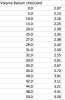 Refer data from conductometric titration of a solution
containing Mg2+ and SO42- with BaCl2.
(a) Determine the concentration of sulfate ion in the 40mL
aliquot if it was titrated with 0.05M BaCl2 solution.
(b) Use these molar ionic conductances to explain the SHAPE of
the titration curve.
Cl- = 76.4
Ba2+ = 127.3
SO4 2- = 160.0
Mg2+ = 106.0
Volume Barium chlol Cond 0.0 5.0 10.0 15.0 20.0 25.0 27.0 29.0 31.0 32.0 33.0 34.0 35.0 40.0 42.0 44.0...
Refer data from conductometric titration of a solution
containing Mg2+ and SO42- with BaCl2.
(a) Determine the concentration of sulfate ion in the 40mL
aliquot if it was titrated with 0.05M BaCl2 solution.
(b) Use these molar ionic conductances to explain the SHAPE of
the titration curve.
Cl- = 76.4
Ba2+ = 127.3
SO4 2- = 160.0
Mg2+ = 106.0
Volume Barium chlol Cond 0.0 5.0 10.0 15.0 20.0 25.0 27.0 29.0 31.0 32.0 33.0 34.0 35.0 40.0 42.0 44.0...
A solution contains 0.021 M Cl? and 0.017 M I?. A solution containing copper (I) ions is added to selectively precipita...
A solution contains 0.021 M Cl? and 0.017 M I?. A solution containing copper (I) ions is added to selectively precipitate one of the ions. At what concentration of copper (I) ion will a precipitate begin to form? What is the identity of the precipitate? Ksp(CuCl) = 1.0 × 10⁻⁶, Ksp(CuI) = 5.1 × 10⁻¹². please show work! A) 4 .8 × 10-5 M, CuCl B) 3 .0 × 10-10 M, CuI C) 3 .0 × 10-10 M, CuCl D)...
A 25.00 mL solution containing 0.035 M sodium acetate is titrated with a 0.098 M solution...
 A 25.00 mL solution containing 0.035 M sodium acetate is titrated with a 0.098 M solution of HCl. How many milliliters of HCI are required to reach the endpoint? Answer CHECK A 25.00 mL solution containing 0.035 M sodium acetate is titrated with a 0.098 M solution of HCI. How many milliliters of HCI are required to reach the endpoint? Answer: CHECK
you have three flasks with 0.03 M Cl- , Br- I- if you have titrated each...
you have three flasks with 0.03 M Cl- , Br- I- if you have titrated each solution with Cu+ what order with the equivalence points appear in the titration curves? Ksp for CuI=1*10-12 Ksp for CuCl=1.9*10-7 Ksp for CuBr = 5 * 10-9 A. pCu+ (I-) < pCu+(Br-)<pCu+(Cl-) B.pCu+ (Cl-) < pCu+(Br-)<pCu+(I-) C.pCu+ (Br-) < pCu+(I-)<pCu+(Cl-)
 if
a solution containing 0.12 M CO32-, N3, Br-, and CN- is treated
with Ag+, in what order will the anions precipitate
6. 0/3 points Previous Answers My Notes Ask You If a solution containing 0.12 M CO?, N o r, and is treated with Ag, in what order will the anions precipitate? (Order your answer from first to last, with species separated by chemPad X.X" - Osek CN>Br>CO,>N CNBCO 42-N The components in your answer are not in the...
if
a solution containing 0.12 M CO32-, N3, Br-, and CN- is treated
with Ag+, in what order will the anions precipitate
6. 0/3 points Previous Answers My Notes Ask You If a solution containing 0.12 M CO?, N o r, and is treated with Ag, in what order will the anions precipitate? (Order your answer from first to last, with species separated by chemPad X.X" - Osek CN>Br>CO,>N CNBCO 42-N The components in your answer are not in the...
 1. If a solution containing 0.100 M Cl, Br,I and CrO4 is treated with Hg22* in what order will the ions precipitate? (There are 2 values for HgaBr2 you should use 5.6 x 10²³) (ignore Activities) hw 20.0 What is the pH in a saturated solution of Ca(OH)2? (solvent is Pure Water with u = 0) 2.
 If a solution containing 0.16 M CO_3^2- BrO_3, I^-, and N_3^- is treated with Ag^+, in what order will the anions precipitate? (order your answer from first to last. Use the appropriate or symbol to separate <, =, or > substances in the list.)
 Refer data from conductometric titration of a solution
containing Mg2+ and SO42- with BaCl2.
(a) Determine the concentration of sulfate ion in the 40mL
aliquot if it was titrated with 0.05M BaCl2 solution.
(b) Use these molar ionic conductances to explain the SHAPE of
the titration curve.
Cl- = 76.4
Ba2+ = 127.3
SO4 2- = 160.0
Mg2+ = 106.0
Volume Barium chlol Cond 0.0 5.0 10.0 15.0 20.0 25.0 27.0 29.0 31.0 32.0 33.0 34.0 35.0 40.0 42.0 44.0...
Refer data from conductometric titration of a solution
containing Mg2+ and SO42- with BaCl2.
(a) Determine the concentration of sulfate ion in the 40mL
aliquot if it was titrated with 0.05M BaCl2 solution.
(b) Use these molar ionic conductances to explain the SHAPE of
the titration curve.
Cl- = 76.4
Ba2+ = 127.3
SO4 2- = 160.0
Mg2+ = 106.0
Volume Barium chlol Cond 0.0 5.0 10.0 15.0 20.0 25.0 27.0 29.0 31.0 32.0 33.0 34.0 35.0 40.0 42.0 44.0...
 A 25.00 mL solution containing 0.035 M sodium acetate is titrated with a 0.098 M solution of HCl. How many milliliters of HCI are required to reach the endpoint? Answer CHECK A 25.00 mL solution containing 0.035 M sodium acetate is titrated with a 0.098 M solution of HCI. How many milliliters of HCI are required to reach the endpoint? Answer: CHECK
Most questions answered within 3 hours.
-
Where is the error in this code sequence?
String s1 = "Hello";
String s2 = "ello";...
asked 11 months ago -
Financial data for Joel de Paris, Inc., for last year
follow:
Joel de Paris, Inc.
Balance...
asked 11 months ago -
Consider this reaction:
Al2(SO4)3 (aq)+ BaCl3
(aq) Al2Cl6 (aq)- +
3BaSO4(s) . What is the...
asked 11 months ago -
Suppose that Savneet is considering increasing her
recent random sample from 20 car rentals to 40...
asked 11 months ago -
Trucks arrive at an unloading terminal at an average rate of 120
per hour.
Trucks arrive...
asked 11 months ago -
Why are methanol and ethanol completely soluble in water while
octanol is not very little soluble....
asked 11 months ago -
A facilities manager at a university reads in a research report
that the mean amount of...
asked 11 months ago -
When the CuSO4 is rehydrated by adding water to the anhydrous
compound, is this an endothermic...
asked 11 months ago -
A ray of sunlight is passing from diamond into crown glass; the
angle of incidence is...
asked 11 months ago -
A block of mass 0.249 kg is placed on top of a light, vertical
spring of...
asked 11 months ago -
how do the kidneys compensate in the presences of acidosis
a) trigger hyperventilate
b) reserve acid...
asked 11 months ago -
Question 501 pts
The rental rate of capital to the firm increases. Which of the
following...
asked 11 months ago