Please help, using Python Write a Python function sum_of_4th_powers, which accepts one argument. You can assume...
Please help, using Python
Write a Python function sum_of_4th_powers, which accepts one argument. You can assume that the function is only called with an integer n as argument, i.e., no need to worry about invalid inputs. If the argument n can be written as a sum n=a4+b4+c4 with all of a,b,c being non-zero, your function should return such a decomposition. Otherwise your function must return False.
For example: sum_of_4th_powers(5) must return False, sum_of_4th_powers(18) could return (1,1,2).
*Please go step by step*
Homework Answers
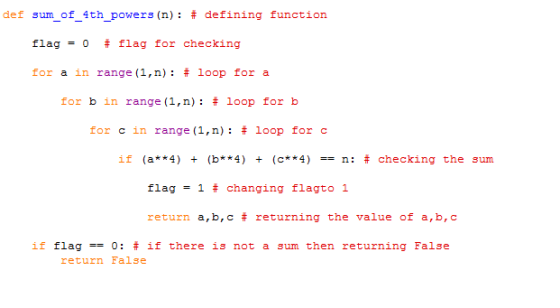
here is the code
cannot provide copyable because indentation gets messed up
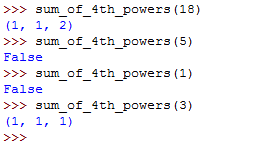
output
Add Answer to:
Please help, using Python
Write a Python function sum_of_4th_powers, which
accepts one argument. You can assume...
python In a program, write a function named roll that accepts an integer argument number_of_throws. The...
python In a program, write a function named roll that accepts an integer argument number_of_throws. The function should generate and return a sorted list of number_of_throws random numbers between 1 and 6. The program should prompt the user to enter a positive integer that is sent to the function, and then print the returned list.
For Python debugExercise12.py is a recursive function that accepts an integer argument, n, and prints the...
For Python debugExercise12.py is a recursive function that accepts an integer argument, n, and prints the numbers 1 up through n. By debugging these programs, you can gain expertise in program logic in general and the Python programming language in particular. def main(): # Local variable number = 0 # Get number as input from the user. number = int(input('How many numbers to display? ')) # Display the numbers. print_num(number) # The print_num function is a a recursive function #...
In python programming. Write a recursive function that accepts an integer argument, n. The function should...
In python programming. Write a recursive function that accepts an integer argument, n. The function should display n lines of asterisks on the screen, with the first line showing 1 asterisk, the second line showing 2 asterisks, up to the nth line which shows n asterisks.
1. Write a function called ordinal_sum that accepts a string argument and returns the sum of...
1. Write a function called ordinal_sum that accepts a string argument and returns the sum of the ordinal values of each character in the string. The ordinal value of a character is its numeric Unicode code point in decimal. 2. Write code that creates a Python set containing each unique character in a string named my_string. For example, if the string is 'hello', the set would be {'h', 'e', 'l', 'o'} (in any order). Assign the set to a variable...
Python Language Only!!!! Python Language Only!!!! Python Language Only!!!! Python 3 is used. Write a function...
Python Language Only!!!! Python Language Only!!!! Python Language Only!!!! Python 3 is used. Write a function named capital_letter that accepts a string as an argument and checks if each word in the string begins with a capital letter. If so, the function will return true, otherwise, return false. Please see the outcome below: Outcome number 1: Enter a string: Python Is Really Fun! True Sample run number 2: Enter a string: i Love Python False Note: Try to keep this...
Using Python, write a function recur, which on input a positive integer n retuns the value...
Using Python, write a function recur, which on input a positive integer n retuns the value Bn defined as follows. You can assume that the function is only called with positive integer arguments. B1 = 5, B2 = 4 B2 = Bn-1* Bn-2 if n is divisible by 3 B3 = Bn-1 + Bn-2 otherwise *Please go step by step with explanation*
Python please Write a function print_back_upper() that accepts a string my_str as an argument and displays...
Python please Write a function print_back_upper() that accepts a string my_str as an argument and displays the string backwards and in uppercase, all in one line (Note: Create any necessary variables) For example: if my_str = "Python" then, your output should display as follows: NOHTYP (Hint: You can use for loop navigating up to range of len of string-1, -1, -1 and use reverse() and upper() functions to create and display the string backwards in uppercase)
1.1. Write a function named "areFirstTwoTheSame AsLast TwoChars" that accepts a string. It returns true if...
 1.1. Write a function named "areFirstTwoTheSame AsLast TwoChars" that accepts a string. It returns true if the first two characters and the last two characters of the string are the same. It returns false otherwise. In addition, if the string is empty or has only one character, it also returns false. For example, these are the strings with their expected return values false falsc "AB" true "ABA" false "ABAB" trus "ABBA" false "ABCABC false "ABCCAB" true 1.2 Write a function...
Write a python program (recursive.py) that contains a main() function. The main() should test the following...
Write a python program (recursive.py) that contains a main() function. The main() should test the following functions by calling each one with several different values. Here are the functions: 1) rprint - Recursive Printing: Design a recursive function that accepts an integer argument, n, and prints the numbers 1 up through n. 2) rmult - Recursive Multiplication: Design a recursive function that accepts two arguments into the parameters x and y. The function should return the value of x times...
Using Java: 1. Recursive Multiplication Write a recursive function that accepts two arguments into the parameters...
Using Java: 1. Recursive Multiplication Write a recursive function that accepts two arguments into the parameters x and y. The function should return the value of x times y. Remember, multiplication can be performed as repeated addition as follows: 5×6=6+6+6+6+6 2. Recursive findings Write a recursive boolean method named reFinding. The method should search an array for a specified value, and return true if the value is found in the array, or false if the value is not found in...
 1.1. Write a function named "areFirstTwoTheSame AsLast TwoChars" that accepts a string. It returns true if the first two characters and the last two characters of the string are the same. It returns false otherwise. In addition, if the string is empty or has only one character, it also returns false. For example, these are the strings with their expected return values false falsc "AB" true "ABA" false "ABAB" trus "ABBA" false "ABCABC false "ABCCAB" true 1.2 Write a function...
Most questions answered within 3 hours.
-
Where is the error in this code sequence?
String s1 = "Hello";
String s2 = "ello";...
asked 11 months ago -
Financial data for Joel de Paris, Inc., for last year
follow:
Joel de Paris, Inc.
Balance...
asked 11 months ago -
Consider this reaction:
Al2(SO4)3 (aq)+ BaCl3
(aq) Al2Cl6 (aq)- +
3BaSO4(s) . What is the...
asked 11 months ago -
Suppose that Savneet is considering increasing her
recent random sample from 20 car rentals to 40...
asked 11 months ago -
Trucks arrive at an unloading terminal at an average rate of 120
per hour.
Trucks arrive...
asked 11 months ago -
Why are methanol and ethanol completely soluble in water while
octanol is not very little soluble....
asked 11 months ago -
A facilities manager at a university reads in a research report
that the mean amount of...
asked 11 months ago -
When the CuSO4 is rehydrated by adding water to the anhydrous
compound, is this an endothermic...
asked 11 months ago -
A ray of sunlight is passing from diamond into crown glass; the
angle of incidence is...
asked 11 months ago -
A block of mass 0.249 kg is placed on top of a light, vertical
spring of...
asked 11 months ago -
how do the kidneys compensate in the presences of acidosis
a) trigger hyperventilate
b) reserve acid...
asked 11 months ago -
Question 501 pts
The rental rate of capital to the firm increases. Which of the
following...
asked 11 months ago