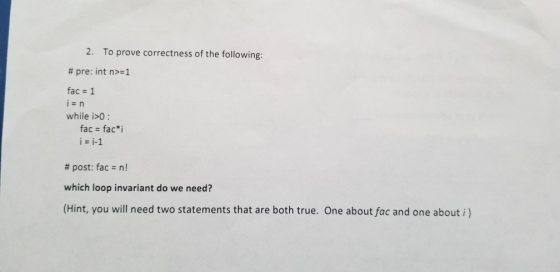
To prove the correctness of the following:
# pre: int >= 1
fac = 1
i = n
while i>0:
fac = fac*i
i = i-1
# post: fac = n!
which loop invariant do we need?
(Hint, you will need two statements that are both true. One about fac and one about i)
Please provide both full statements as well as which loop invariant is needed in a full proof.
Homework Answers
# pre: int >= 1
fac = 1
i = n
while i>0:
fac = fac*i
i = i-1
# post: fac = n!
statement 1:loop invariant would be fac*(i!) = n! where n is the initial value of i that is passed to the function. This statement is always true, no matter how many iterations of the loop have already been done.
statement 2: in each iteration value of i reduced by 1 till it
reaches 0
proof:
Precondition :
i = n ,fac=1
fac*(i!) = 1*(n!) = n!
Maintenance :
in each iteration fac = fac*i
and i=i-1;
(fac*i)*((i-1)!) = n!
Termination :
fac = 1*2*3*4*.........*(n-1)*n = n!
Add Answer to:
To prove the correctness of the following:
# pre: int >= 1
fac = 1
i...
Which of the following does the choice rule not allow you to do? Take any pre-condition of the if...
 Hey, could someone help me check my answers with these please :)
Thank you
Which of the following does the choice rule not allow you to do? Take any pre-condition of the if: construction as a pre-condition of the if: and else: blocks Take the condition of the if statement a a pre-condition of the if: block Take (P) as a post-condition of the whole if: construction if (Py is a post-condition of both the if: and else: blocks Take...
Hey, could someone help me check my answers with these please :)
Thank you
Which of the following does the choice rule not allow you to do? Take any pre-condition of the if: construction as a pre-condition of the if: and else: blocks Take the condition of the if statement a a pre-condition of the if: block Take (P) as a post-condition of the whole if: construction if (Py is a post-condition of both the if: and else: blocks Take...
6. [8 marks Consider the sequence 10, 11, ... defined by To = 0, 11 =...
 6. [8 marks Consider the sequence 10, 11, ... defined by To = 0, 11 = 1, and ri = i-1 + 24-2 for all i > 2. Consider the following algorithm that attempts to compute the value In, given an n > 0. Algorithm 6 1: //pre: (n e Z) ^ (n > 0) 2: if n == 0 then 3: bro 1: else 5: a 0 6: 5+ 1 it1 //LoopInv: while i<n do ct a+b atb bc...
(15 points) Consider the algorithm for insertion sort shown below. The input to this algorithm is...
 (15 points) Consider the algorithm for insertion sort shown below. The input to this algorithm is an earray A. You must assume that indexing begins at 1. 1: for j = 2: A.length do key = A i=j-1 while i > 0 and A[i] > key do Ali + 1] = Ai i=i-1 7: A[i+1] = key (a) Follow this algorithm for A[1..4) =< 7,9,6,8 >. Specifically, please indicate the contents of the array after each iteration of the outer...
Problem Description proving program correctness Consider the following program specification: Input: An integer n > 0...
Problem Description proving program correctness Consider the following program specification: Input: An integer n > 0 and an array A[0..(n - 1)] of n integers. Output: The smallest index s such that A[s] is the largest value in A[0..(n - 1)]. For example, if n = 9 and A = [ 4, 8, 1, 3, 8, 5, 4, 7, 2 ] (so A[0] = 4, A[1] = 8, etc.), then the program would return 1, since the largest value in...
For the while loop below, use the loop invariant given to show that if the pre-condition...
 For the while loop below, use the loop invariant given to show that if the pre-condition is the loop.In each step, clearly state true before the loop then the post-condition is true after what facts are assumed and what facts will be proven. (computes the sum of a list of numbers.) fa ,an While (<n) sum := sum + am j j+1 End-while ° Pre-condition: j- 1, sum a, n is a positive integer, a,,.. a, is a list of...
double sinLoops (double x) { int i = 7; //this didn't exist. double result = 1/(m+1)...
 double sinLoops (double x) { int i = 7; //this didn't exist. double result = 1/(m+1) // line 3 double pi=3.14; //You need the individual taylor series element. do { double num = x; //these need to be reset each time. double fac = 1; //if not they overflow and infinity/infinity is NaN and it exits. for (int counter = 1; counter < (2 * i + 1); counter++) { } (2 * i + 1); counter2 >= 1; counter2--)...
Argue the correctness of Heapsort using the following loop invariant for the second loop in the...
Argue the correctness of Heapsort using the following loop invariant for the second loop in the algorithm (after the array has been heapified): "At the start of each iteration of the for loop, the subarray A[0 ... i-1] is a max-heap containing the i smallest elements of the original array, and the subarray A[i ... n-1] contains the n-i largest elements of the original array in sorted order
For this pseudocode present a loop invariant and prove it, n >= 0. i <= 0;...
For this pseudocode present a loop invariant and prove it, n >= 0. i <= 0; s <=2; while i < n do i <= i + 1 s <= s * s
Consider the code below int s =1; for (int i=1; i<N; i++){ //Assertion: s = s...
Consider the code below int s =1; for (int i=1; i<N; i++){ //Assertion: s = s = s+(2*i+1);} printf("%d", s); a) What is a reasonable assertion for the main loop? b) What does the code accomplish? c) Using the method of initalization-maintenance-termination, prove that the invariant holds, and that the final output is correct.
An array A of n integers is called semi-sorted if it is increasing until some index...
An array A of n integers is called semi-sorted if it is increasing until some index and then decreasing afterwards. In other words, there is some index 1 ≤ p ≤ n such that: • A[i] < A[i + 1] for 1 ≤ i < p, and • A[i] > A[i + 1] for p ≤ i < n. Note that in this case, A[p] is the maximum element of A. Give an algorithm with running time O(logn) that finds...
 Hey, could someone help me check my answers with these please :)
Thank you
Which of the following does the choice rule not allow you to do? Take any pre-condition of the if: construction as a pre-condition of the if: and else: blocks Take the condition of the if statement a a pre-condition of the if: block Take (P) as a post-condition of the whole if: construction if (Py is a post-condition of both the if: and else: blocks Take...
Hey, could someone help me check my answers with these please :)
Thank you
Which of the following does the choice rule not allow you to do? Take any pre-condition of the if: construction as a pre-condition of the if: and else: blocks Take the condition of the if statement a a pre-condition of the if: block Take (P) as a post-condition of the whole if: construction if (Py is a post-condition of both the if: and else: blocks Take...
 6. [8 marks Consider the sequence 10, 11, ... defined by To = 0, 11 = 1, and ri = i-1 + 24-2 for all i > 2. Consider the following algorithm that attempts to compute the value In, given an n > 0. Algorithm 6 1: //pre: (n e Z) ^ (n > 0) 2: if n == 0 then 3: bro 1: else 5: a 0 6: 5+ 1 it1 //LoopInv: while i<n do ct a+b atb bc...
 (15 points) Consider the algorithm for insertion sort shown below. The input to this algorithm is an earray A. You must assume that indexing begins at 1. 1: for j = 2: A.length do key = A i=j-1 while i > 0 and A[i] > key do Ali + 1] = Ai i=i-1 7: A[i+1] = key (a) Follow this algorithm for A[1..4) =< 7,9,6,8 >. Specifically, please indicate the contents of the array after each iteration of the outer...
 For the while loop below, use the loop invariant given to show that if the pre-condition is the loop.In each step, clearly state true before the loop then the post-condition is true after what facts are assumed and what facts will be proven. (computes the sum of a list of numbers.) fa ,an While (<n) sum := sum + am j j+1 End-while ° Pre-condition: j- 1, sum a, n is a positive integer, a,,.. a, is a list of...
 double sinLoops (double x) { int i = 7; //this didn't exist. double result = 1/(m+1) // line 3 double pi=3.14; //You need the individual taylor series element. do { double num = x; //these need to be reset each time. double fac = 1; //if not they overflow and infinity/infinity is NaN and it exits. for (int counter = 1; counter < (2 * i + 1); counter++) { } (2 * i + 1); counter2 >= 1; counter2--)...
Most questions answered within 3 hours.
-
Where is the error in this code sequence?
String s1 = "Hello";
String s2 = "ello";...
asked 11 months ago -
Financial data for Joel de Paris, Inc., for last year
follow:
Joel de Paris, Inc.
Balance...
asked 11 months ago -
Consider this reaction:
Al2(SO4)3 (aq)+ BaCl3
(aq) Al2Cl6 (aq)- +
3BaSO4(s) . What is the...
asked 11 months ago -
Suppose that Savneet is considering increasing her
recent random sample from 20 car rentals to 40...
asked 11 months ago -
Trucks arrive at an unloading terminal at an average rate of 120
per hour.
Trucks arrive...
asked 11 months ago -
Why are methanol and ethanol completely soluble in water while
octanol is not very little soluble....
asked 11 months ago -
A facilities manager at a university reads in a research report
that the mean amount of...
asked 11 months ago -
When the CuSO4 is rehydrated by adding water to the anhydrous
compound, is this an endothermic...
asked 11 months ago -
A ray of sunlight is passing from diamond into crown glass; the
angle of incidence is...
asked 11 months ago -
A block of mass 0.249 kg is placed on top of a light, vertical
spring of...
asked 11 months ago -
how do the kidneys compensate in the presences of acidosis
a) trigger hyperventilate
b) reserve acid...
asked 11 months ago -
Question 501 pts
The rental rate of capital to the firm increases. Which of the
following...
asked 11 months ago