Calculate the number of pounds of CO2 released into the atmosphere when a 19.0-gallon tank of...
Calculate the number of pounds of CO2 released into the atmosphere when a 19.0-gallon tank of gasoline is burned in an automobile engine. Assume that gasoline is primarily octane, C8H18, and that the density of gasoline is 0.692 g·mL–1 (this assumption ignores additives). Also assume complete combustion.
Homework Answers
The combustion reaction taking place is:
C8H18 + 12.5O2 ---> 8CO2 + 9H2O
Mass of octane taken = Density*Volume = 0.692*71922.8 = 49770.58 g
Moles of octane = Mass/MW = 49770.58/114.23 = 435.71
According to reaction stoichiometry,
Moles of CO2 produced = 8*Moles of octane = 435.71*8 = 3485.68
Mass of CO2 produced = Moles*MW = 3485.68*44 = 153369.92 g = 338.12 pounds
Hope this helps !
Add Answer to:
Calculate the number of pounds of CO2 released into the
atmosphere when a 19.0-gallon tank of...
Calculate the number of pounds of Co, released into the atmosphere when a 24.0 gallon tank...
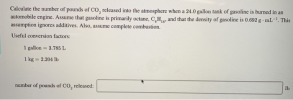 Calculate the number of pounds of Co, released into the atmosphere when a 24.0 gallon tank of gasoline is burned in an automobile engine. Assume that gasoline is primarily octane, CHg, and that the density of gasoline is 0.692 g.mL-1. This assumption ignores additives. Also, assume complete combustion. Useful conversion factors: 1 gallon = 3.785 L 1 kg = 2.204 lb number of pounds of Co, released:
i need help asap Calculate the number of pounds of Co, released into the atmosphere when...
 i need help asap
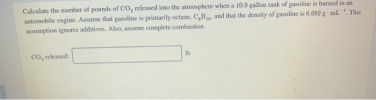
Calculate the number of pounds of Co, released into the atmosphere when a 10.0 gallon tank of gasoline is burned in an automobile engine. Assume that gasoline is primarily octane, CHg, and that the density of gasoline is 0.692 g - mL ! This assumption ignores additives. Also, assume complete combustion. CO, released
i need help asap
Calculate the number of pounds of Co, released into the atmosphere when a 10.0 gallon tank of gasoline is burned in an automobile engine. Assume that gasoline is primarily octane, CHg, and that the density of gasoline is 0.692 g - mL ! This assumption ignores additives. Also, assume complete combustion. CO, released
1. Calculate the number of pounds of CO2 released into the atmosphere when a 15.0-gallon tank...
1. Calculate the number of pounds of CO2 released into the atmosphere when a 15.0-gallon tank of gasoline is burned in an automobile engine. Assume that gasoline is primarily octane, C8H18, and that the density of gasoline is 0.692 g·mL–1 (this assumption ignores additives). Also assume complete combustion. 2.The flask shown here contains 10.0 mL of HCl and a few drops of phenolphthalein indicator. The buret contains 0.220 M NaOH. a. What volume of NaOH is needed to reach the...
1.) An aqueous solution containing 5.66 g of lead(II) nitrate is added to an aqueous solution...
1.) An aqueous solution containing 5.66 g of lead(II) nitrate is added to an aqueous solution containing 6.30 g of potassium chloride. Enter the balanced chemical equation for this reaction. Be sure to include all physical states. balanced chemical equation What is the limiting reactant? The percent yield for the reaction is 79.2 % . How many grams of precipitate is recovered? precipitate recovered: How many grams of the excess reactant remain? excess reactant remaining: 2.) Chlorine gas can be...
Automobiles are often implicated as contributors to global warming because they are a source of the...
Automobiles are often implicated as contributors to global warming because they are a source of the greenhouse gas CO2. How many pounds of CO2 would your car release in a year if it was driven 160. miles per week? Gasoline is a complex mixture of hydrocarbons. In your calculations, assume that gasoline is octane (molecular formula C8H18) and that it is burned completely to CO2 and H2O in the engine of your car. Also assume that the car averages 29.3...
1. Assuming your car gets 30 miles/gallon and you drive 5,000 miles each year, calculate how...
1. Assuming your car gets 30 miles/gallon and you drive 5,000 miles each year, calculate how many gallons of gasoline you use per year by driving your car. Give your (numerical) answer to the nearest 1 without any unit. 2. )Using your answer above, 167 gallons, calculate how many liters of gasoline your car burns per year. 1 gallon = 3.8 liters, 1 L = 1000 mL, 1 kg = 1000 g Give you answer to the nearest 1 without...
3. If 18.5 gallons of gasoline are burned while driving to the mountains, how many pounds...
 3. If 18.5 gallons of gasoline are burned while driving to the mountains, how many pounds of carbon dioxide are produced? You will need to write a complete balanced equation, including phase labels, for this combustion reaction (gasoline can be approximated by C8H18 and has a density of 0.72 g/cm'). You will also need to use the following equivalence statements: 1 lb = 0.071429 stone, 6.35 kg - 1 stone, 1 gallon = 1024 fluid drams (fl dm), 1 fluid...
Write the balanced equation for the combustion of isooctane (C8H18) to produce carbon dioxide and water....
 Write the balanced equation for the combustion of
isooctane (C8H18) to produce carbon dioxide
and water. Use the smallest possible integers to balance the
equation. Also, separate the + sign with 1 space.
2C8H18 + 25O2 ?
16CO2 + 18H2O
You are correct.
Your receipt no. is 161-2857
Previous Tries
Assuming gasoline is 90.0% isooctane, with a density
of 0.692 g/mL, what is the theoretical yield (in grams) of
CO2 produced by the combustion of 1.42 x 10¹⁰
gallons of...
Write the balanced equation for the combustion of
isooctane (C8H18) to produce carbon dioxide
and water. Use the smallest possible integers to balance the
equation. Also, separate the + sign with 1 space.
2C8H18 + 25O2 ?
16CO2 + 18H2O
You are correct.
Your receipt no. is 161-2857
Previous Tries
Assuming gasoline is 90.0% isooctane, with a density
of 0.692 g/mL, what is the theoretical yield (in grams) of
CO2 produced by the combustion of 1.42 x 10¹⁰
gallons of...
 Calculate the number of pounds of Co, released into the atmosphere when a 24.0 gallon tank of gasoline is burned in an automobile engine. Assume that gasoline is primarily octane, CHg, and that the density of gasoline is 0.692 g.mL-1. This assumption ignores additives. Also, assume complete combustion. Useful conversion factors: 1 gallon = 3.785 L 1 kg = 2.204 lb number of pounds of Co, released:
 i need help asap
Calculate the number of pounds of Co, released into the atmosphere when a 10.0 gallon tank of gasoline is burned in an automobile engine. Assume that gasoline is primarily octane, CHg, and that the density of gasoline is 0.692 g - mL ! This assumption ignores additives. Also, assume complete combustion. CO, released
i need help asap
Calculate the number of pounds of Co, released into the atmosphere when a 10.0 gallon tank of gasoline is burned in an automobile engine. Assume that gasoline is primarily octane, CHg, and that the density of gasoline is 0.692 g - mL ! This assumption ignores additives. Also, assume complete combustion. CO, released
 3. If 18.5 gallons of gasoline are burned while driving to the mountains, how many pounds of carbon dioxide are produced? You will need to write a complete balanced equation, including phase labels, for this combustion reaction (gasoline can be approximated by C8H18 and has a density of 0.72 g/cm'). You will also need to use the following equivalence statements: 1 lb = 0.071429 stone, 6.35 kg - 1 stone, 1 gallon = 1024 fluid drams (fl dm), 1 fluid...
 Write the balanced equation for the combustion of
isooctane (C8H18) to produce carbon dioxide
and water. Use the smallest possible integers to balance the
equation. Also, separate the + sign with 1 space.
2C8H18 + 25O2 ?
16CO2 + 18H2O
You are correct.
Your receipt no. is 161-2857
Previous Tries
Assuming gasoline is 90.0% isooctane, with a density
of 0.692 g/mL, what is the theoretical yield (in grams) of
CO2 produced by the combustion of 1.42 x 10¹⁰
gallons of...
Write the balanced equation for the combustion of
isooctane (C8H18) to produce carbon dioxide
and water. Use the smallest possible integers to balance the
equation. Also, separate the + sign with 1 space.
2C8H18 + 25O2 ?
16CO2 + 18H2O
You are correct.
Your receipt no. is 161-2857
Previous Tries
Assuming gasoline is 90.0% isooctane, with a density
of 0.692 g/mL, what is the theoretical yield (in grams) of
CO2 produced by the combustion of 1.42 x 10¹⁰
gallons of...
Most questions answered within 3 hours.
-
Where is the error in this code sequence?
String s1 = "Hello";
String s2 = "ello";...
asked 11 months ago -
Financial data for Joel de Paris, Inc., for last year
follow:
Joel de Paris, Inc.
Balance...
asked 11 months ago -
Consider this reaction:
Al2(SO4)3 (aq)+ BaCl3
(aq) Al2Cl6 (aq)- +
3BaSO4(s) . What is the...
asked 11 months ago -
Suppose that Savneet is considering increasing her
recent random sample from 20 car rentals to 40...
asked 11 months ago -
Trucks arrive at an unloading terminal at an average rate of 120
per hour.
Trucks arrive...
asked 11 months ago -
Why are methanol and ethanol completely soluble in water while
octanol is not very little soluble....
asked 11 months ago -
A facilities manager at a university reads in a research report
that the mean amount of...
asked 11 months ago -
When the CuSO4 is rehydrated by adding water to the anhydrous
compound, is this an endothermic...
asked 11 months ago -
A ray of sunlight is passing from diamond into crown glass; the
angle of incidence is...
asked 11 months ago -
A block of mass 0.249 kg is placed on top of a light, vertical
spring of...
asked 11 months ago -
how do the kidneys compensate in the presences of acidosis
a) trigger hyperventilate
b) reserve acid...
asked 11 months ago -
Question 501 pts
The rental rate of capital to the firm increases. Which of the
following...
asked 11 months ago