
Homework Answers
Solution
Given that
Add Answer to:
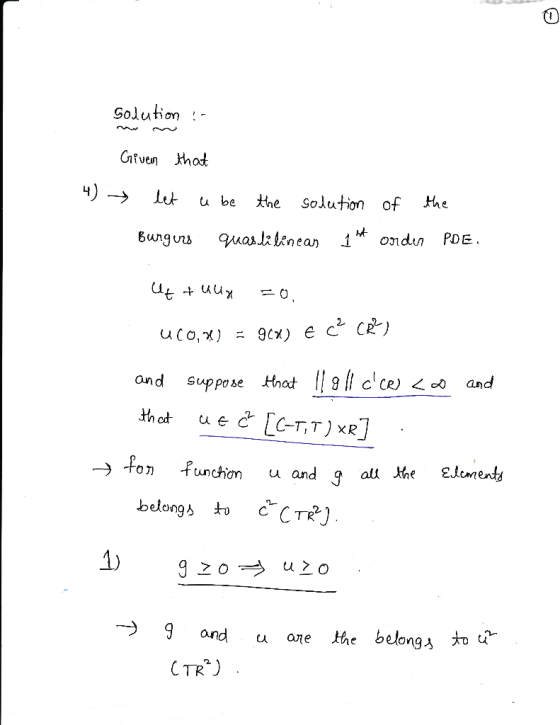
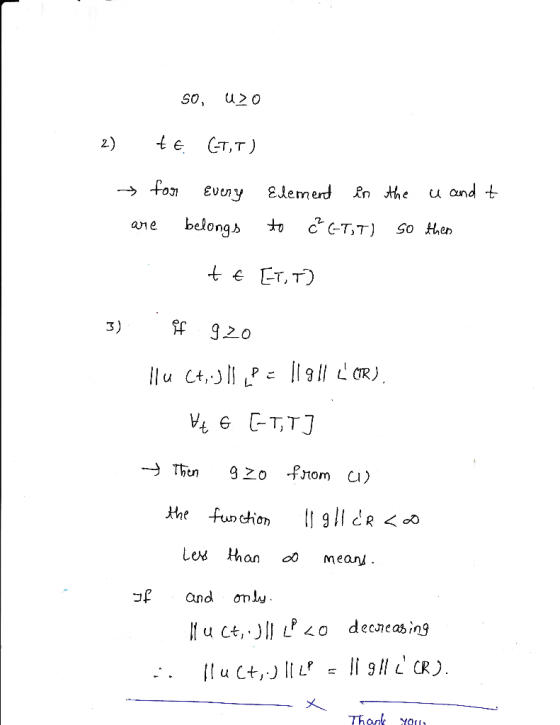
4. Let u be the solution of the Burgers quaslilinear 1st order PDE u, + uu,-0,...
1. Let u be a solution of the wave equation u 0. Let the points A, B, C, D be the vertices of the...
 1. Let u be a solution of the wave equation u 0. Let the points A, B, C, D be the vertices of the paralleogram formed by the two pairs of characteristic lines r-ctC1,x- ct-2,+ ct- di,r +ct- d2 Show that u (A)+u (C)-u (B) + u (D Use this to find u satisfying For which (x, t) can you determine u (x, t) uniquely this way? 2. Suppose u satisfies the wave equation utt -curr0 in the strip 0...
(4) Let f R -R be a strictly conve:r C2 function and let 0 a) Write the Euler-Lagrange equation...
 (4) Let f R -R be a strictly conve:r C2 function and let 0 a) Write the Euler-Lagrange equation for the minimizer u.(x) of the following problem: minimize u subject to: u E A, where A- 0,REC1[0 , 1and u (0 a u(1)b) b) Assuming the minimizer u(a) is a C2 function, prove t is strictly convex
(4) Let f R -R be a strictly conve:r C2 function and let 0
a) Write the Euler-Lagrange equation for the minimizer u.(x)...
(4) Let f R -R be a strictly conve:r C2 function and let 0 a) Write the Euler-Lagrange equation for the minimizer u.(x) of the following problem: minimize u subject to: u E A, where A- 0,REC1[0 , 1and u (0 a u(1)b) b) Assuming the minimizer u(a) is a C2 function, prove t is strictly convex
(4) Let f R -R be a strictly conve:r C2 function and let 0
a) Write the Euler-Lagrange equation for the minimizer u.(x)...
Please detail Please detail PDE Utt = Uzx + 2a sin(at) sin(1x) 0 < x <1...
 Please detail
PDE Utt = Uzx + 2a sin(at) sin(1x) 0 < x <1 0<t< oo BCS S u(0,t) = 0 | u(1,t) = 0 0<t< oo ICs u(x,0) = 0 | u4(,0) = sin(nx) 0 < x <1 u (0,t) = f (t) u (L,t) = g(t) S Use sine transform Uz (0,t) = f(t) uz (L,t) = g(t)) Use cosine transform 2 L S [u (x,t)] = Sn (t) = 1 | u(x, t) sin (ntx/L)...
Please detail
Please detail
PDE Utt = Uzx + 2a sin(at) sin(1x) 0 < x <1 0<t< oo BCS S u(0,t) = 0 | u(1,t) = 0 0<t< oo ICs u(x,0) = 0 | u4(,0) = sin(nx) 0 < x <1 u (0,t) = f (t) u (L,t) = g(t) S Use sine transform Uz (0,t) = f(t) uz (L,t) = g(t)) Use cosine transform 2 L S [u (x,t)] = Sn (t) = 1 | u(x, t) sin (ntx/L)...
Find solution to the IBVP PDE BCs Ic u(0, t)-0, 0<oo l u(1, t) 0, 0<t<...
 Find solution to the IBVP PDE BCs Ic u(0, t)-0, 0<oo l u(1, t) 0, 0<t< oo u(z,0)=x-x2ババ1
(2) [15pts] Write the solution of the PDE for 0
 Can you help me with this question please?
(2) [15pts] Write the solution of the PDE for 0 <<1 and t>0 u(0,t) 0 u(1,t) = 0 u(x,0)-0 Make sure you simplify as much as possible by using the fact that the source term f depends only on z and not on t. What is the solution at long time lim,-+oo u(x, t) if f()T) [Hint: You can obtain this by solving a single (trivial) ODE]
(2) [15pts] Write the solution...
Can you help me with this question please?
(2) [15pts] Write the solution of the PDE for 0 <<1 and t>0 u(0,t) 0 u(1,t) = 0 u(x,0)-0 Make sure you simplify as much as possible by using the fact that the source term f depends only on z and not on t. What is the solution at long time lim,-+oo u(x, t) if f()T) [Hint: You can obtain this by solving a single (trivial) ODE]
(2) [15pts] Write the solution...
2. Let U C R2 be simply connected and let to E U. Let g: U(oR2 be irrotational and of class C1. A...
 2. Let U C R2 be simply connected and let to E U. Let g: U(oR2 be irrotational and of class C1. Assume that there exists r >0 such that B(zo, r) C U and g=0. Let γ be a closed sinile polygonal arc with range in U \ {zo), let「be its range, and let V be the bounded connected component of R2 \ Г. (a) Assume that V C U \ [xo) and prove that g=0. (b) Assume that...
5. Let y E C2([0, T]; R), T > 0 satisfy y"(t) = 피t, y(0) = y'(0) = 0 e R. Use Picard-Lindelöf 1+...
 5. Let y E C2([0, T]; R), T > 0 satisfy y"(t) = 피t, y(0) = y'(0) = 0 e R. Use Picard-Lindelöf 1+t' to prove that a unique solution to the IVP exists for short time, as follows: (a) Let b E R2, A E M2 (R) . Show that any function g : R2 -R2.9(x) = Ax+b is Lipschitz. 1 mark (b) Transform the DE for y into a(t) Az(t) +b(t) for a suitable z, A, b. 2...
3. Determine the discretization of the heat equation driven at the boundary, PDE IC (x,0) BC t E R+ u(0, r) =g(x),ur(1,1) = 0, 3. Determine the discretization of the heat equation driven at the...
 3. Determine the discretization of the heat equation driven at the boundary, PDE IC (x,0) BC t E R+ u(0, r) =g(x),ur(1,1) = 0,
3. Determine the discretization of the heat equation driven at the boundary, PDE IC (x,0) BC t E R+ u(0, r) =g(x),ur(1,1) = 0,
3. Determine the discretization of the heat equation driven at the boundary, PDE IC (x,0) BC t E R+ u(0, r) =g(x),ur(1,1) = 0,
Can anyone help with this question please? Given a domain Ω c R2 and a smooth function f,uo : Ω-+ R consider the proble...
 Can anyone help with this question please?
Given a domain Ω c R2 and a smooth function f,uo : Ω-+ R consider the problem Uz (x, t)-Au (x, t) + u(x, t) u(x, t = f(x) Y(x, t) E Ω × (0, oo), V(x, t) E 2 x (0, 00), Assume that u(z, t) is a smooth solution and that v(x) is a smooth stationary (i.e., time-independent) solution. Derive a PDE problem for the difference w(x, t)u(x, t)(x) By multiplying...
Can anyone help with this question please?
Given a domain Ω c R2 and a smooth function f,uo : Ω-+ R consider the problem Uz (x, t)-Au (x, t) + u(x, t) u(x, t = f(x) Y(x, t) E Ω × (0, oo), V(x, t) E 2 x (0, 00), Assume that u(z, t) is a smooth solution and that v(x) is a smooth stationary (i.e., time-independent) solution. Derive a PDE problem for the difference w(x, t)u(x, t)(x) By multiplying...
Consider the linear second-order PDE for u = u(x, y), 2uxx – 3uxy – 2uyy =...
 Consider the linear second-order PDE for u = u(x, y), 2uxx – 3uxy – 2uyy = (2x + y)2. (i) Determine the type (elliptic, hyperbolic, or parabolic) of (*). (ii) Introduce new independent variables s, t via x = 8 + 2t, y = -2s+t, and let w = w(s, t) be the function u in these new variables, i.e., let w(s, t) = u(s + 2t, -2s +t). Utilizing the chain rule, Ug = W58x + witz, Uy =...
 1. Let u be a solution of the wave equation u 0. Let the points A, B, C, D be the vertices of the paralleogram formed by the two pairs of characteristic lines r-ctC1,x- ct-2,+ ct- di,r +ct- d2 Show that u (A)+u (C)-u (B) + u (D Use this to find u satisfying For which (x, t) can you determine u (x, t) uniquely this way? 2. Suppose u satisfies the wave equation utt -curr0 in the strip 0...
 (4) Let f R -R be a strictly conve:r C2 function and let 0 a) Write the Euler-Lagrange equation for the minimizer u.(x) of the following problem: minimize u subject to: u E A, where A- 0,REC1[0 , 1and u (0 a u(1)b) b) Assuming the minimizer u(a) is a C2 function, prove t is strictly convex
(4) Let f R -R be a strictly conve:r C2 function and let 0
a) Write the Euler-Lagrange equation for the minimizer u.(x)...
(4) Let f R -R be a strictly conve:r C2 function and let 0 a) Write the Euler-Lagrange equation for the minimizer u.(x) of the following problem: minimize u subject to: u E A, where A- 0,REC1[0 , 1and u (0 a u(1)b) b) Assuming the minimizer u(a) is a C2 function, prove t is strictly convex
(4) Let f R -R be a strictly conve:r C2 function and let 0
a) Write the Euler-Lagrange equation for the minimizer u.(x)...
 Please detail
PDE Utt = Uzx + 2a sin(at) sin(1x) 0 < x <1 0<t< oo BCS S u(0,t) = 0 | u(1,t) = 0 0<t< oo ICs u(x,0) = 0 | u4(,0) = sin(nx) 0 < x <1 u (0,t) = f (t) u (L,t) = g(t) S Use sine transform Uz (0,t) = f(t) uz (L,t) = g(t)) Use cosine transform 2 L S [u (x,t)] = Sn (t) = 1 | u(x, t) sin (ntx/L)...
Please detail
Please detail
PDE Utt = Uzx + 2a sin(at) sin(1x) 0 < x <1 0<t< oo BCS S u(0,t) = 0 | u(1,t) = 0 0<t< oo ICs u(x,0) = 0 | u4(,0) = sin(nx) 0 < x <1 u (0,t) = f (t) u (L,t) = g(t) S Use sine transform Uz (0,t) = f(t) uz (L,t) = g(t)) Use cosine transform 2 L S [u (x,t)] = Sn (t) = 1 | u(x, t) sin (ntx/L)...
 Find solution to the IBVP PDE BCs Ic u(0, t)-0, 0<oo l u(1, t) 0, 0<t< oo u(z,0)=x-x2ババ1
 Can you help me with this question please?
(2) [15pts] Write the solution of the PDE for 0 <<1 and t>0 u(0,t) 0 u(1,t) = 0 u(x,0)-0 Make sure you simplify as much as possible by using the fact that the source term f depends only on z and not on t. What is the solution at long time lim,-+oo u(x, t) if f()T) [Hint: You can obtain this by solving a single (trivial) ODE]
(2) [15pts] Write the solution...
Can you help me with this question please?
(2) [15pts] Write the solution of the PDE for 0 <<1 and t>0 u(0,t) 0 u(1,t) = 0 u(x,0)-0 Make sure you simplify as much as possible by using the fact that the source term f depends only on z and not on t. What is the solution at long time lim,-+oo u(x, t) if f()T) [Hint: You can obtain this by solving a single (trivial) ODE]
(2) [15pts] Write the solution...
 2. Let U C R2 be simply connected and let to E U. Let g: U(oR2 be irrotational and of class C1. Assume that there exists r >0 such that B(zo, r) C U and g=0. Let γ be a closed sinile polygonal arc with range in U \ {zo), let「be its range, and let V be the bounded connected component of R2 \ Г. (a) Assume that V C U \ [xo) and prove that g=0. (b) Assume that...
 5. Let y E C2([0, T]; R), T > 0 satisfy y"(t) = 피t, y(0) = y'(0) = 0 e R. Use Picard-Lindelöf 1+t' to prove that a unique solution to the IVP exists for short time, as follows: (a) Let b E R2, A E M2 (R) . Show that any function g : R2 -R2.9(x) = Ax+b is Lipschitz. 1 mark (b) Transform the DE for y into a(t) Az(t) +b(t) for a suitable z, A, b. 2...
 3. Determine the discretization of the heat equation driven at the boundary, PDE IC (x,0) BC t E R+ u(0, r) =g(x),ur(1,1) = 0,
3. Determine the discretization of the heat equation driven at the boundary, PDE IC (x,0) BC t E R+ u(0, r) =g(x),ur(1,1) = 0,
3. Determine the discretization of the heat equation driven at the boundary, PDE IC (x,0) BC t E R+ u(0, r) =g(x),ur(1,1) = 0,
 Can anyone help with this question please?
Given a domain Ω c R2 and a smooth function f,uo : Ω-+ R consider the problem Uz (x, t)-Au (x, t) + u(x, t) u(x, t = f(x) Y(x, t) E Ω × (0, oo), V(x, t) E 2 x (0, 00), Assume that u(z, t) is a smooth solution and that v(x) is a smooth stationary (i.e., time-independent) solution. Derive a PDE problem for the difference w(x, t)u(x, t)(x) By multiplying...
Can anyone help with this question please?
Given a domain Ω c R2 and a smooth function f,uo : Ω-+ R consider the problem Uz (x, t)-Au (x, t) + u(x, t) u(x, t = f(x) Y(x, t) E Ω × (0, oo), V(x, t) E 2 x (0, 00), Assume that u(z, t) is a smooth solution and that v(x) is a smooth stationary (i.e., time-independent) solution. Derive a PDE problem for the difference w(x, t)u(x, t)(x) By multiplying...
 Consider the linear second-order PDE for u = u(x, y), 2uxx – 3uxy – 2uyy = (2x + y)2. (i) Determine the type (elliptic, hyperbolic, or parabolic) of (*). (ii) Introduce new independent variables s, t via x = 8 + 2t, y = -2s+t, and let w = w(s, t) be the function u in these new variables, i.e., let w(s, t) = u(s + 2t, -2s +t). Utilizing the chain rule, Ug = W58x + witz, Uy =...
Most questions answered within 3 hours.
-
Where is the error in this code sequence?
String s1 = "Hello";
String s2 = "ello";...
asked 11 months ago -
Financial data for Joel de Paris, Inc., for last year
follow:
Joel de Paris, Inc.
Balance...
asked 11 months ago -
Consider this reaction:
Al2(SO4)3 (aq)+ BaCl3
(aq) Al2Cl6 (aq)- +
3BaSO4(s) . What is the...
asked 11 months ago -
Suppose that Savneet is considering increasing her
recent random sample from 20 car rentals to 40...
asked 11 months ago -
Trucks arrive at an unloading terminal at an average rate of 120
per hour.
Trucks arrive...
asked 11 months ago -
Why are methanol and ethanol completely soluble in water while
octanol is not very little soluble....
asked 11 months ago -
A facilities manager at a university reads in a research report
that the mean amount of...
asked 11 months ago -
When the CuSO4 is rehydrated by adding water to the anhydrous
compound, is this an endothermic...
asked 11 months ago -
A ray of sunlight is passing from diamond into crown glass; the
angle of incidence is...
asked 11 months ago -
A block of mass 0.249 kg is placed on top of a light, vertical
spring of...
asked 11 months ago -
how do the kidneys compensate in the presences of acidosis
a) trigger hyperventilate
b) reserve acid...
asked 11 months ago -
Question 501 pts
The rental rate of capital to the firm increases. Which of the
following...
asked 11 months ago