
Homework Answers
Add Answer to:
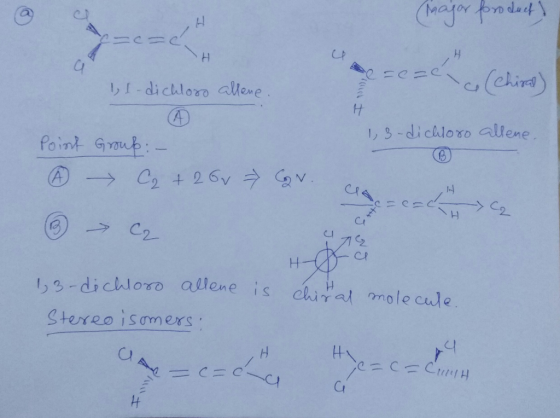
a) Find all the symmetry elements of 1,1-dichloroallene and 1,3-dichloroallene. Please draw the structures of the...
Draw all possible stereoisomers of 1,3-dichlorocyclopentane, and label each structure as A, B etc. a) Label all chira...
Draw all possible stereoisomers of 1,3-dichlorocyclopentane, and label each structure as A, B etc. a) Label all chiral C's, b) write "chiral" by chiral isomers, c) write "meso" if appropriate, and d) Classify the relationship between any two structures, for example A/B enantiomers, or A/B diatereomers, etc.. (For any that are the same, scratch out the duplicate!)
a. Name and draw the 3 symmetry elements (besides the identity) in the molecule 1,1- dichloroethylene....
 a. Name and draw the 3 symmetry elements (besides the identity) in the molecule 1,1- dichloroethylene. b. What is the point group?
Find and list all symmetry elements present in the molecules below, and assign a point group...
 Find and list all symmetry elements present in the molecules
below, and assign a point group to each. Indicate the principal
axis (z axis) on each drawing. Note: Different resonance structures
involving p-bonds do not destroy symmetry elements. You can assume
the highest level of symmetry depicted in the drawings.
We were unable to transcribe this imageENERGIES કોની કોની વનિ તો રોડ શો કરવા દીકરીની વિદEટી /
Find and list all symmetry elements present in the molecules
below, and assign a point group to each. Indicate the principal
axis (z axis) on each drawing. Note: Different resonance structures
involving p-bonds do not destroy symmetry elements. You can assume
the highest level of symmetry depicted in the drawings.
We were unable to transcribe this imageENERGIES કોની કોની વનિ તો રોડ શો કરવા દીકરીની વિદEટી /
please solve them clear & be sure thank you . 1. (21 points) Is the following...
 please solve them clear & be sure thank you .
1. (21 points) Is the following compound a meso-compound? If yes, show it in 3D in the box below using wedged and dashed bonds to indicate the substituent bond direction and draw the internal mirror plane of symmetry (if any). (3 points) HOOC-CHOH-CHOH-COOH Draw the 3D structures of the stereoisomers of the compound above. Use wedged and dashed bonds to indicate the substituent bond direction in each stereoisomer. [Hint: if...
please solve them clear & be sure thank you .
1. (21 points) Is the following compound a meso-compound? If yes, show it in 3D in the box below using wedged and dashed bonds to indicate the substituent bond direction and draw the internal mirror plane of symmetry (if any). (3 points) HOOC-CHOH-CHOH-COOH Draw the 3D structures of the stereoisomers of the compound above. Use wedged and dashed bonds to indicate the substituent bond direction in each stereoisomer. [Hint: if...
For the molecules below, draw all the symmetry elements, and determine the symmetry point group.a) XeF5.b)...
 For the molecules below, draw all the symmetry elements, and determine the symmetry point group.a) XeF5.b) BrF5.c) O-dichlorobenzene.d) cis-dichloroethene.e) trans-dichloroethene.f) furan.g) eclipsed ferrocene.h) staggered ferrocene.
Give the point group (pt. group) for the following, list all symmetry elements (other than E;...
Give the point group (pt. group) for the following, list all symmetry elements (other than E; if there are 2C3’s, for example, in a character table, just write C3), and circle either Y or N to note whether the molecule is chiral (Y) or not chiral (N), and polar (Y) or nonpolar (N). Assume that Me = CH3 groups (e.g., #2, 8, 9) rotate freely, so ignore their H’s.Ph = phenyl, C6H5 3) BBr3 pt. group = ____ symmetry elements:...
Give the point group (pt. group) for the following, list all symmetry elements (other than E;...
Give the point group (pt. group) for the following, list all symmetry elements (other than E; if there are 2C3’s, for example, in a character table, just write C3), and circle either Y or N to note whether the molecule is chiral (Y) or not chiral (N), and polar (Y) or nonpolar (N). Assume that Me = CH3 groups (e.g., #2, 8, 9) rotate freely, so ignore their H’s.Ph = phenyl, C6H5 18) GaBrI2 pt. group = ____ symmetry elements:...
3. Draw skeletal structures for any two trans isomers for a cyclopentane possessing the formula C7H14....
 3. Draw skeletal structures for any two trans isomers for a cyclopentane possessing the formula C7H14. (4 pts) 4. Provide structures for the following molecules based on the given IUPAC nomenclature using "sawhorse" or wedge-based skeletal structures. (8 pts) a. (3R, 4R)-3,4-dimethylhexane b. cis-1,3-di-(1,1-dimethylethyl)cyclohexane
Assign the point groups of the following molecules (you may have to look up their structures). List all symmetry el...
 Assign the point groups of the following molecules (you may have to look up their structures). List all symmetry elements and draw a sketch of each symmetry operation, you may omit repetitive drawings per structure. [10 pts] trans-N2F2 SCIF H30 HCI SOCl2
A. Enantiomers: Certain substances have the unique property of rotating the plane of plane-polarized light. Such...
 A. Enantiomers: Certain substances have the unique property of rotating the plane of plane-polarized light. Such light rotation is detectable with the aid of a polarimeter. In order for a molecule to be optically active it must be chiral. Chiral objects lack a plane of symmetry and are non-superimposable on their mirror images. A sp?- hybridized carbon atom can fulfill these requirements if all four of its substituents are different. 1. Methane a) Prepare a methane molecule and then substitute...
 a. Name and draw the 3 symmetry elements (besides the identity) in the molecule 1,1- dichloroethylene. b. What is the point group?
 Find and list all symmetry elements present in the molecules
below, and assign a point group to each. Indicate the principal
axis (z axis) on each drawing. Note: Different resonance structures
involving p-bonds do not destroy symmetry elements. You can assume
the highest level of symmetry depicted in the drawings.
We were unable to transcribe this imageENERGIES કોની કોની વનિ તો રોડ શો કરવા દીકરીની વિદEટી /
Find and list all symmetry elements present in the molecules
below, and assign a point group to each. Indicate the principal
axis (z axis) on each drawing. Note: Different resonance structures
involving p-bonds do not destroy symmetry elements. You can assume
the highest level of symmetry depicted in the drawings.
We were unable to transcribe this imageENERGIES કોની કોની વનિ તો રોડ શો કરવા દીકરીની વિદEટી /
 please solve them clear & be sure thank you .
1. (21 points) Is the following compound a meso-compound? If yes, show it in 3D in the box below using wedged and dashed bonds to indicate the substituent bond direction and draw the internal mirror plane of symmetry (if any). (3 points) HOOC-CHOH-CHOH-COOH Draw the 3D structures of the stereoisomers of the compound above. Use wedged and dashed bonds to indicate the substituent bond direction in each stereoisomer. [Hint: if...
please solve them clear & be sure thank you .
1. (21 points) Is the following compound a meso-compound? If yes, show it in 3D in the box below using wedged and dashed bonds to indicate the substituent bond direction and draw the internal mirror plane of symmetry (if any). (3 points) HOOC-CHOH-CHOH-COOH Draw the 3D structures of the stereoisomers of the compound above. Use wedged and dashed bonds to indicate the substituent bond direction in each stereoisomer. [Hint: if...
 For the molecules below, draw all the symmetry elements, and determine the symmetry point group.a) XeF5.b) BrF5.c) O-dichlorobenzene.d) cis-dichloroethene.e) trans-dichloroethene.f) furan.g) eclipsed ferrocene.h) staggered ferrocene.
 3. Draw skeletal structures for any two trans isomers for a cyclopentane possessing the formula C7H14. (4 pts) 4. Provide structures for the following molecules based on the given IUPAC nomenclature using "sawhorse" or wedge-based skeletal structures. (8 pts) a. (3R, 4R)-3,4-dimethylhexane b. cis-1,3-di-(1,1-dimethylethyl)cyclohexane
 Assign the point groups of the following molecules (you may have to look up their structures). List all symmetry elements and draw a sketch of each symmetry operation, you may omit repetitive drawings per structure. [10 pts] trans-N2F2 SCIF H30 HCI SOCl2
 A. Enantiomers: Certain substances have the unique property of rotating the plane of plane-polarized light. Such light rotation is detectable with the aid of a polarimeter. In order for a molecule to be optically active it must be chiral. Chiral objects lack a plane of symmetry and are non-superimposable on their mirror images. A sp?- hybridized carbon atom can fulfill these requirements if all four of its substituents are different. 1. Methane a) Prepare a methane molecule and then substitute...
Most questions answered within 3 hours.
-
Where is the error in this code sequence?
String s1 = "Hello";
String s2 = "ello";...
asked 11 months ago -
Financial data for Joel de Paris, Inc., for last year
follow:
Joel de Paris, Inc.
Balance...
asked 11 months ago -
Consider this reaction:
Al2(SO4)3 (aq)+ BaCl3
(aq) Al2Cl6 (aq)- +
3BaSO4(s) . What is the...
asked 11 months ago -
Suppose that Savneet is considering increasing her
recent random sample from 20 car rentals to 40...
asked 11 months ago -
Trucks arrive at an unloading terminal at an average rate of 120
per hour.
Trucks arrive...
asked 11 months ago -
Why are methanol and ethanol completely soluble in water while
octanol is not very little soluble....
asked 11 months ago -
A facilities manager at a university reads in a research report
that the mean amount of...
asked 11 months ago -
When the CuSO4 is rehydrated by adding water to the anhydrous
compound, is this an endothermic...
asked 11 months ago -
A ray of sunlight is passing from diamond into crown glass; the
angle of incidence is...
asked 11 months ago -
A block of mass 0.249 kg is placed on top of a light, vertical
spring of...
asked 11 months ago -
how do the kidneys compensate in the presences of acidosis
a) trigger hyperventilate
b) reserve acid...
asked 11 months ago -
Question 501 pts
The rental rate of capital to the firm increases. Which of the
following...
asked 11 months ago