
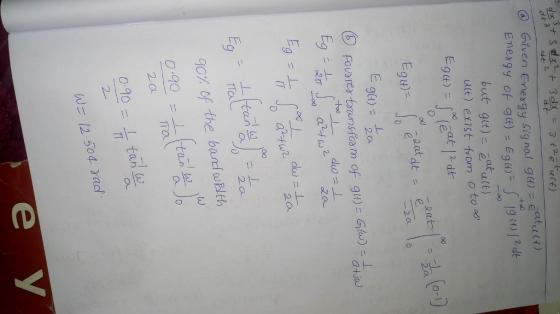
Find the energy of the signal g(t)
Find the bandwidth (W) if 90% of the energy is contained in frequencies below W
Homework Answers
Add Answer to:
Find the energy of the signal g(t)
Find the bandwidth (W) if 90% of the energy...
Please answer in details For the signal 2a 6. g(t) t2 + a? Determine the essential...
 Please answer in details
For the signal 2a 6. g(t) t2 + a? Determine the essential bandwidth B Hz of g(t) such that the energy contained in the spectra component of g(t) of frequencies below B Hz is 99% of the signal energy Eg, Hint: Determine G) by applying the duality property to pair 3 of the Fourier Transforms' Table.
Please answer in details
For the signal 2a 6. g(t) t2 + a? Determine the essential bandwidth B Hz of g(t) such that the energy contained in the spectra component of g(t) of frequencies below B Hz is 99% of the signal energy Eg, Hint: Determine G) by applying the duality property to pair 3 of the Fourier Transforms' Table.
2.51 (a) The root mean-square (rms) bandwidth of a low-pass signal g(t) of finite energy is...
 2.51 (a) The root mean-square (rms) bandwidth of a low-pass signal g(t) of finite energy is defined by 0O 1/2 rms where G()2 is the energy spectral density of the signal. Correspondingly, the root mean- square (rms) duration of the signal is defined by rms- &(t) dt Using these definitions, show that Assume that Ig(t)| → 0 faster than 1 / Vlt! as lt-oo (b) Consider a Gaussian pulse defined by g(t) exp(-I2) Show that, for this signal, the equality...
10 pts Question 3 A signal has a single-sided bandwidth of W - 90 kHz. If...
 10 pts Question 3 A signal has a single-sided bandwidth of W - 90 kHz. If this signal is sampled at the Nyquist rate ( fs - 2W samples/sec) and PAM encoded what is the minimum required bandwidth needed for a channel to transmit this signal?
4. (25 pt) Given a signal, g(t) 10eStu(t) (a) Find the Fourier transform of the signal,...
 4. (25 pt) Given a signal, g(t) 10eStu(t) (a) Find the Fourier transform of the signal, G(). (b) What is the Energy Spectral Density (ESD) of the signal, e().Plot the variation of ESD with frequency using the frequency range of [-3,3]. (c) Determine the signal energy Eg of the signal using Parseval's Theorem.
there is no img... Que 3 A bandpass signal g(t) of bandwidth B Hz centered at...
 there is no img...
Que 3 A bandpass signal g(t) of bandwidth B Hz centered at f 104 Hz is passed through the RC filter in Example 3.16 (Fig. 3.26a) with RC = 10-3. If over the passband, the variation of less than 2% in amplitude response and less than 1 % in time delay is considered to be distortionless transmission, determine what is the maximum allowable value of bandwidth B in order for g(t) to be transmitted through this...
there is no img...
Que 3 A bandpass signal g(t) of bandwidth B Hz centered at f 104 Hz is passed through the RC filter in Example 3.16 (Fig. 3.26a) with RC = 10-3. If over the passband, the variation of less than 2% in amplitude response and less than 1 % in time delay is considered to be distortionless transmission, determine what is the maximum allowable value of bandwidth B in order for g(t) to be transmitted through this...
Given a signal g(t) = 20 cos(140πt): a. Calculate the signal bandwidth. b. Can the Signal...
Given a signal g(t) = 20 cos(140πt): a. Calculate the signal bandwidth. b. Can the Signal be recovered if sampled at a rate (fs) of 200 samples per second? Justify your answer mathematically. c. With fs = 200 samples per sec and quantization levels (L) = 8, calculate the first 3 samples, first 3 quantized samples, and the binary codes of the first 3 samples. Assume sampling starts at t=0 and natural binary code is used.
4- Find the auto-correlation function of the signal g(t) = e-at u(t). From this determine the...
 4- Find the auto-correlation function of the signal g(t) = e-at
u(t). From this determine the energy
spectrum density of g(t).
4 Find the auto-correlation function of the signal g(t) = e-at u(t). From this determine the energy spectrum density of g(t).
4- Find the auto-correlation function of the signal g(t) = e-at
u(t). From this determine the energy
spectrum density of g(t).
4 Find the auto-correlation function of the signal g(t) = e-at u(t). From this determine the energy spectrum density of g(t).
Consider the signal x(t)=sinc(2000t) a. Find X(w), which is the fourier transform of x(t). b. Find...
Consider the signal x(t)=sinc(2000t) a. Find X(w), which is the fourier transform of x(t). b. Find |X(w)|, which is the magnitude of X(w). c. sketch |X(w)| versus w. d. which frequencies ( in Hz) are present in x(t)?
Suppose that € m(t) = 5cos3000πt is the message signal to be frequency-modulated. a) Calculate the bandwidth of the modulated signal, if the modulation is NBFM. b) For WBFM with bandwidth € BFM ≈ 2Δf...
Suppose that € m(t) = 5cos3000πt is the message signal to be frequency-modulated. a) Calculate the bandwidth of the modulated signal, if the modulation is NBFM. b) For WBFM with bandwidth € BFM ≈ 2Δf , find the smallest value of € kf . (Let > mean “at least ten times” smaller and greater, respectively). c) For the value of € kf found in (b), what is the bandwidth of the modulated signal?
Given a message signal m(t) with a bandwidth of 4kHz and a Power of 1W, find the post-detection S...
Given a message signal m(t) with a bandwidth of 4kHz and a Power of 1W, find the post-detection SNR (Signal-to-noise Ratio) in [dB], of the Amplitude Modulated Signal: s(t) = 10*(1+0.5*m(t))cos(
 Please answer in details
For the signal 2a 6. g(t) t2 + a? Determine the essential bandwidth B Hz of g(t) such that the energy contained in the spectra component of g(t) of frequencies below B Hz is 99% of the signal energy Eg, Hint: Determine G) by applying the duality property to pair 3 of the Fourier Transforms' Table.
Please answer in details
For the signal 2a 6. g(t) t2 + a? Determine the essential bandwidth B Hz of g(t) such that the energy contained in the spectra component of g(t) of frequencies below B Hz is 99% of the signal energy Eg, Hint: Determine G) by applying the duality property to pair 3 of the Fourier Transforms' Table.
 2.51 (a) The root mean-square (rms) bandwidth of a low-pass signal g(t) of finite energy is defined by 0O 1/2 rms where G()2 is the energy spectral density of the signal. Correspondingly, the root mean- square (rms) duration of the signal is defined by rms- &(t) dt Using these definitions, show that Assume that Ig(t)| → 0 faster than 1 / Vlt! as lt-oo (b) Consider a Gaussian pulse defined by g(t) exp(-I2) Show that, for this signal, the equality...
 10 pts Question 3 A signal has a single-sided bandwidth of W - 90 kHz. If this signal is sampled at the Nyquist rate ( fs - 2W samples/sec) and PAM encoded what is the minimum required bandwidth needed for a channel to transmit this signal?
 4. (25 pt) Given a signal, g(t) 10eStu(t) (a) Find the Fourier transform of the signal, G(). (b) What is the Energy Spectral Density (ESD) of the signal, e().Plot the variation of ESD with frequency using the frequency range of [-3,3]. (c) Determine the signal energy Eg of the signal using Parseval's Theorem.
 there is no img...
Que 3 A bandpass signal g(t) of bandwidth B Hz centered at f 104 Hz is passed through the RC filter in Example 3.16 (Fig. 3.26a) with RC = 10-3. If over the passband, the variation of less than 2% in amplitude response and less than 1 % in time delay is considered to be distortionless transmission, determine what is the maximum allowable value of bandwidth B in order for g(t) to be transmitted through this...
there is no img...
Que 3 A bandpass signal g(t) of bandwidth B Hz centered at f 104 Hz is passed through the RC filter in Example 3.16 (Fig. 3.26a) with RC = 10-3. If over the passband, the variation of less than 2% in amplitude response and less than 1 % in time delay is considered to be distortionless transmission, determine what is the maximum allowable value of bandwidth B in order for g(t) to be transmitted through this...
 4- Find the auto-correlation function of the signal g(t) = e-at
u(t). From this determine the energy
spectrum density of g(t).
4 Find the auto-correlation function of the signal g(t) = e-at u(t). From this determine the energy spectrum density of g(t).
4- Find the auto-correlation function of the signal g(t) = e-at
u(t). From this determine the energy
spectrum density of g(t).
4 Find the auto-correlation function of the signal g(t) = e-at u(t). From this determine the energy spectrum density of g(t).
Most questions answered within 3 hours.
-
Where is the error in this code sequence?
String s1 = "Hello";
String s2 = "ello";...
asked 11 months ago -
Financial data for Joel de Paris, Inc., for last year
follow:
Joel de Paris, Inc.
Balance...
asked 11 months ago -
Consider this reaction:
Al2(SO4)3 (aq)+ BaCl3
(aq) Al2Cl6 (aq)- +
3BaSO4(s) . What is the...
asked 11 months ago -
Suppose that Savneet is considering increasing her
recent random sample from 20 car rentals to 40...
asked 11 months ago -
Trucks arrive at an unloading terminal at an average rate of 120
per hour.
Trucks arrive...
asked 11 months ago -
Why are methanol and ethanol completely soluble in water while
octanol is not very little soluble....
asked 11 months ago -
A facilities manager at a university reads in a research report
that the mean amount of...
asked 11 months ago -
When the CuSO4 is rehydrated by adding water to the anhydrous
compound, is this an endothermic...
asked 11 months ago -
A ray of sunlight is passing from diamond into crown glass; the
angle of incidence is...
asked 11 months ago -
A block of mass 0.249 kg is placed on top of a light, vertical
spring of...
asked 11 months ago -
how do the kidneys compensate in the presences of acidosis
a) trigger hyperventilate
b) reserve acid...
asked 11 months ago -
Question 501 pts
The rental rate of capital to the firm increases. Which of the
following...
asked 11 months ago