An architect is designing placement of an 1 m by 2 m window on a 12 m wide south-facing wall of a building. The prevalent wind direction in winter in this area is East-West. One design criteria of window placement is to minimize the heat loss through the window during winter. For this reason, the architect is already using a double-paned window. After satisfying several other design criteria, the architect realizes that she can either place the window on the Eastern edge of the wall or at the center as shown in Fig. 1. As per design, the heating system of the building can maintain a temperature of 8 ?C on the outer surface of the window. From the meteorological data, the architect finds out that average wind speed during peak winter months is 4.2 m/s and average wind temperature is ?7.7 ?C. Assume the outside surface of the window is perfectly flushed with wall surface and the interface does not affect the flow in any way. Assume the wind flow to be laminar before it encounters the wall. Neglect radiation.
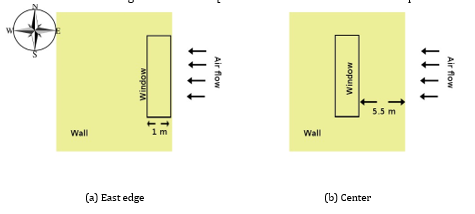
(a) Assuming in the winter most of the time wind flows from East to West, decide where (out of the two configurations) should the architect place the window? (16 pt)
(b) With as little calculation as possible, make a reasonable guess and if the choice of placement of the window will still be the correct one if the prevalent wind direction were from West to East? (4 pt)
Homework Answers
Answer for a) According to given condition, Winter most of the time and wind flows from east west so location of window at eastern edge is prior option to center.Because in window placing orientation and local climatic conditions plays important role.
- This configuration allows morning sun in winter.
- This orientation maximises late afternoon solar gains.
- It excludes south-facing windows and minimises exposure to westerly winds
- This configurationallows reasonable breeze access.
- This configuration is also useful in warmer climates where cooling breezes are from the south-east.
- Slightly increased overhangs for north eaves reduce solar gains in spring and autumn in these climates, and breeze filtering plantings to the east provide shade from morning sun.
- Center configuration uses low emissivity reflective insulation to reduce daytime heat gains
- Center configuration allowing conduction
- Center iconfiguration convection to allow upward flow of heat at night.
- Center configuration only useful in climates with low or no heating needs.
- Avoid full length windows as the lower part of the window will invariably be in permanent shade raise the sill height to avoid heat loss through wasted areas’.
- Avoid use high level windows and vents to create convection currents for cooling
- Use insulation, draught proofing and window protection to improve the thermal performance.
Answer for b) No, it is correct because the keys to good wind ventilation design are the building orientation and massing, as well as sizing and placing openings appropriately for the climate. In order to maximize wind ventilation, you’ll want the pressure difference between the windward (inlet) and leeward (outlet) to be maximized. In almost all cases, high pressures occur on the windward side of a building and low pressures occur on the leeward side.If air moves through openings that are not intentional as a result of wind ventilation, then the building has infiltration, or unwanted ventilation (air leaking in). This can be properly understand by Bernoulli's Equation for fluid flow.
Add Answer to:
An architect is designing placement of an 1 m by 2 m window on a
12...
Wind is blowing at 5 km/h over a building wall of size 5 mx10 m. Air temperature is 0°C and wall 1) surface is at 1...
 Wind is blowing at 5 km/h over a building wall of size 5 mx10 m. Air temperature is 0°C and wall 1) surface is at 10°C. 1) Calculate the avg. heat transfer coefficient along the 10 m width of the wall. 2) Calculate the local heat transfer coefficient at a location 10 cm from the leading edge of the wall. (25pts)
Wind is blowing at 5 km/h over a building wall of size 5 mx10 m. Air temperature is 0°C...
Wind is blowing at 5 km/h over a building wall of size 5 mx10 m. Air temperature is 0°C and wall 1) surface is at 10°C. 1) Calculate the avg. heat transfer coefficient along the 10 m width of the wall. 2) Calculate the local heat transfer coefficient at a location 10 cm from the leading edge of the wall. (25pts)
Wind is blowing at 5 km/h over a building wall of size 5 mx10 m. Air temperature is 0°C...
Problem 1: Atmospheric air at 25°C flows over both surfaces of 2 m long flat plate...
 Problem 1: Atmospheric air at 25°C flows over both surfaces of 2 m long flat plate maintained at 125°C. For upper surface, velocity of air is 1 m/s and for lower surface, velocity is 10 m/s. (Rex,c = 5x10⁵) (a) Determine the flow condition for upper and lower surfaces. (Laminar, or turbulent). If the condition is that laminar to turbulent is taking place, calculate the position where transition from the laminar to turbulent happens. (b) Determine the rate of heat...
Question 1: Identify the classification of the following heat transfer (convective flow) problems: *Note that there...
 Question 1: Identify the classification of the following heat transfer (convective flow) problems: *Note that there may be other modes of heat transfer present (e.g. radiation or conduction), but ignore those effects. For example, a hot ball bearing being dropped from a building roof. Ans. Forced, external convection over a sphere. a. Water flow through a fire hose from a hydrant. b. Heat transfer from a clothes iron sitting on an ironing board. c. Heat transfer from a climber trapped...
summarizr the followung info and write them in your own words and break them into different...
summarizr the followung info and write them in your own words and break them into different key points. 6.5 Metering Chamber: 6.5.1 The minimum size of the metering box is governed by the metering area required to obtain a representative test area for the specimen (see 7.2) and for maintenance of reasonable test accuracy. For example, for specimens incorporating air spaces or stud spaces, the metering area shall span an integral number of spaces (see 5.5). The depth of...
summatize the following info and break them into differeng key points. write them in yojr own...
 summatize the following info and break them into differeng key points. write them in yojr own words
apartus
6.1 Introduction—The design of a successful hot box appa- ratus is influenced by many factors. Before beginning the design of an apparatus meeting this standard, the designer shall review the discussion on the limitations and accuracy, Section 13, discussions of the energy flows in a hot box, Annex A2, the metering box wall loss flow, Annex A3, and flanking loss, Annex...
summatize the following info and break them into differeng key points. write them in yojr own words
apartus
6.1 Introduction—The design of a successful hot box appa- ratus is influenced by many factors. Before beginning the design of an apparatus meeting this standard, the designer shall review the discussion on the limitations and accuracy, Section 13, discussions of the energy flows in a hot box, Annex A2, the metering box wall loss flow, Annex A3, and flanking loss, Annex...
please Identify the key points and main thesis of the article 2. Describe the skills you...
 please Identify the key points and main thesis of the
article
2. Describe the skills you will need to develop to manage the
hospital of the future.
use critical analysis doing these questions
Suggestion for writing assignmemnt make believe the reader has
never read the article -what are the key points you would want the
reader to know in order to understand the hospital of the future.
In addition, managers, executives do not have time to read--so
again what key...
please Identify the key points and main thesis of the
article
2. Describe the skills you will need to develop to manage the
hospital of the future.
use critical analysis doing these questions
Suggestion for writing assignmemnt make believe the reader has
never read the article -what are the key points you would want the
reader to know in order to understand the hospital of the future.
In addition, managers, executives do not have time to read--so
again what key...
10. Write a one-page summary of the attached paper? INTRODUCTION Many problems can develop in activated...
10. Write a one-page summary of the attached paper? INTRODUCTION Many problems can develop in activated sludge operation that adversely affect effluent quality with origins in the engineering, hydraulic and microbiological components of the process. The real "heart" of the activated sludge system is the development and maintenance of a mixed microbial culture (activated sludge) that treats wastewater and which can be managed. One definition of a wastewater treatment plant operator is a "bug farmer", one who controls the aeration...
 Wind is blowing at 5 km/h over a building wall of size 5 mx10 m. Air temperature is 0°C and wall 1) surface is at 10°C. 1) Calculate the avg. heat transfer coefficient along the 10 m width of the wall. 2) Calculate the local heat transfer coefficient at a location 10 cm from the leading edge of the wall. (25pts)
Wind is blowing at 5 km/h over a building wall of size 5 mx10 m. Air temperature is 0°C...
Wind is blowing at 5 km/h over a building wall of size 5 mx10 m. Air temperature is 0°C and wall 1) surface is at 10°C. 1) Calculate the avg. heat transfer coefficient along the 10 m width of the wall. 2) Calculate the local heat transfer coefficient at a location 10 cm from the leading edge of the wall. (25pts)
Wind is blowing at 5 km/h over a building wall of size 5 mx10 m. Air temperature is 0°C...
 Problem 1: Atmospheric air at 25°C flows over both surfaces of 2 m long flat plate maintained at 125°C. For upper surface, velocity of air is 1 m/s and for lower surface, velocity is 10 m/s. (Rex,c = 5x10⁵) (a) Determine the flow condition for upper and lower surfaces. (Laminar, or turbulent). If the condition is that laminar to turbulent is taking place, calculate the position where transition from the laminar to turbulent happens. (b) Determine the rate of heat...
 Question 1: Identify the classification of the following heat transfer (convective flow) problems: *Note that there may be other modes of heat transfer present (e.g. radiation or conduction), but ignore those effects. For example, a hot ball bearing being dropped from a building roof. Ans. Forced, external convection over a sphere. a. Water flow through a fire hose from a hydrant. b. Heat transfer from a clothes iron sitting on an ironing board. c. Heat transfer from a climber trapped...
 summatize the following info and break them into differeng key points. write them in yojr own words
apartus
6.1 Introduction—The design of a successful hot box appa- ratus is influenced by many factors. Before beginning the design of an apparatus meeting this standard, the designer shall review the discussion on the limitations and accuracy, Section 13, discussions of the energy flows in a hot box, Annex A2, the metering box wall loss flow, Annex A3, and flanking loss, Annex...
summatize the following info and break them into differeng key points. write them in yojr own words
apartus
6.1 Introduction—The design of a successful hot box appa- ratus is influenced by many factors. Before beginning the design of an apparatus meeting this standard, the designer shall review the discussion on the limitations and accuracy, Section 13, discussions of the energy flows in a hot box, Annex A2, the metering box wall loss flow, Annex A3, and flanking loss, Annex...
 please Identify the key points and main thesis of the
article
2. Describe the skills you will need to develop to manage the
hospital of the future.
use critical analysis doing these questions
Suggestion for writing assignmemnt make believe the reader has
never read the article -what are the key points you would want the
reader to know in order to understand the hospital of the future.
In addition, managers, executives do not have time to read--so
again what key...
please Identify the key points and main thesis of the
article
2. Describe the skills you will need to develop to manage the
hospital of the future.
use critical analysis doing these questions
Suggestion for writing assignmemnt make believe the reader has
never read the article -what are the key points you would want the
reader to know in order to understand the hospital of the future.
In addition, managers, executives do not have time to read--so
again what key...
Most questions answered within 3 hours.
-
Where is the error in this code sequence?
String s1 = "Hello";
String s2 = "ello";...
asked 11 months ago -
Financial data for Joel de Paris, Inc., for last year
follow:
Joel de Paris, Inc.
Balance...
asked 11 months ago -
Consider this reaction:
Al2(SO4)3 (aq)+ BaCl3
(aq) Al2Cl6 (aq)- +
3BaSO4(s) . What is the...
asked 11 months ago -
Suppose that Savneet is considering increasing her
recent random sample from 20 car rentals to 40...
asked 11 months ago -
Trucks arrive at an unloading terminal at an average rate of 120
per hour.
Trucks arrive...
asked 11 months ago -
Why are methanol and ethanol completely soluble in water while
octanol is not very little soluble....
asked 11 months ago -
A facilities manager at a university reads in a research report
that the mean amount of...
asked 11 months ago -
When the CuSO4 is rehydrated by adding water to the anhydrous
compound, is this an endothermic...
asked 11 months ago -
A ray of sunlight is passing from diamond into crown glass; the
angle of incidence is...
asked 11 months ago -
A block of mass 0.249 kg is placed on top of a light, vertical
spring of...
asked 11 months ago -
how do the kidneys compensate in the presences of acidosis
a) trigger hyperventilate
b) reserve acid...
asked 11 months ago -
Question 501 pts
The rental rate of capital to the firm increases. Which of the
following...
asked 11 months ago