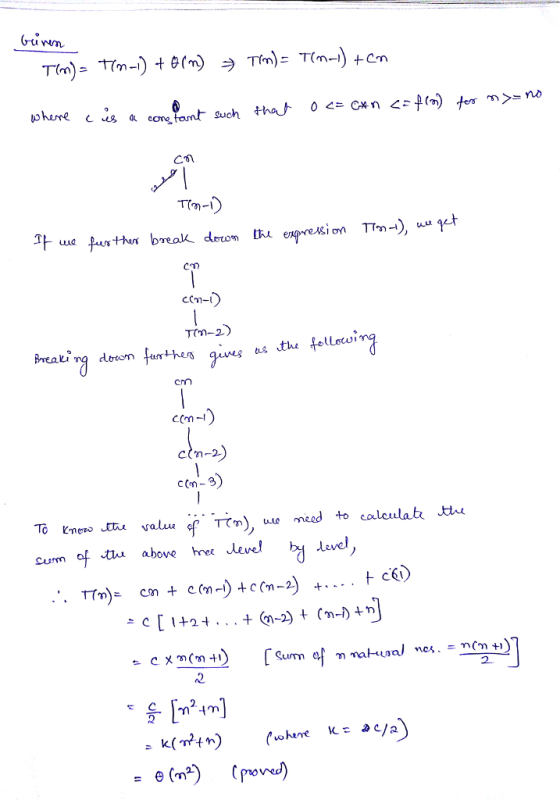
Use recursion tree method to prove that is . Note that the theta symbol is is big...
Use recursion tree method to prove that  is
is  .
.
Note that the theta symbol is is big theta. Please make sure all steps are there and they are easy to read.
Homework Answers
Add Answer to:
Use recursion tree method to prove that
is .
Note that the theta symbol is is big...
Show the recursion tree for T(n) = 4T(n/4) + c and derive the solution using big-Theta...
Show the recursion tree for T(n) = 4T(n/4) + c and derive the solution using big-Theta notation. Explain the intuition why this result is different from the solution of T(n) = 4T(n/2) + c.
Use the properties of Big - Oh, Big - Omega, and Big - Theta to prove...
 Use the properties of Big - Oh, Big - Omega, and Big - Theta to prove that if f (n) = theta (3 Squareroot n) and g (n) = Ohm (f (n) + 7 f (n)^2 + 49 Squareroot n), then g (n)^3 = Ohm (n^2). You may use the fact that n^a = 0 (n^b) if and only if a lessthanorequalto b, where a and b are constants.
For the following problems please use the recursion tree method to determine the asymptotic bound for...
For the following problems please use the recursion tree method to determine the asymptotic bound for each recursion. T(n) = T(n-1) + log n T(n) = T(n-2) + n3
(a) Use the recursion tree method to guess tight 5 asymptotic bounds for the recurrence T(n)-4T(n/2)+n....
 (a) Use the recursion tree method to guess tight 5 asymptotic bounds for the recurrence T(n)-4T(n/2)+n. Use substitution method to prove it.
Part 3 - Big-Theta 15pts For the following problem, give and prove the Big-Oh, Big-Omega, and...
Part 3 - Big-Theta 15pts For the following problem, give and prove the Big-Oh, Big-Omega, and thus the Big-Theta of the function. Provide a graph for both the Big-Oh and Big-Omega inequalities with the constants you chose. You may use wolframalpha.com or any other graphing site to achieve this. Show that f(n)= 18n+4 is in Θ(n). Explain your analysis.
Recursion Tree Goal: Predict the output of a recursive method call using a recursion tree. Draw...
Recursion Tree Goal: Predict the output of a recursive method call using a recursion tree. Draw the recursion tree of the following source code, showing all method calls and outputs: public class Main { public static void main(String[] args) { f(3, 4); } public static void f(int x, int y) { if(x + y > 1) { f(x - 2, y - 1); System.out.print(x + " "); f(y, x - 2); System.out.print(2 * x + y + " "); }...
Formal Definitions of Big-Oh, Big-Theta and Big-Omega: 1. Use the formal definition of Big-Oh to prove that if f(n) is...
 Formal Definitions of Big-Oh, Big-Theta and Big-Omega:
1. Use the formal definition of Big-Oh to prove that if f(n) is a decreasing function, then f(n) = 0(1). A decreasing function is one in which f(x1) f(r2) if and only if xi 5 r2. You may assume that f(n) is positive evervwhere Hint: drawing a picture might make the proof for this problem more obvious 2. Use the formal definition of Big-Oh to prove that if f(n) = 0(g(n)) and g(n)...
Formal Definitions of Big-Oh, Big-Theta and Big-Omega:
1. Use the formal definition of Big-Oh to prove that if f(n) is a decreasing function, then f(n) = 0(1). A decreasing function is one in which f(x1) f(r2) if and only if xi 5 r2. You may assume that f(n) is positive evervwhere Hint: drawing a picture might make the proof for this problem more obvious 2. Use the formal definition of Big-Oh to prove that if f(n) = 0(g(n)) and g(n)...
Use the recursion tree method to find a closed form solution to T(n) = 4T(n/4) +...
Use the recursion tree method to find a closed form solution to T(n) = 4T(n/4) + n.
Consider the recurrence T (n) = 3 · T (n/2) + n. Use the recursion tree...
Consider the recurrence T (n) = 3 · T (n/2) + n. Use the recursion tree method to guess an asymptotic upper bound for T (n). Show your work. • Prove the correctness of your guess by induction. Assume that values of n are powers of 2.
(Weight: 3090) Use substitution, summation, or recursion tree method to solve the f ollowi recurrence relations....
 (Weight: 3090) Use substitution, summation, or recursion tree method to solve the f ollowi recurrence relations. (a) T(n) = 2T(n/2) + nign (b) T(n) 2T(n-1)+5" 7(0) = 8
 Use the properties of Big - Oh, Big - Omega, and Big - Theta to prove that if f (n) = theta (3 Squareroot n) and g (n) = Ohm (f (n) + 7 f (n)^2 + 49 Squareroot n), then g (n)^3 = Ohm (n^2). You may use the fact that n^a = 0 (n^b) if and only if a lessthanorequalto b, where a and b are constants.
 (a) Use the recursion tree method to guess tight 5 asymptotic bounds for the recurrence T(n)-4T(n/2)+n. Use substitution method to prove it.
 Formal Definitions of Big-Oh, Big-Theta and Big-Omega:
1. Use the formal definition of Big-Oh to prove that if f(n) is a decreasing function, then f(n) = 0(1). A decreasing function is one in which f(x1) f(r2) if and only if xi 5 r2. You may assume that f(n) is positive evervwhere Hint: drawing a picture might make the proof for this problem more obvious 2. Use the formal definition of Big-Oh to prove that if f(n) = 0(g(n)) and g(n)...
Formal Definitions of Big-Oh, Big-Theta and Big-Omega:
1. Use the formal definition of Big-Oh to prove that if f(n) is a decreasing function, then f(n) = 0(1). A decreasing function is one in which f(x1) f(r2) if and only if xi 5 r2. You may assume that f(n) is positive evervwhere Hint: drawing a picture might make the proof for this problem more obvious 2. Use the formal definition of Big-Oh to prove that if f(n) = 0(g(n)) and g(n)...
 (Weight: 3090) Use substitution, summation, or recursion tree method to solve the f ollowi recurrence relations. (a) T(n) = 2T(n/2) + nign (b) T(n) 2T(n-1)+5" 7(0) = 8
Most questions answered within 3 hours.
-
Where is the error in this code sequence?
String s1 = "Hello";
String s2 = "ello";...
asked 10 months ago -
Financial data for Joel de Paris, Inc., for last year
follow:
Joel de Paris, Inc.
Balance...
asked 10 months ago -
Consider this reaction:
Al2(SO4)3 (aq)+ BaCl3
(aq) Al2Cl6 (aq)- +
3BaSO4(s) . What is the...
asked 10 months ago -
Suppose that Savneet is considering increasing her
recent random sample from 20 car rentals to 40...
asked 10 months ago -
Trucks arrive at an unloading terminal at an average rate of 120
per hour.
Trucks arrive...
asked 10 months ago -
Why are methanol and ethanol completely soluble in water while
octanol is not very little soluble....
asked 10 months ago -
A facilities manager at a university reads in a research report
that the mean amount of...
asked 10 months ago -
When the CuSO4 is rehydrated by adding water to the anhydrous
compound, is this an endothermic...
asked 10 months ago -
A ray of sunlight is passing from diamond into crown glass; the
angle of incidence is...
asked 10 months ago -
A block of mass 0.249 kg is placed on top of a light, vertical
spring of...
asked 10 months ago -
how do the kidneys compensate in the presences of acidosis
a) trigger hyperventilate
b) reserve acid...
asked 10 months ago -
Question 501 pts
The rental rate of capital to the firm increases. Which of the
following...
asked 10 months ago