![Liquid bromine [Br2(1)] is held together by: (Electronegativity: Br 2.8) Dispersion (London) force Hydrogen bond Dipole-dipol](http://img.homeworklib.com/questions/c0146910-f8bd-11eb-aac7-ff0256ba6171.png?x-oss-process=image/resize,w_560)
Homework Answers
Add Answer to:
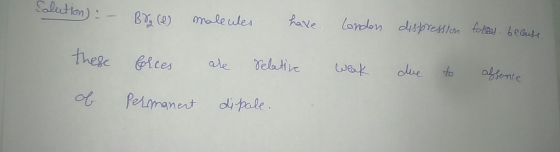
Liquid bromine [Br2(1)] is held together by: (Electronegativity: Br 2.8) Dispersion (London) force Hydrogen bond Dipole-dipole...
Match each of the following: Hydrogen bond London dispersion forces Covalent bond Dipole-dipole interaction Ionic interaction...
Match each of the following: Hydrogen bond London dispersion forces Covalent bond Dipole-dipole interaction Ionic interaction 1. ~20 kJ/mol 2. ~10 kJ/mol 3. ~400 kJ/mol 4. ~80 kJ/mol 5. ~0.4kJ/mol
dentify the predominant intermolecular force in each of these substances. Hydrogen bonding Dipole-dipole Dispersion (London) forces...
 dentify the predominant intermolecular force in each of these substances. Hydrogen bonding Dipole-dipole Dispersion (London) forces Answer Bank CH OH CHECCH) OH CH,COCH about us Careers privacy policy terms of use contact us help
Identify the strongest intermolecular force in the compound KHSO4 O lonic forces Dipole-dipole Hydrogen bonding O...
 Identify the strongest intermolecular force in the compound KHSO4 O lonic forces Dipole-dipole Hydrogen bonding O lon-dipole London dispersion forces Question 23 1.5 pts What intermolecular force or bond is responsible for the density of solid water (ice) being less than that of liquid water? O London dispersion forces Olonic bonding O Covalent bonding O Dipole-dipole forces Hydrogen bonding In which of the following molecules and ions does the central carbon atom or sulfur atom have sp hybridization: Cl,CO, SO32-,...
Given the following intermolecular attractive forces 1. Hydrogen bonding 2 Dipole-Dipole 3 London dispersion 4 Ion-dipole...
Given the following intermolecular attractive forces 1. Hydrogen bonding 2 Dipole-Dipole 3 London dispersion 4 Ion-dipole When sodium chloride dissolves in water what new attractive forces are formed between solute and solvent?
Determine the most important type of interparticle force (i.e., dispersion, dipole, hydrogen bond or ionic) present...
 Determine the most important type of interparticle force (i.e., dispersion, dipole, hydrogen bond or ionic) present in each substance.
1. What types of intermolecular forces (dipole-dipole, London dispersion, and hydrogen bonding) would be expected for...
1. What types of intermolecular forces (dipole-dipole, London dispersion, and hydrogen bonding) would be expected for urea with ethanol, water, hexanes, and 1,2-dimethoxyethane? 2. A sample was isolated that contained both cholesterol and urea. 1,2-dimethoxyethane was added and the solution was heated for 5 minutes. The solution was filtered and the organic layer evaporated. What compound is likely to be isolated from the organic layer? 2a. What compound is likely the solid residue?
options : electrostatic attraction, London dispersion force,disulfide bond, amide bond,hydrogen bond The tertiary structure of a...
 options : electrostatic attraction, London dispersion
force,disulfide bond, amide bond,hydrogen bond
The tertiary structure of a protein is shown below. Identify each of the labeled interactions. Interaction ais (Select] Interaction bis (Select] Interaction cis (Select] Interaction d is (Select] 0- Z-I H-N NH3 6 SS CH3 CHCH2CH3 CH3 CH,CH.CH
options : electrostatic attraction, London dispersion
force,disulfide bond, amide bond,hydrogen bond
The tertiary structure of a protein is shown below. Identify each of the labeled interactions. Interaction ais (Select] Interaction bis (Select] Interaction cis (Select] Interaction d is (Select] 0- Z-I H-N NH3 6 SS CH3 CHCH2CH3 CH3 CH,CH.CH
My answers: Not sure if they are correct. 1. a. London dispersion b. H-bonding, dipole-dipole,...
 My answers: Not sure if they are correct.
1. a. London dispersion
b. H-bonding, dipole-dipole, london dispersion
c. London dispersion
d. Ionic, london disperson
2. The second one because not a lot of H+ and less acidic. Need
help understanding the meaning of the question.
3. Diethyl cannot h-bond because it does not provide intermolecular
bonding engery while 1-b. can form h-bond making strong
intermolecular bonds to take up greater engery to break
molecules.
4. Not sure...
My answers: Not sure if they are correct.
1. a. London dispersion
b. H-bonding, dipole-dipole, london dispersion
c. London dispersion
d. Ionic, london disperson
2. The second one because not a lot of H+ and less acidic. Need
help understanding the meaning of the question.
3. Diethyl cannot h-bond because it does not provide intermolecular
bonding engery while 1-b. can form h-bond making strong
intermolecular bonds to take up greater engery to break
molecules.
4. Not sure...
Identify the strongest intermolecular force in the compound KHSO4. O lonic forces Dipole-dipole Hydrogen bonding lon-dipole...
 Identify the strongest intermolecular force in the compound KHSO4. O lonic forces Dipole-dipole Hydrogen bonding lon-dipole London dispersion forces What intermolecular force or bond is responsible for the density of solid water (ice) being less than that of liquid water? London dispersion forces O lonic bonding Covalent bonding Dipole-dipole forces Hydrogen bonding Which of the following compounds would have the strongest intermolecular attractive forces ? 0 CH3-NH-CH2-CH3 CH3-CH2-CH2-OH O CH3-CH2-O-CH3 O CH3-CH2-CO2H CO2 A 0.258-9 sample of a pure triprotic...
Identify the strongest attractive force present in the pure substances shown: London forces, dipole-dipole, hydrogen bonding,...
Identify the strongest attractive force present in the pure substances shown: London forces, dipole-dipole, hydrogen bonding, ion-dipole, or ionic attractions. 1. CH3OH 2. LiBr 3. CH3F 4. CH3CH2CH3
 dentify the predominant intermolecular force in each of these substances. Hydrogen bonding Dipole-dipole Dispersion (London) forces Answer Bank CH OH CHECCH) OH CH,COCH about us Careers privacy policy terms of use contact us help
 Identify the strongest intermolecular force in the compound KHSO4 O lonic forces Dipole-dipole Hydrogen bonding O lon-dipole London dispersion forces Question 23 1.5 pts What intermolecular force or bond is responsible for the density of solid water (ice) being less than that of liquid water? O London dispersion forces Olonic bonding O Covalent bonding O Dipole-dipole forces Hydrogen bonding In which of the following molecules and ions does the central carbon atom or sulfur atom have sp hybridization: Cl,CO, SO32-,...
 Determine the most important type of interparticle force (i.e., dispersion, dipole, hydrogen bond or ionic) present in each substance.
 options : electrostatic attraction, London dispersion
force,disulfide bond, amide bond,hydrogen bond
The tertiary structure of a protein is shown below. Identify each of the labeled interactions. Interaction ais (Select] Interaction bis (Select] Interaction cis (Select] Interaction d is (Select] 0- Z-I H-N NH3 6 SS CH3 CHCH2CH3 CH3 CH,CH.CH
options : electrostatic attraction, London dispersion
force,disulfide bond, amide bond,hydrogen bond
The tertiary structure of a protein is shown below. Identify each of the labeled interactions. Interaction ais (Select] Interaction bis (Select] Interaction cis (Select] Interaction d is (Select] 0- Z-I H-N NH3 6 SS CH3 CHCH2CH3 CH3 CH,CH.CH
 My answers: Not sure if they are correct.
1. a. London dispersion
b. H-bonding, dipole-dipole, london dispersion
c. London dispersion
d. Ionic, london disperson
2. The second one because not a lot of H+ and less acidic. Need
help understanding the meaning of the question.
3. Diethyl cannot h-bond because it does not provide intermolecular
bonding engery while 1-b. can form h-bond making strong
intermolecular bonds to take up greater engery to break
molecules.
4. Not sure...
My answers: Not sure if they are correct.
1. a. London dispersion
b. H-bonding, dipole-dipole, london dispersion
c. London dispersion
d. Ionic, london disperson
2. The second one because not a lot of H+ and less acidic. Need
help understanding the meaning of the question.
3. Diethyl cannot h-bond because it does not provide intermolecular
bonding engery while 1-b. can form h-bond making strong
intermolecular bonds to take up greater engery to break
molecules.
4. Not sure...
 Identify the strongest intermolecular force in the compound KHSO4. O lonic forces Dipole-dipole Hydrogen bonding lon-dipole London dispersion forces What intermolecular force or bond is responsible for the density of solid water (ice) being less than that of liquid water? London dispersion forces O lonic bonding Covalent bonding Dipole-dipole forces Hydrogen bonding Which of the following compounds would have the strongest intermolecular attractive forces ? 0 CH3-NH-CH2-CH3 CH3-CH2-CH2-OH O CH3-CH2-O-CH3 O CH3-CH2-CO2H CO2 A 0.258-9 sample of a pure triprotic...
Most questions answered within 3 hours.
-
Where is the error in this code sequence?
String s1 = "Hello";
String s2 = "ello";...
asked 10 months ago -
Financial data for Joel de Paris, Inc., for last year
follow:
Joel de Paris, Inc.
Balance...
asked 10 months ago -
Consider this reaction:
Al2(SO4)3 (aq)+ BaCl3
(aq) Al2Cl6 (aq)- +
3BaSO4(s) . What is the...
asked 10 months ago -
Suppose that Savneet is considering increasing her
recent random sample from 20 car rentals to 40...
asked 10 months ago -
Trucks arrive at an unloading terminal at an average rate of 120
per hour.
Trucks arrive...
asked 10 months ago -
Why are methanol and ethanol completely soluble in water while
octanol is not very little soluble....
asked 10 months ago -
A facilities manager at a university reads in a research report
that the mean amount of...
asked 10 months ago -
When the CuSO4 is rehydrated by adding water to the anhydrous
compound, is this an endothermic...
asked 10 months ago -
A ray of sunlight is passing from diamond into crown glass; the
angle of incidence is...
asked 10 months ago -
A block of mass 0.249 kg is placed on top of a light, vertical
spring of...
asked 10 months ago -
how do the kidneys compensate in the presences of acidosis
a) trigger hyperventilate
b) reserve acid...
asked 10 months ago -
Question 501 pts
The rental rate of capital to the firm increases. Which of the
following...
asked 10 months ago