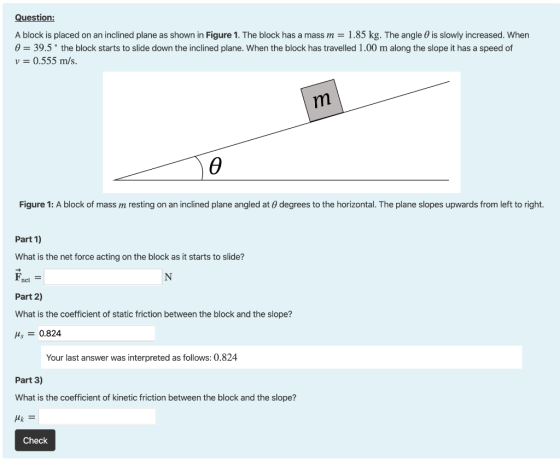
Need help with the first and third question. Thanks
Homework Answers
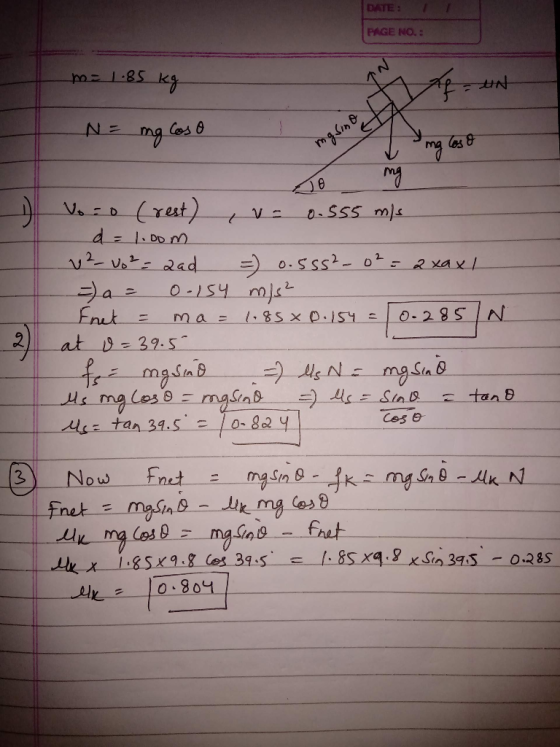
Add Answer to:
Need help with the first and third question. Thanks
Question: A block is placed on an...
I need help with this question 5, A block with mass 2.00 kg slides 0.750 m...
 I need help with this question
5, A block with mass 2.00 kg slides 0.750 m down an inclined plane that slopes downward at an angle θ = 370 below the horizontal. block. b) If the kinetic friction coefficient H.-075, what is the acceleration of the block? a) lIf the block starts from rest, what is its final speed? Assume no friction acts on the
I need help with this question
5, A block with mass 2.00 kg slides 0.750 m down an inclined plane that slopes downward at an angle θ = 370 below the horizontal. block. b) If the kinetic friction coefficient H.-075, what is the acceleration of the block? a) lIf the block starts from rest, what is its final speed? Assume no friction acts on the
mi 13) A block with mass m = 5.00 kg is placed on an inclined plane...
 mi 13) A block with mass m = 5.00 kg is placed on an inclined plane with slope of a = 30.0° and is connected to a hanging block with mass m2 = 3.00 kg by a cord passing over a small, frictionless pulley as shown in the figure to the right. The coefficient of static friction is 0.333, and the coefficient of kinetic friction is 0.150. What is the magnitude and direction of the friction force on block mı?
A block with mass one 10.0 kg is placed on an inclined plane with slope angle...
A block with mass one 10.0 kg is placed on an inclined plane with slope angle 20.0 degrees and is connected to a second hanging block that has mass two 14.0 kg by a cord passing over a small, frictionless pulley. The coefficient of kinetic friction between the inclined plane and the block is 0.35. What is the ACCELERATION of the block up the incline?
A block of mass m = 1.0 kg is placed at rest at a distance 8.15...
A block of mass m = 1.0 kg is placed at rest at a distance 8.15 m (measured along the slope) from the horizontal plane on an incline whose surface makes θ=25o to the horizontal as shown in Figure 2. The coefficient of kinetic friction between the surface where the block is placed and the block is μk = 0.19. After the block starts descending on the slope, find the block’s speed at the time when it reaches the bottom...
Figure 1: Block on incline. 2, A block of mass m = 5 kg is subject...
 Figure 1: Block on incline. 2, A block of mass m = 5 kg is subject to a force of magnitude 20 N that makes an angle of p20 with the (frictionless) inclined plane of contact. The plane itself is inclined θ = 300 with the horizontal. (a) What is the acceleration of the block along the incline? (b) If the block begins at rest, in what direction will it move subsequently (i.e., up or down the incline)? (c) If...
A block of jello with mass 8.08 kg is resting on an inclined plane. The plane...
A block of jello with mass 8.08 kg is resting on an inclined plane. The plane is inclined to the horizontal by an angle 28.3°. The jello has a coefficient of static friction with respect to the surface of the plane of µs=0.77. What is the magnitude of the static friction force between the jello and the ramp?
A block of ice with mass 2.00 kg slides 1.77 m down an inclined plane that...
 A block of ice with mass 2.00 kg slides 1.77 m down an inclined plane that slopes downward at an angle of 36.9° below the horizontal. Part A If the block of ice starts from rest, what is its final speed? Ignore friction. Express your answer with the appropriate units. v = Value Units Submit Request Answer
A block of ice with mass 2.00 kg slides 0.830 m down an inclined plane that...
A block of ice with mass 2.00 kg slides 0.830 m down an inclined plane that slopes downward at an angle of 31.0 ∘ below the horizontal. If the block of ice starts from rest, what is its final speed? You can ignore friction.
A block of ice with mass 2.00 kg slides 0.63 m down an inclined plane that...
A block of ice with mass 2.00 kg slides 0.63 m down an inclined plane that slopes downward at an angle of 37.8∘ below the horizontal. A) If the block of ice starts from rest, what is its final speed? You can ignore friction.
A block of ice with mass 2.00 kg slides 0.750 m down an inclined plane that...
A block of ice with mass 2.00 kg slides 0.750 m down an inclined plane that slopes downward at an angle of 36.9 degrees below the horizontal. If the block of ice starts from rest, what is its final speed? You can ignore friction.
 I need help with this question
5, A block with mass 2.00 kg slides 0.750 m down an inclined plane that slopes downward at an angle θ = 370 below the horizontal. block. b) If the kinetic friction coefficient H.-075, what is the acceleration of the block? a) lIf the block starts from rest, what is its final speed? Assume no friction acts on the
I need help with this question
5, A block with mass 2.00 kg slides 0.750 m down an inclined plane that slopes downward at an angle θ = 370 below the horizontal. block. b) If the kinetic friction coefficient H.-075, what is the acceleration of the block? a) lIf the block starts from rest, what is its final speed? Assume no friction acts on the
 mi 13) A block with mass m = 5.00 kg is placed on an inclined plane with slope of a = 30.0° and is connected to a hanging block with mass m2 = 3.00 kg by a cord passing over a small, frictionless pulley as shown in the figure to the right. The coefficient of static friction is 0.333, and the coefficient of kinetic friction is 0.150. What is the magnitude and direction of the friction force on block mı?
 Figure 1: Block on incline. 2, A block of mass m = 5 kg is subject to a force of magnitude 20 N that makes an angle of p20 with the (frictionless) inclined plane of contact. The plane itself is inclined θ = 300 with the horizontal. (a) What is the acceleration of the block along the incline? (b) If the block begins at rest, in what direction will it move subsequently (i.e., up or down the incline)? (c) If...
 A block of ice with mass 2.00 kg slides 1.77 m down an inclined plane that slopes downward at an angle of 36.9° below the horizontal. Part A If the block of ice starts from rest, what is its final speed? Ignore friction. Express your answer with the appropriate units. v = Value Units Submit Request Answer
Most questions answered within 3 hours.
-
Where is the error in this code sequence?
String s1 = "Hello";
String s2 = "ello";...
asked 10 months ago -
Financial data for Joel de Paris, Inc., for last year
follow:
Joel de Paris, Inc.
Balance...
asked 10 months ago -
Consider this reaction:
Al2(SO4)3 (aq)+ BaCl3
(aq) Al2Cl6 (aq)- +
3BaSO4(s) . What is the...
asked 10 months ago -
Suppose that Savneet is considering increasing her
recent random sample from 20 car rentals to 40...
asked 10 months ago -
Trucks arrive at an unloading terminal at an average rate of 120
per hour.
Trucks arrive...
asked 10 months ago -
Why are methanol and ethanol completely soluble in water while
octanol is not very little soluble....
asked 10 months ago -
A facilities manager at a university reads in a research report
that the mean amount of...
asked 10 months ago -
When the CuSO4 is rehydrated by adding water to the anhydrous
compound, is this an endothermic...
asked 10 months ago -
A ray of sunlight is passing from diamond into crown glass; the
angle of incidence is...
asked 10 months ago -
A block of mass 0.249 kg is placed on top of a light, vertical
spring of...
asked 10 months ago -
how do the kidneys compensate in the presences of acidosis
a) trigger hyperventilate
b) reserve acid...
asked 10 months ago -
Question 501 pts
The rental rate of capital to the firm increases. Which of the
following...
asked 10 months ago