A block of mass m = 1.0 kg is placed at rest at a distance 8.15...
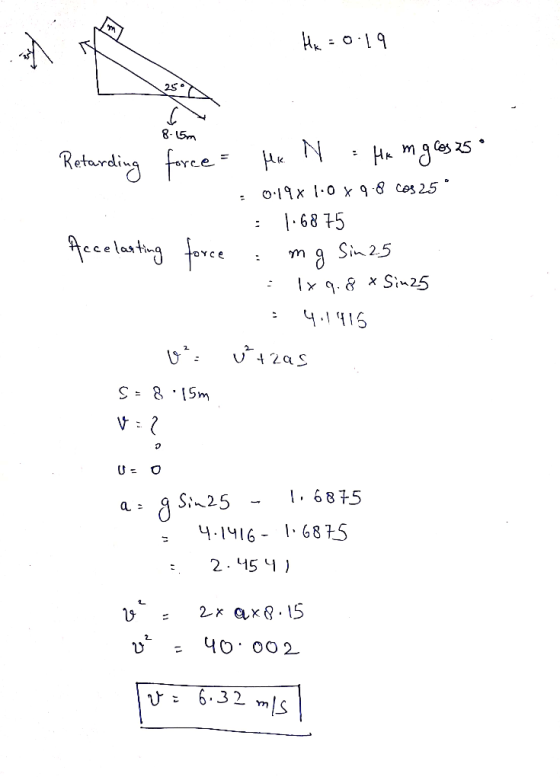
A block of mass m = 1.0 kg is placed at rest at a distance 8.15 m (measured along the slope) from the horizontal plane on an incline whose surface makes θ=25o to the horizontal as shown in Figure 2. The coefficient of kinetic friction between the surface where the block is placed and the block is μk = 0.19. After the block starts descending on the slope, find the block’s speed at the time when it reaches the bottom of the incline in m/s2. 0
Homework Answers
A 1 kg block in the figure above begins at rest at the top of a...
A 1 kg block in the figure above begins at rest at the top of a slope. a. Assuming no friction, derive an expression for the speed of the block at the end of the slope if h = 0.4m and g = 9.8 m/s2. b. If θ = 30◦, calculate the horizontal component of the velocity when the block is at the bottom end of the slope. c. If θ = 30◦, calculate the vertical component of the velocity...
A block of mass M = 4.000 kg is released from rest at the top of...
A block of mass M = 4.000 kg is released from rest at the top of an incline of angle θ = 24.0º w.r.t. the horizontal. The coefficient of kinetic friction between the block and the incline is µk = 0.200 and the length of the incline (hypothenuse of the triangle shown below) is L = 6.00 m. ( w.r.t. = with respect to) I am trying to find: a. The work done by the normal force for the complete...
A mass m = 15 kg is pulled along a horizontal floor with NOfriction for...
A mass m = 15 kg is pulled along a horizontal floor with NO friction for a distance d =7.1 m. Then the mass is pulled up an incline that makes an angle θ = 30° with the horizontal and has a coefficient of kinetic friction μk = 0.38. The entire time the massless rope used to pull the block is pulled parallel to the incline at an angle of θ = 30° (thus on the incline it is parallel...
A block of mass m = 3.5 kg is attached to a spring with spring constant k = 780 N/m
 A block of mass m = 3.5 kg is attached to a spring with spring constant k = 780 N/m. It is initially at rest on an inclined plane that is at an angle of θ = 28° with respect to the horizontal, and the coefficient of kinetic friction between the block and the plane is μk = 0.19. In the initial position, where the spring is compressed by a distance of d = 0.19 m, the mass is at...
A block of mass m = 3.5 kg is attached to a spring with spring constant...
A block of mass m = 3.5 kg is attached to a spring with spring constant k = 990 N/m. It is initially at rest on an inclined plane that is at an angle of θ = 22° with respect to the horizontal, and the coefficient of kinetic friction between the block and the plane is μk = 0.12. In the initial position, where the spring is compressed by a distance of d = 0.19 m, the mass is at...
A mass m = 16 kg is pulled along a horizontal floor with NO friction for...
A mass m = 16 kg is pulled along a horizontal floor with NO friction for a distance d =7.5 m. Then the mass is pulled up an incline that makes an angle θ = 33° with the horizontal and has a coefficient of kinetic friction μk = 0.41. The entire time the massless rope used to pull the block is pulled parallel to the incline at an angle of θ = 33° (thus on the incline it is parallel...
A wooden block with mass 1.50 kg is placed against a compressed spring at the bottom...
A wooden block with mass 1.50 kg is placed against a compressed spring at the bottom of a slope inclined at an angle of 29.0 ∘ (point A). When the spring is released, it projects the block up the incline. At point B, a distance of 7.15 m up the incline from A, the block is moving up the incline at a speed of 7.50 m/s and is no longer in contact with the spring. The coefficient of kinetic friction...
a block of mass 10 kg is initially at rest when it slides down a frictionless...
a block of mass 10 kg is initially at rest when it slides down a frictionless incline whose height is 10 m and is pitched at an angle of 30 degrees. At the bottom of the incline the mass encounters a horizontal surface that has a coefficient of kinetic friction of 0.4 with the mass. How far from the bottom of the incline will the mass come to a stop?
A mass m = 12 kg is pulled along a horizontal floor with NO friction for...
 A mass m = 12 kg is pulled along a horizontal floor with NO
friction for a distance d =6.5 m. Then the mass is pulled up an
incline that makes an angle θ = 25° with the horizontal and has a
coefficient of kinetic friction μk = 0.44. The entire
time the massless rope used to pull the block is pulled parallel to
the incline at an angle of θ = 25° (thus on the incline it is
parallel...
A mass m = 12 kg is pulled along a horizontal floor with NO
friction for a distance d =6.5 m. Then the mass is pulled up an
incline that makes an angle θ = 25° with the horizontal and has a
coefficient of kinetic friction μk = 0.44. The entire
time the massless rope used to pull the block is pulled parallel to
the incline at an angle of θ = 25° (thus on the incline it is
parallel...
A mass m = 17 kg is pulled along a horizontal floor with NO friction for...
 A mass m = 17 kg is pulled along a horizontal floor with NO
friction for a distance d =6 m. Then the mass is pulled up an
incline that makes an angle θ = 37° with the horizontal and has a
coefficient of kinetic friction μk = 0.4. The entire
time the massless rope used to pull the block is pulled parallel to
the incline at an angle of θ = 37° (thus on the incline it is
parallel...
A mass m = 17 kg is pulled along a horizontal floor with NO
friction for a distance d =6 m. Then the mass is pulled up an
incline that makes an angle θ = 37° with the horizontal and has a
coefficient of kinetic friction μk = 0.4. The entire
time the massless rope used to pull the block is pulled parallel to
the incline at an angle of θ = 37° (thus on the incline it is
parallel...
 A mass m = 12 kg is pulled along a horizontal floor with NO
friction for a distance d =6.5 m. Then the mass is pulled up an
incline that makes an angle θ = 25° with the horizontal and has a
coefficient of kinetic friction μk = 0.44. The entire
time the massless rope used to pull the block is pulled parallel to
the incline at an angle of θ = 25° (thus on the incline it is
parallel...
A mass m = 12 kg is pulled along a horizontal floor with NO
friction for a distance d =6.5 m. Then the mass is pulled up an
incline that makes an angle θ = 25° with the horizontal and has a
coefficient of kinetic friction μk = 0.44. The entire
time the massless rope used to pull the block is pulled parallel to
the incline at an angle of θ = 25° (thus on the incline it is
parallel...
 A mass m = 17 kg is pulled along a horizontal floor with NO
friction for a distance d =6 m. Then the mass is pulled up an
incline that makes an angle θ = 37° with the horizontal and has a
coefficient of kinetic friction μk = 0.4. The entire
time the massless rope used to pull the block is pulled parallel to
the incline at an angle of θ = 37° (thus on the incline it is
parallel...
A mass m = 17 kg is pulled along a horizontal floor with NO
friction for a distance d =6 m. Then the mass is pulled up an
incline that makes an angle θ = 37° with the horizontal and has a
coefficient of kinetic friction μk = 0.4. The entire
time the massless rope used to pull the block is pulled parallel to
the incline at an angle of θ = 37° (thus on the incline it is
parallel...
Most questions answered within 3 hours.
-
Where is the error in this code sequence?
String s1 = "Hello";
String s2 = "ello";...
asked 11 months ago -
Financial data for Joel de Paris, Inc., for last year
follow:
Joel de Paris, Inc.
Balance...
asked 11 months ago -
Consider this reaction:
Al2(SO4)3 (aq)+ BaCl3
(aq) Al2Cl6 (aq)- +
3BaSO4(s) . What is the...
asked 11 months ago -
Suppose that Savneet is considering increasing her
recent random sample from 20 car rentals to 40...
asked 11 months ago -
Trucks arrive at an unloading terminal at an average rate of 120
per hour.
Trucks arrive...
asked 11 months ago -
Why are methanol and ethanol completely soluble in water while
octanol is not very little soluble....
asked 11 months ago -
A facilities manager at a university reads in a research report
that the mean amount of...
asked 11 months ago -
When the CuSO4 is rehydrated by adding water to the anhydrous
compound, is this an endothermic...
asked 11 months ago -
A ray of sunlight is passing from diamond into crown glass; the
angle of incidence is...
asked 11 months ago -
A block of mass 0.249 kg is placed on top of a light, vertical
spring of...
asked 11 months ago -
how do the kidneys compensate in the presences of acidosis
a) trigger hyperventilate
b) reserve acid...
asked 11 months ago -
Question 501 pts
The rental rate of capital to the firm increases. Which of the
following...
asked 11 months ago