
Homework Answers


Add Answer to:
Problem 3: The drain current Ip through Ms and Mp is 0.5mA. Please calculate (1) How...
VDD Problem 3: The drain current Io through MN and Mp is 0.5mA. Please calculate (1)...
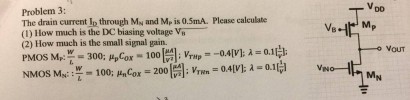 VDD Problem 3: The drain current Io through MN and Mp is 0.5mA. Please calculate (1) How much is the DC biasing voltage VB (2) How much is the small signal gain. VOUT MN
Can you explain where the negative on the equation VGs = -(0.2 +Vthp) = -0.6 and explain the equation of vb = vg = vs - 0.6 And also why are we using the gm of pmos and not the nmos Problem 3 The dra...
 Can you explain where the negative on the equation VGs = -(0.2
+Vthp) = -0.6 and explain the equation of vb = vg = vs - 0.6
And also why are we using the gm of pmos and not the nmos
Problem 3 The drain current Ip through MN and Mp is 0.5mA. Please calculate (1) How much is the DC biasing voltage VB (2) How much is the small signal gain. w= 300; μ.cox = 1001쓺1 ; VrHp VouT...
Can you explain where the negative on the equation VGs = -(0.2
+Vthp) = -0.6 and explain the equation of vb = vg = vs - 0.6
And also why are we using the gm of pmos and not the nmos
Problem 3 The drain current Ip through MN and Mp is 0.5mA. Please calculate (1) How much is the DC biasing voltage VB (2) How much is the small signal gain. w= 300; μ.cox = 1001쓺1 ; VrHp VouT...
Please show step on how to solve this. Problem 4 Assume the current through M1 and Q1, M2 and Q1 is lmA.Voc.bias (1). Please calculate the small-signal resistance r and r2 (2). Please calculate the s...
 Please show step on how to solve this.
Problem 4 Assume the current through M1 and Q1, M2 and Q1 is lmA.Voc.bias (1). Please calculate the small-signal resistance r and r2 (2). Please calculate the small-signal gain in both case (a) and VDC,bias M Vout r Vout Vin Vin MI (NMOS) M2 (PMOS) Q1 (NPN) ls = 1 × 10-18[A]. β 100, va = 100[V],
Problem 4 Assume the current through M1 and Q1, M2 and Q1 is lmA.Voc.bias (1)....
Please show step on how to solve this.
Problem 4 Assume the current through M1 and Q1, M2 and Q1 is lmA.Voc.bias (1). Please calculate the small-signal resistance r and r2 (2). Please calculate the small-signal gain in both case (a) and VDC,bias M Vout r Vout Vin Vin MI (NMOS) M2 (PMOS) Q1 (NPN) ls = 1 × 10-18[A]. β 100, va = 100[V],
Problem 4 Assume the current through M1 and Q1, M2 and Q1 is lmA.Voc.bias (1)....
2. Consider an N-channel MOSFET circuit where the gate and drain terminals are shorted to- gether...
 Please help, and explain as much as possible. Thank
you!
2. Consider an N-channel MOSFET circuit where the gate and drain terminals are shorted to- gether2 as shown in Figre 2. Assume that the MOSFET has trans-conductance parameter of gm = 0.5mA/V and the threshold voltage of 0.7V (a) Identify in which region the n-channel MOSFET is operating (Triode region or Saturation region)? (b) Write MATLAB code to compute the drain current for the following gate-to-source voltage, Vcs Ves-VDs 0,1,2,3,4,5,6,7...
Please help, and explain as much as possible. Thank
you!
2. Consider an N-channel MOSFET circuit where the gate and drain terminals are shorted to- gether2 as shown in Figre 2. Assume that the MOSFET has trans-conductance parameter of gm = 0.5mA/V and the threshold voltage of 0.7V (a) Identify in which region the n-channel MOSFET is operating (Triode region or Saturation region)? (b) Write MATLAB code to compute the drain current for the following gate-to-source voltage, Vcs Ves-VDs 0,1,2,3,4,5,6,7...
Part "c" Please! Consider the circuit below. Assume that the only inductance of interest is the...
 Part "c" Please!
Consider the circuit below. Assume that the only inductance of interest is the load inductor L = 15mH connected to the output terminal. The resistors have the following values: R1 = 5kN, R2 = 2kN, R3 = 0.1kN, and RI, = 10kN. The supply voltage is Vs = 15V. Vs R2 R, vo R1 R3 Figure 6-1 It is known that the input voltage vị can be decomposed into two parts, a constant Vị and a small...
Part "c" Please!
Consider the circuit below. Assume that the only inductance of interest is the load inductor L = 15mH connected to the output terminal. The resistors have the following values: R1 = 5kN, R2 = 2kN, R3 = 0.1kN, and RI, = 10kN. The supply voltage is Vs = 15V. Vs R2 R, vo R1 R3 Figure 6-1 It is known that the input voltage vị can be decomposed into two parts, a constant Vị and a small...
Problem 2: BJT Small-Signal Voltage Amplifiers in the lectures, we covered in detail the analysis of an npn BJT amplifier that utilizes a single-supply DC biasing. In this problem, you will meet...
 Problem 2: BJT Small-Signal Voltage Amplifiers in the lectures, we covered in detail the analysis of an npn BJT amplifier that utilizes a single-supply DC biasing. In this problem, you will meet two additional amplifier architectures- one that is based on dual DC supplies combined with a DC current source, and the other that utilizes a pnp BJT with single-supply biasing. In both problems (below) you need to manually find the amplifier's Q-point (that is, the DC values of Ic...
Problem #1 : For the Circut in the figure assume β-100 and VA-120. A) Calculate the...
 Problem #1 : For the Circut in the figure assume β-100 and VA-120. A) Calculate the DC operating point of the transistor, gm ro, and r. (Neglect Early effect and ls for the DC analysis part) B) Calculate the small signal input and output resistance of the amplifier C) Calculate the small signal voltage and current gain of the amplifier L0V 20k 100 Vi k C1 ез 40k 3 k -10V
L = 90nm, Veff = 0.2V at 100uA of drain current. also Vbias = 0.6V Kn-μ.co.-280...
 L = 90nm, Veff = 0.2V at 100uA of drain current. also Vbias =
0.6V
Kn-μ.co.-280 μΑ/V2, k',-HoCo.-70 μΑ/V2, VDD-1.2 V Vro.N=0.4V, VrJF-0.4V, PHE 120 0.8V for N and P, γ=0.35 Vos, λし=0.1 um/V, VuN=inf.. For the circuit on the right, assume W and L values from (1) Discuss how the DC values of Vout and drainVin current relate to the DC values of Vbias and Vin Calculate the DC value of Vout, when Vin,dc-0.6V. (does this circuit have the...
L = 90nm, Veff = 0.2V at 100uA of drain current. also Vbias =
0.6V
Kn-μ.co.-280 μΑ/V2, k',-HoCo.-70 μΑ/V2, VDD-1.2 V Vro.N=0.4V, VrJF-0.4V, PHE 120 0.8V for N and P, γ=0.35 Vos, λし=0.1 um/V, VuN=inf.. For the circuit on the right, assume W and L values from (1) Discuss how the DC values of Vout and drainVin current relate to the DC values of Vbias and Vin Calculate the DC value of Vout, when Vin,dc-0.6V. (does this circuit have the...
Please just a walk through guide with formulas and steps. Problem 1. For the differential amplifier...
 Please just a walk through guide with formulas and
steps.
Problem 1. For the differential amplifier of Figure P-1, it is given that RA-RB-602, R2-302, RSA-RsB 3kS2, R 6kS2. To calculate bias currents, you may assume that K, = and β = oo . Also I'm = ν,,-IV (DC). You may make reasonable approximations to obtain answers accurate to 10% . Find the bias current Ic3 b) Find the bias voltages at VoUT, VE1, and Vcs c) Find the small-signal...
Please just a walk through guide with formulas and
steps.
Problem 1. For the differential amplifier of Figure P-1, it is given that RA-RB-602, R2-302, RSA-RsB 3kS2, R 6kS2. To calculate bias currents, you may assume that K, = and β = oo . Also I'm = ν,,-IV (DC). You may make reasonable approximations to obtain answers accurate to 10% . Find the bias current Ic3 b) Find the bias voltages at VoUT, VE1, and Vcs c) Find the small-signal...
please help with 1&2 Problem i. Common-Gate Amplifier: Assume kp = 2 mA/V, VTp = -1...
 please help with 1&2
Problem i. Common-Gate Amplifier: Assume kp = 2 mA/V, VTp = -1 V.=y=0. Determine the following: (5 pt) 1) Vos and VDS (5 pt) 2) The small-signal parameters, go andro (7.5 pt) 3) Draw small-signal equivalent circuit (7.5 pt) 4) Input Resistance, Rin (7.5 pt) 5) Output Resistance, Rout (15 pt) 6) Small-signal Voltage Gain; A, = Yout +15 V -15 V ima 0 1 ko 50 kn Rout (50 pt) Problem 2. Common-Source Amplifier: Assume...
please help with 1&2
Problem i. Common-Gate Amplifier: Assume kp = 2 mA/V, VTp = -1 V.=y=0. Determine the following: (5 pt) 1) Vos and VDS (5 pt) 2) The small-signal parameters, go andro (7.5 pt) 3) Draw small-signal equivalent circuit (7.5 pt) 4) Input Resistance, Rin (7.5 pt) 5) Output Resistance, Rout (15 pt) 6) Small-signal Voltage Gain; A, = Yout +15 V -15 V ima 0 1 ko 50 kn Rout (50 pt) Problem 2. Common-Source Amplifier: Assume...
 VDD Problem 3: The drain current Io through MN and Mp is 0.5mA. Please calculate (1) How much is the DC biasing voltage VB (2) How much is the small signal gain. VOUT MN
 Can you explain where the negative on the equation VGs = -(0.2
+Vthp) = -0.6 and explain the equation of vb = vg = vs - 0.6
And also why are we using the gm of pmos and not the nmos
Problem 3 The drain current Ip through MN and Mp is 0.5mA. Please calculate (1) How much is the DC biasing voltage VB (2) How much is the small signal gain. w= 300; μ.cox = 1001쓺1 ; VrHp VouT...
Can you explain where the negative on the equation VGs = -(0.2
+Vthp) = -0.6 and explain the equation of vb = vg = vs - 0.6
And also why are we using the gm of pmos and not the nmos
Problem 3 The drain current Ip through MN and Mp is 0.5mA. Please calculate (1) How much is the DC biasing voltage VB (2) How much is the small signal gain. w= 300; μ.cox = 1001쓺1 ; VrHp VouT...
 Please show step on how to solve this.
Problem 4 Assume the current through M1 and Q1, M2 and Q1 is lmA.Voc.bias (1). Please calculate the small-signal resistance r and r2 (2). Please calculate the small-signal gain in both case (a) and VDC,bias M Vout r Vout Vin Vin MI (NMOS) M2 (PMOS) Q1 (NPN) ls = 1 × 10-18[A]. β 100, va = 100[V],
Problem 4 Assume the current through M1 and Q1, M2 and Q1 is lmA.Voc.bias (1)....
Please show step on how to solve this.
Problem 4 Assume the current through M1 and Q1, M2 and Q1 is lmA.Voc.bias (1). Please calculate the small-signal resistance r and r2 (2). Please calculate the small-signal gain in both case (a) and VDC,bias M Vout r Vout Vin Vin MI (NMOS) M2 (PMOS) Q1 (NPN) ls = 1 × 10-18[A]. β 100, va = 100[V],
Problem 4 Assume the current through M1 and Q1, M2 and Q1 is lmA.Voc.bias (1)....
 Please help, and explain as much as possible. Thank
you!
2. Consider an N-channel MOSFET circuit where the gate and drain terminals are shorted to- gether2 as shown in Figre 2. Assume that the MOSFET has trans-conductance parameter of gm = 0.5mA/V and the threshold voltage of 0.7V (a) Identify in which region the n-channel MOSFET is operating (Triode region or Saturation region)? (b) Write MATLAB code to compute the drain current for the following gate-to-source voltage, Vcs Ves-VDs 0,1,2,3,4,5,6,7...
Please help, and explain as much as possible. Thank
you!
2. Consider an N-channel MOSFET circuit where the gate and drain terminals are shorted to- gether2 as shown in Figre 2. Assume that the MOSFET has trans-conductance parameter of gm = 0.5mA/V and the threshold voltage of 0.7V (a) Identify in which region the n-channel MOSFET is operating (Triode region or Saturation region)? (b) Write MATLAB code to compute the drain current for the following gate-to-source voltage, Vcs Ves-VDs 0,1,2,3,4,5,6,7...
 Part "c" Please!
Consider the circuit below. Assume that the only inductance of interest is the load inductor L = 15mH connected to the output terminal. The resistors have the following values: R1 = 5kN, R2 = 2kN, R3 = 0.1kN, and RI, = 10kN. The supply voltage is Vs = 15V. Vs R2 R, vo R1 R3 Figure 6-1 It is known that the input voltage vị can be decomposed into two parts, a constant Vị and a small...
Part "c" Please!
Consider the circuit below. Assume that the only inductance of interest is the load inductor L = 15mH connected to the output terminal. The resistors have the following values: R1 = 5kN, R2 = 2kN, R3 = 0.1kN, and RI, = 10kN. The supply voltage is Vs = 15V. Vs R2 R, vo R1 R3 Figure 6-1 It is known that the input voltage vị can be decomposed into two parts, a constant Vị and a small...
 Problem 2: BJT Small-Signal Voltage Amplifiers in the lectures, we covered in detail the analysis of an npn BJT amplifier that utilizes a single-supply DC biasing. In this problem, you will meet two additional amplifier architectures- one that is based on dual DC supplies combined with a DC current source, and the other that utilizes a pnp BJT with single-supply biasing. In both problems (below) you need to manually find the amplifier's Q-point (that is, the DC values of Ic...
 Problem #1 : For the Circut in the figure assume β-100 and VA-120. A) Calculate the DC operating point of the transistor, gm ro, and r. (Neglect Early effect and ls for the DC analysis part) B) Calculate the small signal input and output resistance of the amplifier C) Calculate the small signal voltage and current gain of the amplifier L0V 20k 100 Vi k C1 ез 40k 3 k -10V
 L = 90nm, Veff = 0.2V at 100uA of drain current. also Vbias =
0.6V
Kn-μ.co.-280 μΑ/V2, k',-HoCo.-70 μΑ/V2, VDD-1.2 V Vro.N=0.4V, VrJF-0.4V, PHE 120 0.8V for N and P, γ=0.35 Vos, λし=0.1 um/V, VuN=inf.. For the circuit on the right, assume W and L values from (1) Discuss how the DC values of Vout and drainVin current relate to the DC values of Vbias and Vin Calculate the DC value of Vout, when Vin,dc-0.6V. (does this circuit have the...
L = 90nm, Veff = 0.2V at 100uA of drain current. also Vbias =
0.6V
Kn-μ.co.-280 μΑ/V2, k',-HoCo.-70 μΑ/V2, VDD-1.2 V Vro.N=0.4V, VrJF-0.4V, PHE 120 0.8V for N and P, γ=0.35 Vos, λし=0.1 um/V, VuN=inf.. For the circuit on the right, assume W and L values from (1) Discuss how the DC values of Vout and drainVin current relate to the DC values of Vbias and Vin Calculate the DC value of Vout, when Vin,dc-0.6V. (does this circuit have the...
 Please just a walk through guide with formulas and
steps.
Problem 1. For the differential amplifier of Figure P-1, it is given that RA-RB-602, R2-302, RSA-RsB 3kS2, R 6kS2. To calculate bias currents, you may assume that K, = and β = oo . Also I'm = ν,,-IV (DC). You may make reasonable approximations to obtain answers accurate to 10% . Find the bias current Ic3 b) Find the bias voltages at VoUT, VE1, and Vcs c) Find the small-signal...
Please just a walk through guide with formulas and
steps.
Problem 1. For the differential amplifier of Figure P-1, it is given that RA-RB-602, R2-302, RSA-RsB 3kS2, R 6kS2. To calculate bias currents, you may assume that K, = and β = oo . Also I'm = ν,,-IV (DC). You may make reasonable approximations to obtain answers accurate to 10% . Find the bias current Ic3 b) Find the bias voltages at VoUT, VE1, and Vcs c) Find the small-signal...
 please help with 1&2
Problem i. Common-Gate Amplifier: Assume kp = 2 mA/V, VTp = -1 V.=y=0. Determine the following: (5 pt) 1) Vos and VDS (5 pt) 2) The small-signal parameters, go andro (7.5 pt) 3) Draw small-signal equivalent circuit (7.5 pt) 4) Input Resistance, Rin (7.5 pt) 5) Output Resistance, Rout (15 pt) 6) Small-signal Voltage Gain; A, = Yout +15 V -15 V ima 0 1 ko 50 kn Rout (50 pt) Problem 2. Common-Source Amplifier: Assume...
please help with 1&2
Problem i. Common-Gate Amplifier: Assume kp = 2 mA/V, VTp = -1 V.=y=0. Determine the following: (5 pt) 1) Vos and VDS (5 pt) 2) The small-signal parameters, go andro (7.5 pt) 3) Draw small-signal equivalent circuit (7.5 pt) 4) Input Resistance, Rin (7.5 pt) 5) Output Resistance, Rout (15 pt) 6) Small-signal Voltage Gain; A, = Yout +15 V -15 V ima 0 1 ko 50 kn Rout (50 pt) Problem 2. Common-Source Amplifier: Assume...
Most questions answered within 3 hours.
-
Where is the error in this code sequence?
String s1 = "Hello";
String s2 = "ello";...
asked 10 months ago -
Financial data for Joel de Paris, Inc., for last year
follow:
Joel de Paris, Inc.
Balance...
asked 10 months ago -
Consider this reaction:
Al2(SO4)3 (aq)+ BaCl3
(aq) Al2Cl6 (aq)- +
3BaSO4(s) . What is the...
asked 10 months ago -
Suppose that Savneet is considering increasing her
recent random sample from 20 car rentals to 40...
asked 10 months ago -
Trucks arrive at an unloading terminal at an average rate of 120
per hour.
Trucks arrive...
asked 10 months ago -
Why are methanol and ethanol completely soluble in water while
octanol is not very little soluble....
asked 10 months ago -
A facilities manager at a university reads in a research report
that the mean amount of...
asked 10 months ago -
When the CuSO4 is rehydrated by adding water to the anhydrous
compound, is this an endothermic...
asked 10 months ago -
A ray of sunlight is passing from diamond into crown glass; the
angle of incidence is...
asked 10 months ago -
A block of mass 0.249 kg is placed on top of a light, vertical
spring of...
asked 10 months ago -
how do the kidneys compensate in the presences of acidosis
a) trigger hyperventilate
b) reserve acid...
asked 10 months ago -
Question 501 pts
The rental rate of capital to the firm increases. Which of the
following...
asked 10 months ago