
Homework Answers
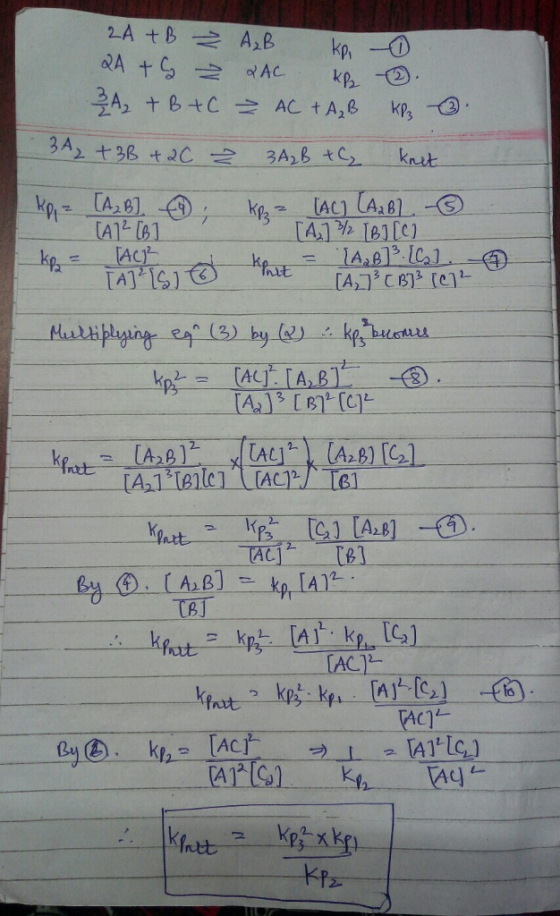
If you liked the answer please like.
If you have any doubts please comment. I will be happy to clarify.
Thanks
Add Answer to:
18. Given the following information: 8 points 32A;(g) + Big) + C(g)-AC(g) + AD(g) Kp3 In...
For the following reaction: A(g) + 2 B(g) ⇌ 2 C(g) Calculate the equilibrium constant K given the following information:...
For the following reaction: A(g) + 2 B(g) ⇌ 2 C(g) Calculate the equilibrium constant K given the following information: The initial pressure of A is 2.755 bar and the initial pressure of B is 1.582 bar The equilibrium pressure of C is 0.460 bar B)For the following reaction: 2 A(g) + B(g) ⇌ C(g) Calculate the equilibrium constant K given the following information: The initial pressure of A is 2.772 bar and the initial pressure of B is 2.645...
6. (8 points, 2 points each) Consider the following reaction: CO2(g) + 2 NH3(g) = CO(NH2)2(s)...
 6. (8 points, 2 points each) Consider the following reaction: CO2(g) + 2 NH3(g) = CO(NH2)2(s) + H2O(g) AH° = -90 kJ Circle the change expected for each of the following to reestablish equilibrium: a. Add CO2 to the equilibrium mixture form more form more no change products reactants b. Compress the equilibrium mixture at constant temperature. (smaller volume) form more form more no change products reactants c. Heat the equilibrium mixture form more form more no change products reactants...
5. Consider the following concentration table 4 NH3(g) 0.30 mol 702(g) 0.80 mol 〈=> 2N,04(g) + 6...
 Please answer ALL parts OF LETTER F and show
work/explain
LETTER F
5. Consider the following concentration table 4 NH3(g) 0.30 mol 702(g) 0.80 mol 〈=> 2N,04(g) + 6H20(g) I (initial moles) C (change) E (equilibrium moles) a) What are the values for each of the v;? b) Show that Σ v, Xi-0. c) Fill in the concentration table in terms of 5, the extent of reaction. d) According to your concentration table what are the minimum and maximum values...
Please answer ALL parts OF LETTER F and show
work/explain
LETTER F
5. Consider the following concentration table 4 NH3(g) 0.30 mol 702(g) 0.80 mol 〈=> 2N,04(g) + 6H20(g) I (initial moles) C (change) E (equilibrium moles) a) What are the values for each of the v;? b) Show that Σ v, Xi-0. c) Fill in the concentration table in terms of 5, the extent of reaction. d) According to your concentration table what are the minimum and maximum values...
5. Consider the following concentration table 4 NH3(g) 0.30 mol 702(g) 0.80 mol 〈=> 2N,04(g) + 6...
 Please answer ALL parts OF LETTER E and show
work/explain
LETTER E
5. Consider the following concentration table 4 NH3(g) 0.30 mol 702(g) 0.80 mol 〈=> 2N,04(g) + 6H20(g) I (initial moles) C (change) E (equilibrium moles) a) What are the values for each of the v;? b) Show that Σ v, Xi-0. c) Fill in the concentration table in terms of 5, the extent of reaction. d) According to your concentration table what are the minimum and maximum values...
Please answer ALL parts OF LETTER E and show
work/explain
LETTER E
5. Consider the following concentration table 4 NH3(g) 0.30 mol 702(g) 0.80 mol 〈=> 2N,04(g) + 6H20(g) I (initial moles) C (change) E (equilibrium moles) a) What are the values for each of the v;? b) Show that Σ v, Xi-0. c) Fill in the concentration table in terms of 5, the extent of reaction. d) According to your concentration table what are the minimum and maximum values...
1) Consider the following reaction at equilibrium: H2(g) + Br2(g) = 2 HBr(g) Kc = 3.8...
 1) Consider the following reaction at equilibrium: H2(g) + Br2(g) = 2 HBr(g) Kc = 3.8 x 10⁴ a) Is this reaction reactant-favored or product-favored? (1 point) Answer: b) Based on the given equilibrium reaction, determine the value of the equilibrium constant for the following reaction: Show your work for full credit! (4 points) 2 HBr(g) = H2(g) + Br2(g) Kc = c) Use both the equation and your answer from Part b to answer the problem. In a 1.00...
5. Suppose that aggregate demand (AD-C+I+G) can be described by the following equations. C = 500+...
 5. Suppose that aggregate demand (AD-C+I+G) can be described by the following equations. C = 500+ 0.8 (Y-T) 1 = 100+ 0.01"Y G-40 (22 total points) b) Suppose that businesses began to be more pessimistic about the future so started to decrease investment in new plant and equipment. Show how this would affect the graph in part a. (4 points) Note how it would change equilibrium national income. (4 points) (No need to provide specific numbers for either----just show the...
For the following reaction: A(g) + B(g) ⇌ 2 C(g) Given the following information, what is...
For the following reaction: A(g) + B(g) ⇌ 2 C(g) Given the following information, what is the equilibrium pressure of C in bar? Initial pressure of A = 2.629 bar Initial pressure of B = 2.629 bar Initial pressure of C = 0 bar K = 9.6 x 10⁻⁴
For the following reaction: A(g) + 2 B(g) ⇌ 2 C(g) Calculate the equilibrium constant K...
For the following reaction: A(g) + 2 B(g) ⇌ 2 C(g) Calculate the equilibrium constant K given the following information: The initial pressure of A is 2.755 bar and the initial pressure of B is 1.582 bar The equilibrium pressure of C is 0.460 bar B)For the following reaction: 2 A(g) + B(g) ⇌ C(g) Calculate the equilibrium constant K given the following information: The initial pressure of A is 2.772 bar and the initial pressure of B is 2.645...
Problem 3 (a) Use the definitional method to find the smallest big-O estimate for the following following function. You must determine the multiplicative constant C and the threshold constant k the m...
 Problem 3 (a) Use the definitional method to find the smallest big-O estimate for the following following function. You must determine the multiplicative constant C and the threshold constant k the multiplicative constant C and ihet Show calculation. (b) Use the limit method to formally determine the asymptotic relationship between the following two functions. Show the steps of your calculation and clearly state each rule that you used in the calculation. fn) 100log2n and g(n)-log1on [4+ 4 points]
Problem 3...
Problem 3 (a) Use the definitional method to find the smallest big-O estimate for the following following function. You must determine the multiplicative constant C and the threshold constant k the multiplicative constant C and ihet Show calculation. (b) Use the limit method to formally determine the asymptotic relationship between the following two functions. Show the steps of your calculation and clearly state each rule that you used in the calculation. fn) 100log2n and g(n)-log1on [4+ 4 points]
Problem 3...
For the following reaction: 2 A(g) ⇌ B(g) + C(g) Given the following information, what is...
For the following reaction: 2 A(g) ⇌ B(g) + C(g) Given the following information, what is the equilibrium pressure of B in bar? Initial pressure of A = 1.386 bar Initial pressure of B = 0 bar Initial pressure of C = 0 bar K = 8.1 x 10⁻⁴ You have 5 attempts at this question.
 6. (8 points, 2 points each) Consider the following reaction: CO2(g) + 2 NH3(g) = CO(NH2)2(s) + H2O(g) AH° = -90 kJ Circle the change expected for each of the following to reestablish equilibrium: a. Add CO2 to the equilibrium mixture form more form more no change products reactants b. Compress the equilibrium mixture at constant temperature. (smaller volume) form more form more no change products reactants c. Heat the equilibrium mixture form more form more no change products reactants...
 Please answer ALL parts OF LETTER F and show
work/explain
LETTER F
5. Consider the following concentration table 4 NH3(g) 0.30 mol 702(g) 0.80 mol 〈=> 2N,04(g) + 6H20(g) I (initial moles) C (change) E (equilibrium moles) a) What are the values for each of the v;? b) Show that Σ v, Xi-0. c) Fill in the concentration table in terms of 5, the extent of reaction. d) According to your concentration table what are the minimum and maximum values...
Please answer ALL parts OF LETTER F and show
work/explain
LETTER F
5. Consider the following concentration table 4 NH3(g) 0.30 mol 702(g) 0.80 mol 〈=> 2N,04(g) + 6H20(g) I (initial moles) C (change) E (equilibrium moles) a) What are the values for each of the v;? b) Show that Σ v, Xi-0. c) Fill in the concentration table in terms of 5, the extent of reaction. d) According to your concentration table what are the minimum and maximum values...
 Please answer ALL parts OF LETTER E and show
work/explain
LETTER E
5. Consider the following concentration table 4 NH3(g) 0.30 mol 702(g) 0.80 mol 〈=> 2N,04(g) + 6H20(g) I (initial moles) C (change) E (equilibrium moles) a) What are the values for each of the v;? b) Show that Σ v, Xi-0. c) Fill in the concentration table in terms of 5, the extent of reaction. d) According to your concentration table what are the minimum and maximum values...
Please answer ALL parts OF LETTER E and show
work/explain
LETTER E
5. Consider the following concentration table 4 NH3(g) 0.30 mol 702(g) 0.80 mol 〈=> 2N,04(g) + 6H20(g) I (initial moles) C (change) E (equilibrium moles) a) What are the values for each of the v;? b) Show that Σ v, Xi-0. c) Fill in the concentration table in terms of 5, the extent of reaction. d) According to your concentration table what are the minimum and maximum values...
 1) Consider the following reaction at equilibrium: H2(g) + Br2(g) = 2 HBr(g) Kc = 3.8 x 10⁴ a) Is this reaction reactant-favored or product-favored? (1 point) Answer: b) Based on the given equilibrium reaction, determine the value of the equilibrium constant for the following reaction: Show your work for full credit! (4 points) 2 HBr(g) = H2(g) + Br2(g) Kc = c) Use both the equation and your answer from Part b to answer the problem. In a 1.00...
 5. Suppose that aggregate demand (AD-C+I+G) can be described by the following equations. C = 500+ 0.8 (Y-T) 1 = 100+ 0.01"Y G-40 (22 total points) b) Suppose that businesses began to be more pessimistic about the future so started to decrease investment in new plant and equipment. Show how this would affect the graph in part a. (4 points) Note how it would change equilibrium national income. (4 points) (No need to provide specific numbers for either----just show the...
 Problem 3 (a) Use the definitional method to find the smallest big-O estimate for the following following function. You must determine the multiplicative constant C and the threshold constant k the multiplicative constant C and ihet Show calculation. (b) Use the limit method to formally determine the asymptotic relationship between the following two functions. Show the steps of your calculation and clearly state each rule that you used in the calculation. fn) 100log2n and g(n)-log1on [4+ 4 points]
Problem 3...
Problem 3 (a) Use the definitional method to find the smallest big-O estimate for the following following function. You must determine the multiplicative constant C and the threshold constant k the multiplicative constant C and ihet Show calculation. (b) Use the limit method to formally determine the asymptotic relationship between the following two functions. Show the steps of your calculation and clearly state each rule that you used in the calculation. fn) 100log2n and g(n)-log1on [4+ 4 points]
Problem 3...
Most questions answered within 3 hours.
-
Where is the error in this code sequence?
String s1 = "Hello";
String s2 = "ello";...
asked 10 months ago -
Financial data for Joel de Paris, Inc., for last year
follow:
Joel de Paris, Inc.
Balance...
asked 10 months ago -
Consider this reaction:
Al2(SO4)3 (aq)+ BaCl3
(aq) Al2Cl6 (aq)- +
3BaSO4(s) . What is the...
asked 10 months ago -
Suppose that Savneet is considering increasing her
recent random sample from 20 car rentals to 40...
asked 10 months ago -
Trucks arrive at an unloading terminal at an average rate of 120
per hour.
Trucks arrive...
asked 10 months ago -
Why are methanol and ethanol completely soluble in water while
octanol is not very little soluble....
asked 10 months ago -
A facilities manager at a university reads in a research report
that the mean amount of...
asked 10 months ago -
When the CuSO4 is rehydrated by adding water to the anhydrous
compound, is this an endothermic...
asked 10 months ago -
A ray of sunlight is passing from diamond into crown glass; the
angle of incidence is...
asked 10 months ago -
A block of mass 0.249 kg is placed on top of a light, vertical
spring of...
asked 10 months ago -
how do the kidneys compensate in the presences of acidosis
a) trigger hyperventilate
b) reserve acid...
asked 10 months ago -
Question 501 pts
The rental rate of capital to the firm increases. Which of the
following...
asked 10 months ago