The Taylor Rule puts _________ as much weight on closing the unemployment gap as it does...
The Taylor Rule puts _________ as much weight on closing the unemployment gap as it does on closing the inflation gap.
half
just
ten times
twice
Homework Answers
The correct option is (d).
Twice.
As we know that, Taylor Rule is used in economics. The Taylor Rule puts twice as much weight on closing the unemployment gap as it does on closing the inflation gap. Tylor rule is used to predict or guide how central banks should change or alter interest rates due to changes in the economy.
Add Answer to:
The Taylor Rule puts _________ as much weight on closing the unemployment gap as it does...
According to the Taylor Rule, if the inflation rate is 3 percent and the GDP gap...
According to the Taylor Rule, if the inflation rate is 3 percent and the GDP gap is 2 percent, what does the federal funds rate target equal? Group of answer choices 8.5 percent 5.5 percent 3.5 percent 6.5 percent
The Taylor rule explains the changes in inflation rate unemployment rate federal funds rate output
The Taylor rule explains the changes in inflation rate unemployment rate federal funds rate output
Use the Taylor rule to: Calculate the target for the federal funds rate for October 2012,...
Use the Taylor rule to: Calculate the target for the federal funds rate for October 2012, using the following information: equilibrium real federal funds rate of 2%, target inflation rate of 2%, current inflation rate of 1.2%, and a (negative) output gap of 5.9%. In your calculations, the inflation gap is negative if the current inflation rate is below the target inflation rate. How does the targeted federal funds rate calculated using the Taylor rule compare to the actual federal...
Using the Taylor rule, calculate the target for the federal funds rate for July 2010 using the following information:
Using the Taylor rule, calculate the target for the federal funds rate for July 2010 using the following information: Equilibrium real federal funds rate 2% Target inflation rate 2% Current inflation rate 0.9% Output gap -6%The target for the federal funds rate for July 2010 is _______ %. (Enter your response rounded to two decimal places and include a minus sign if necessary) In your calculations, the inflation gap is negative if the current inflation rate is below the target inflation rate. How does the...
a. What does the Taylor Rule imply that monetary policymakers should due to the Federal Funds...
a. What does the Taylor Rule imply that monetary policymakers should due to the Federal Funds Rate under the following scenarios? Please explain your answer using the information in the Taylor Rule. (Hint: you may want to start with the equation for the Taylor Rule.) The Taylor Rule: 1. Unemployment rises due to a recession. 2. An oil price shock causes the inflation rate to rise by 1% and output to fall by 1%. 3. The Fed decreases its target...
Question 47 0.1 pts According to the Taylor Rule: if the inflation rate is 2% and...
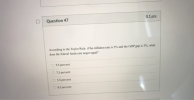 Question 47 0.1 pts According to the Taylor Rule: if the inflation rate is 2% and the GDP gap is 3%, what does the federal funds rate target cqual? 9.5 percent 7.5 percent 5.5 percent 8.5 percent If GDP is $12,000 and velocity is 4, the money supply is $27,000. $12,000. $4,000. $3,000. Ouestions
6. 7. Inflation targeting and the Taylor rule in the IS-LM model Consider a closed economy...
 6.
7.
Inflation targeting and the Taylor rule in the IS-LM model Consider a closed economy in which the central bank follows an interest rate rule. The IS relation is given by Y C(Y- T) I(Y,r) G Where r is the real interest rate. The central bank sets the nominal interest rate according to the rule i = i* + a(n° =- T*) + b(Y- Y1) Where T is expected inflation, T* is the target rate of inflation, and Yn...
6.
7.
Inflation targeting and the Taylor rule in the IS-LM model Consider a closed economy in which the central bank follows an interest rate rule. The IS relation is given by Y C(Y- T) I(Y,r) G Where r is the real interest rate. The central bank sets the nominal interest rate according to the rule i = i* + a(n° =- T*) + b(Y- Y1) Where T is expected inflation, T* is the target rate of inflation, and Yn...
6. 7. Inflation targeting and the Taylor rule in the IS-LM model Consider a closed economy...
 6.
7.
Inflation targeting and the Taylor rule in the IS-LM model Consider a closed economy in which the central bank follows an interest rate rule. The IS relation is given by Y C(Y- T) I(Y,r) G Where r is the real interest rate. The central bank sets the nominal interest rate according to the rule i = i* + a(n° =- T*) + b(Y- Y1) Where T is expected inflation, T* is the target rate of inflation, and Yn...
6.
7.
Inflation targeting and the Taylor rule in the IS-LM model Consider a closed economy in which the central bank follows an interest rate rule. The IS relation is given by Y C(Y- T) I(Y,r) G Where r is the real interest rate. The central bank sets the nominal interest rate according to the rule i = i* + a(n° =- T*) + b(Y- Y1) Where T is expected inflation, T* is the target rate of inflation, and Yn...
please answer Question 7: Inflation targeting and the Taylor rule in the IS-LM model Consider a...
 please answer Question 7:
Inflation targeting and the Taylor rule in the IS-LM model Consider a closed economy in which the central bank follows an interest rate rule. The IS relation is given by Y C(Y- T) I(Y,r) G Where r is the real interest rate. The central bank sets the nominal interest rate according to the rule i = i* + a(n° =- T*) + b(Y- Y1) Where T is expected inflation, T* is the target rate of inflation,...
please answer Question 7:
Inflation targeting and the Taylor rule in the IS-LM model Consider a closed economy in which the central bank follows an interest rate rule. The IS relation is given by Y C(Y- T) I(Y,r) G Where r is the real interest rate. The central bank sets the nominal interest rate according to the rule i = i* + a(n° =- T*) + b(Y- Y1) Where T is expected inflation, T* is the target rate of inflation,...
The Taylor rule specifies how policymakers should set the federal funds rate target. Suppose that U.S....
The Taylor rule specifies how policymakers should set the federal funds rate target. Suppose that U.S. real GDP rises 3% above potential GDP, all else constant. According to the Taylor rule, the Fed should (raise lower) the federal funds rate target by (1.75%,1.25%,1.5%,2%) . Suppose instead that the U.S. inflation rate rises by 3%, all else constant. According to the Taylor rule, the Fed should (raise,lower) the federal funds rate target by (4.5%,4.75%,5%,4.25%) . 1. The opportunity cost of holding...
 Question 47 0.1 pts According to the Taylor Rule: if the inflation rate is 2% and the GDP gap is 3%, what does the federal funds rate target cqual? 9.5 percent 7.5 percent 5.5 percent 8.5 percent If GDP is $12,000 and velocity is 4, the money supply is $27,000. $12,000. $4,000. $3,000. Ouestions
 6.
7.
Inflation targeting and the Taylor rule in the IS-LM model Consider a closed economy in which the central bank follows an interest rate rule. The IS relation is given by Y C(Y- T) I(Y,r) G Where r is the real interest rate. The central bank sets the nominal interest rate according to the rule i = i* + a(n° =- T*) + b(Y- Y1) Where T is expected inflation, T* is the target rate of inflation, and Yn...
6.
7.
Inflation targeting and the Taylor rule in the IS-LM model Consider a closed economy in which the central bank follows an interest rate rule. The IS relation is given by Y C(Y- T) I(Y,r) G Where r is the real interest rate. The central bank sets the nominal interest rate according to the rule i = i* + a(n° =- T*) + b(Y- Y1) Where T is expected inflation, T* is the target rate of inflation, and Yn...
 6.
7.
Inflation targeting and the Taylor rule in the IS-LM model Consider a closed economy in which the central bank follows an interest rate rule. The IS relation is given by Y C(Y- T) I(Y,r) G Where r is the real interest rate. The central bank sets the nominal interest rate according to the rule i = i* + a(n° =- T*) + b(Y- Y1) Where T is expected inflation, T* is the target rate of inflation, and Yn...
6.
7.
Inflation targeting and the Taylor rule in the IS-LM model Consider a closed economy in which the central bank follows an interest rate rule. The IS relation is given by Y C(Y- T) I(Y,r) G Where r is the real interest rate. The central bank sets the nominal interest rate according to the rule i = i* + a(n° =- T*) + b(Y- Y1) Where T is expected inflation, T* is the target rate of inflation, and Yn...
 please answer Question 7:
Inflation targeting and the Taylor rule in the IS-LM model Consider a closed economy in which the central bank follows an interest rate rule. The IS relation is given by Y C(Y- T) I(Y,r) G Where r is the real interest rate. The central bank sets the nominal interest rate according to the rule i = i* + a(n° =- T*) + b(Y- Y1) Where T is expected inflation, T* is the target rate of inflation,...
please answer Question 7:
Inflation targeting and the Taylor rule in the IS-LM model Consider a closed economy in which the central bank follows an interest rate rule. The IS relation is given by Y C(Y- T) I(Y,r) G Where r is the real interest rate. The central bank sets the nominal interest rate according to the rule i = i* + a(n° =- T*) + b(Y- Y1) Where T is expected inflation, T* is the target rate of inflation,...
Most questions answered within 3 hours.
-
Where is the error in this code sequence?
String s1 = "Hello";
String s2 = "ello";...
asked 10 months ago -
Financial data for Joel de Paris, Inc., for last year
follow:
Joel de Paris, Inc.
Balance...
asked 10 months ago -
Consider this reaction:
Al2(SO4)3 (aq)+ BaCl3
(aq) Al2Cl6 (aq)- +
3BaSO4(s) . What is the...
asked 10 months ago -
Suppose that Savneet is considering increasing her
recent random sample from 20 car rentals to 40...
asked 10 months ago -
Trucks arrive at an unloading terminal at an average rate of 120
per hour.
Trucks arrive...
asked 10 months ago -
Why are methanol and ethanol completely soluble in water while
octanol is not very little soluble....
asked 10 months ago -
A facilities manager at a university reads in a research report
that the mean amount of...
asked 10 months ago -
When the CuSO4 is rehydrated by adding water to the anhydrous
compound, is this an endothermic...
asked 10 months ago -
A ray of sunlight is passing from diamond into crown glass; the
angle of incidence is...
asked 10 months ago -
A block of mass 0.249 kg is placed on top of a light, vertical
spring of...
asked 10 months ago -
how do the kidneys compensate in the presences of acidosis
a) trigger hyperventilate
b) reserve acid...
asked 10 months ago -
Question 501 pts
The rental rate of capital to the firm increases. Which of the
following...
asked 10 months ago