A long, straight wire is aligned with the z-axis. It has constant linear charge density λ...
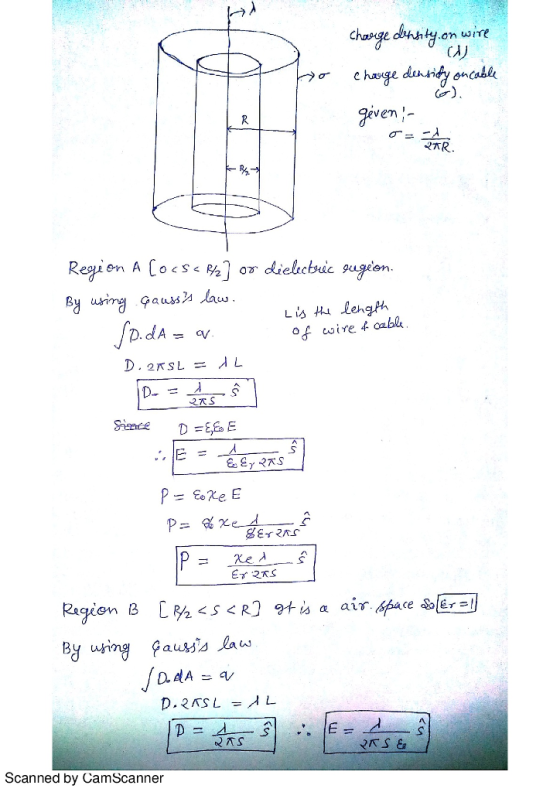
A long, straight wire is aligned with the z-axis. It has constant linear charge density λ and is surrounded by a coaxial cylindrical shell of radius R and surface charge density σ = −λ/(2πR). The region 0 < s < R/2 is filled with a linear dielectric of electric susceptibility χe, and there is no dielectric anywhere else. Label regions of space as follows (s is the distance from the z axis): region A (0 < s < R/2), region B (R/2 < s < R), and region C (s > R).
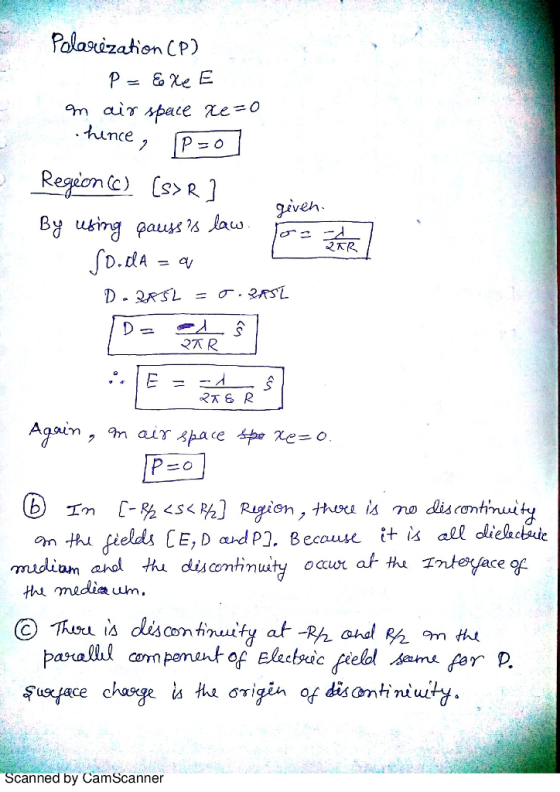
(a) Find E, P, and D in all three regions.
(b) For each of the above three fields, explain whether there a discontinuity when moving radially
outward from s = (R/2)− to s = (R/2)+. What is the origin of the discontinuity if one exists?
(c) For each of the above three fields, explain whether there a discontinuity when moving radially
outward from s = R− to s = R+. What is the origin of the discontinuity if one exists?
Homework Answers
Add Answer to:
A long, straight wire is aligned with the z-axis. It has
constant linear charge density λ...
9.5) Coaxial cable An infinitely long wire carries a uniform linear charge density of −λ. The...
9.5) Coaxial cable An infinitely long wire carries a uniform linear charge density of −λ. The wire is surrounded by a cylindrical sheath of radius a coaxial with the wire. The sheath carries a uniform surface charge density of η = +λ/(2πa). (a) Consider a cylindrical Gaussian surface of radius R and length `coaxial with the cables. How much charge is enclosed in the Gaussian surface for R < a and R > a? (b) What does symmetry dictate about...
An infinitely long straight wire is uniformly charged with a positive linear charge density +?. It...
 An infinitely long straight wire is uniformly charged with a
positive linear charge density +?. It is surrounded by an
insulating hollow cylinder (also infinitely long) of inner radius R
and outer radius 2R. The hollow cylinder has a uniform charge
density ?.
(a) Determine the value of ? if the electric field vanishes at
every point outside the cylinder (r > 2R).
(b) Determine the electric field in the region 0 < r <
R.
(c) Determine the electric...
An infinitely long straight wire is uniformly charged with a
positive linear charge density +?. It is surrounded by an
insulating hollow cylinder (also infinitely long) of inner radius R
and outer radius 2R. The hollow cylinder has a uniform charge
density ?.
(a) Determine the value of ? if the electric field vanishes at
every point outside the cylinder (r > 2R).
(b) Determine the electric field in the region 0 < r <
R.
(c) Determine the electric...
An infinitely long straight wire has a uniform linear charge density of λ. Derive the equation...
An infinitely long straight wire has a uniform linear charge density of λ. Derive the equation for the electric field a distance R away from the wire using Gauss's Law for Electrostatics.
An infinite line of charge with a uniform linear charge density λ runs along the ˆz-axis....
 An infinite line of charge with a uniform linear charge density
λ runs along the ˆz-axis. This line also lies along the axis of an
infinite dielectric shell, of dielectric constant K, whose inner
radius is a and whose outer radius is b, and an infinite, neutral
conducting shell whose inner radius is b and whose outer radius is
c.
a. What is the electric field everywhere in space?
b. What is the surface charge density on the inner surface...
An infinite line of charge with a uniform linear charge density
λ runs along the ˆz-axis. This line also lies along the axis of an
infinite dielectric shell, of dielectric constant K, whose inner
radius is a and whose outer radius is b, and an infinite, neutral
conducting shell whose inner radius is b and whose outer radius is
c.
a. What is the electric field everywhere in space?
b. What is the surface charge density on the inner surface...
16a: An "are" of radius R and linear charge density λ-Xo sin φ lies in the...
 16a: An "are" of radius R and linear charge density λ-Xo sin φ lies in the xy plane. It extends an angle of o above and below the x-axis. Determine the electric field at the origin. b: Determine the z-component of the electric field at the point (0,0, zo) but this time assume that λ--X- IR
30 An infinite line of charge with linear density λ,--S6pcim is positioned along the axis of...
 30 An infinite line of charge with linear density λ,--S6pcim is positioned along the axis of a thick conducting shell of inner radius a 3.4 cm and outer radius b-54 cm and infinite length. The conducting shell is uniformly charged with a linear charge density A 2 3.5 uC/m 1) What is EXP), the electric field at point P, located at (x,y)卟7.6cm, 0cm) ? NIC Submit 2) What is Ey/P), the electric field at point P, located at (xy)-(-7.6 cm,...
1. (a) Consider a line charge distribution with constant linear charge density 'λ'. What is the...
1. (a) Consider a line charge distribution with constant linear charge density 'λ'. What is the total charge in a length 'l' of this line? (b) Consider a spherical charge distribution with constant charge densityρ. What is the total charge in this sphere if it has radius 'R' ? (c) Consider a surface charge distribution with charge density σ(r,θ) =σ0e−rsin2θ.(In this problem,r and θ are the normal polar coordinates.) This charge distribution is spread over a disk of radius 'a'...
4. There is a line of charge with linear charge density λ which traverses a straight...
 4. There is a line of charge with linear charge density λ which traverses a straight line from the point (a,-1/2.0) to (a,1/2,0) in cartesian coordi- nates (x,y,2). Find the first two nonzero terms in the multipole expansion of the electric potential centered at the origin.
A long straight wire has fixed negative charge with a linear charge density of magnitude 3.2...
A long straight wire has fixed negative charge with a linear charge density of magnitude 3.2 nC/m. The wire is to be enclosed by a coaxial, thin-walled, nonconducting cylindrical shell of radius 2.0 cm. The shell is to have positive charge on its outside surface with a surface charge density σ that makes the net external electric field is zero. Calculate σ.
8 A semi-infinite thin rod has a uniform linear positive charge density λ and is located along th...
 8 A semi-infinite thin rod has a uniform linear positive charge density λ and is located along the x-axis between x = x° (>0) and x = +ㆀ. Find the electric field at the origin. Hint: Ja .2 = a-b A.의 dx 1 B. 一巡i E. zero
8 A semi-infinite thin rod has a uniform linear positive charge density λ and is located along the x-axis between x = x° (>0) and x = +ㆀ. Find the electric field at...
8 A semi-infinite thin rod has a uniform linear positive charge density λ and is located along the x-axis between x = x° (>0) and x = +ㆀ. Find the electric field at the origin. Hint: Ja .2 = a-b A.의 dx 1 B. 一巡i E. zero
8 A semi-infinite thin rod has a uniform linear positive charge density λ and is located along the x-axis between x = x° (>0) and x = +ㆀ. Find the electric field at...
 An infinitely long straight wire is uniformly charged with a
positive linear charge density +?. It is surrounded by an
insulating hollow cylinder (also infinitely long) of inner radius R
and outer radius 2R. The hollow cylinder has a uniform charge
density ?.
(a) Determine the value of ? if the electric field vanishes at
every point outside the cylinder (r > 2R).
(b) Determine the electric field in the region 0 < r <
R.
(c) Determine the electric...
An infinitely long straight wire is uniformly charged with a
positive linear charge density +?. It is surrounded by an
insulating hollow cylinder (also infinitely long) of inner radius R
and outer radius 2R. The hollow cylinder has a uniform charge
density ?.
(a) Determine the value of ? if the electric field vanishes at
every point outside the cylinder (r > 2R).
(b) Determine the electric field in the region 0 < r <
R.
(c) Determine the electric...
 An infinite line of charge with a uniform linear charge density
λ runs along the ˆz-axis. This line also lies along the axis of an
infinite dielectric shell, of dielectric constant K, whose inner
radius is a and whose outer radius is b, and an infinite, neutral
conducting shell whose inner radius is b and whose outer radius is
c.
a. What is the electric field everywhere in space?
b. What is the surface charge density on the inner surface...
An infinite line of charge with a uniform linear charge density
λ runs along the ˆz-axis. This line also lies along the axis of an
infinite dielectric shell, of dielectric constant K, whose inner
radius is a and whose outer radius is b, and an infinite, neutral
conducting shell whose inner radius is b and whose outer radius is
c.
a. What is the electric field everywhere in space?
b. What is the surface charge density on the inner surface...
 16a: An "are" of radius R and linear charge density λ-Xo sin φ lies in the xy plane. It extends an angle of o above and below the x-axis. Determine the electric field at the origin. b: Determine the z-component of the electric field at the point (0,0, zo) but this time assume that λ--X- IR
 30 An infinite line of charge with linear density λ,--S6pcim is positioned along the axis of a thick conducting shell of inner radius a 3.4 cm and outer radius b-54 cm and infinite length. The conducting shell is uniformly charged with a linear charge density A 2 3.5 uC/m 1) What is EXP), the electric field at point P, located at (x,y)卟7.6cm, 0cm) ? NIC Submit 2) What is Ey/P), the electric field at point P, located at (xy)-(-7.6 cm,...
 4. There is a line of charge with linear charge density λ which traverses a straight line from the point (a,-1/2.0) to (a,1/2,0) in cartesian coordi- nates (x,y,2). Find the first two nonzero terms in the multipole expansion of the electric potential centered at the origin.
 8 A semi-infinite thin rod has a uniform linear positive charge density λ and is located along the x-axis between x = x° (>0) and x = +ㆀ. Find the electric field at the origin. Hint: Ja .2 = a-b A.의 dx 1 B. 一巡i E. zero
8 A semi-infinite thin rod has a uniform linear positive charge density λ and is located along the x-axis between x = x° (>0) and x = +ㆀ. Find the electric field at...
8 A semi-infinite thin rod has a uniform linear positive charge density λ and is located along the x-axis between x = x° (>0) and x = +ㆀ. Find the electric field at the origin. Hint: Ja .2 = a-b A.의 dx 1 B. 一巡i E. zero
8 A semi-infinite thin rod has a uniform linear positive charge density λ and is located along the x-axis between x = x° (>0) and x = +ㆀ. Find the electric field at...
Most questions answered within 3 hours.
-
Where is the error in this code sequence?
String s1 = "Hello";
String s2 = "ello";...
asked 10 months ago -
Financial data for Joel de Paris, Inc., for last year
follow:
Joel de Paris, Inc.
Balance...
asked 10 months ago -
Consider this reaction:
Al2(SO4)3 (aq)+ BaCl3
(aq) Al2Cl6 (aq)- +
3BaSO4(s) . What is the...
asked 10 months ago -
Suppose that Savneet is considering increasing her
recent random sample from 20 car rentals to 40...
asked 10 months ago -
Trucks arrive at an unloading terminal at an average rate of 120
per hour.
Trucks arrive...
asked 10 months ago -
Why are methanol and ethanol completely soluble in water while
octanol is not very little soluble....
asked 10 months ago -
A facilities manager at a university reads in a research report
that the mean amount of...
asked 10 months ago -
When the CuSO4 is rehydrated by adding water to the anhydrous
compound, is this an endothermic...
asked 10 months ago -
A ray of sunlight is passing from diamond into crown glass; the
angle of incidence is...
asked 10 months ago -
A block of mass 0.249 kg is placed on top of a light, vertical
spring of...
asked 10 months ago -
how do the kidneys compensate in the presences of acidosis
a) trigger hyperventilate
b) reserve acid...
asked 10 months ago -
Question 501 pts
The rental rate of capital to the firm increases. Which of the
following...
asked 10 months ago