MATLAB questions. Please answer everything and explain for question 2.
Homework Answers
Answer:
Problem-1:
Matlab Code:
clc;
clear all;
close all;
% used to clear screen , clear previous data
%% Given data
G=tf([1 1],[1 2 0])
% tf creates a transverse function with first term numerator and
second denominator
H=tf([1 3],[1 4])
%% 1A
% cascade
sys1a=series(G,H)
sysa=zpk(sys1a)
% zpk converts system in zeros and poles form
%% 1B
% parallel
sys1b=parallel(G,H)
sysb=zpk(sys1b)
%% 1C
% feedback system
sys1c=feedback(G,H)
sysc=zpk(sys1c)
%% 2 impulse and step to plot above functions
%% %% 1A
figure
impulse(sys1a)
title('impulse response of cascade')
figure
step(sys1a)
title('step response of cascade')
%% %% 2B
figure
impulse(sys1b)
title('impulse response of parallel')
figure
step(sys1b)
title('step response of parallel')
%% %% 2C
figure
impulse(sys1c)
title('impulse response of feedback')
figure
step(sys1c)
title('impulse response of feedback'
OutPuts:
Impulse Response of Cascade
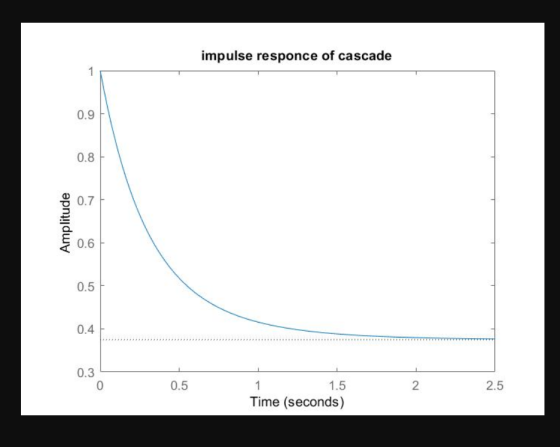
Step Response
of Cascade: Impulse response of
Parallel:
Impulse response of
Parallel:
 Step response of
Parallel:
Step response of
Parallel:
Impulse response of feedback

Impulse response of Feedback

Problem-2:
Command window


 Result:
Impulse response of Feedback
 Note: Due to
limited time, explanation is not possible this time. if you want
explanation re-post question 2 separately and you have any problem
with this answer , please comment. i will clear your doubts Thank
you.
Note: Due to
limited time, explanation is not possible this time. if you want
explanation re-post question 2 separately and you have any problem
with this answer , please comment. i will clear your doubts Thank
you.
Add Answer to:
MATLAB questions. Please answer everything and explain for
question 2.
Using the Following Functions G()1672) and...
Using the Following Functions G()1672) and H() - 54 S+1 s(s+2) 1. Enter the G(s) and H(s) functio...
 Please answer number two in detail. Thanks.
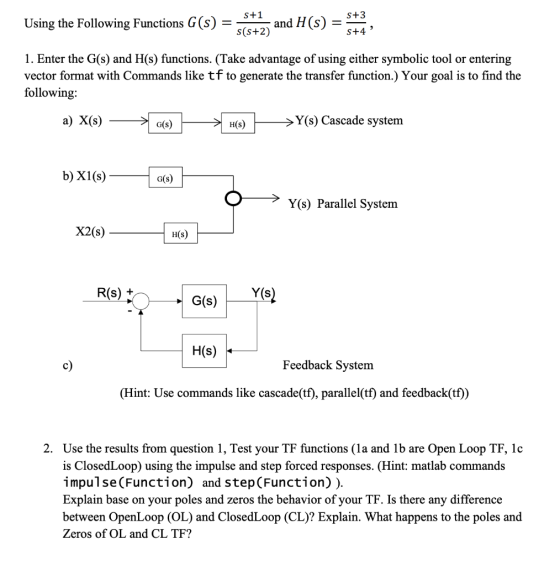
Using the Following Functions G()1672) and H() - 54 S+1 s(s+2) 1. Enter the G(s) and H(s) functions. (Take advantage of using either symbolic tool or entering vector format with Commands like tf to generate the transfer function.) Your goal is to find the following: a) X(s) G(s) H(s) Y(s) Cascade system b) X1(s) G(s) Y(s) Parallel System X2(s) H(s) c) Feedback System (Hint: Use commands like cascade(tf), parallel(tf) and feedback(tf)) 2. Use...
Please answer number two in detail. Thanks.
Using the Following Functions G()1672) and H() - 54 S+1 s(s+2) 1. Enter the G(s) and H(s) functions. (Take advantage of using either symbolic tool or entering vector format with Commands like tf to generate the transfer function.) Your goal is to find the following: a) X(s) G(s) H(s) Y(s) Cascade system b) X1(s) G(s) Y(s) Parallel System X2(s) H(s) c) Feedback System (Hint: Use commands like cascade(tf), parallel(tf) and feedback(tf)) 2. Use...
Using the Following Functions G(s) = 1 and H(s) = 1 1. Enter the G(s) and...
 Using the Following Functions G(s) = 1 and H(s) = 1 1. Enter the G(s) and H(s) functions. (Take advantage of using either symbolic tool or entering vector format with Commands like tf to generate the transfer function.) Your goal is to find the following a) X(5) - O Y ) Cascade system b) XI(6) — 6) → Y(s) Parallel System X2(8) — 20) R(S) O G() Yes H(s) Feedback System (Hint: Use commands like cascade(tf), parallel(tf) and feedback(tt)) 2....
1. Write the MATLAB commands (tf.) and zpk (...)) that yield the following trans fer functions:...
 1. Write the MATLAB commands (tf.) and zpk (...)) that yield the following trans fer functions: ii) Hy=1+1+ ii) H3-3-*+-1 (s + 1)( -2) iv) H. - 3)(8 + 4) 2. Consider the feedback system: C(0) = K * G(s) Determine the values of K, a, and b of C(s) such that the dominant-closed loop poles are located at $12 = -1 j. Use the root locus method. Provide the locations of the dominant poles. You should include the root...
Exercise 1 (Transfer Function Analysis) MATLAB provides numerous commands for working with polyno...
 Please do part C only, thank you.
Exercise 1 (Transfer Function Analysis) MATLAB provides numerous commands for working with polynomials, ratios of polynomials, partial fraction expansions and transfer functions: see, for example, the commands roots, poly, conv, residue, zpk and tf (a) Use MATLAB to gener ate the continuous-time transfer function H5+15)( +26(s+72) s(s +56)2(s2 +5s +30) H(s) displaying the result in two forms: as (i) the given ratio of factors and (ii) a ratio of two polynomials. (b) Use...
Please do part C only, thank you.
Exercise 1 (Transfer Function Analysis) MATLAB provides numerous commands for working with polynomials, ratios of polynomials, partial fraction expansions and transfer functions: see, for example, the commands roots, poly, conv, residue, zpk and tf (a) Use MATLAB to gener ate the continuous-time transfer function H5+15)( +26(s+72) s(s +56)2(s2 +5s +30) H(s) displaying the result in two forms: as (i) the given ratio of factors and (ii) a ratio of two polynomials. (b) Use...
Given the following system, where Gs(s) - -e2) Given the following system, where Gc(s) S+3 3s++2)...
 Given the following system, where Gs(s) - -e2) Given the following system, where Gc(s) S+3 3s++2) and H(s)s R(S) . Gc(s) G(s) Y(s) SOLVE IN MATLAB CODE ONLY Obtain the transfer function of the system above. Find zeros, poles, and gain of the transfer function and plot zeros and poles. Rewrite the transfer function using the partial fraction expansion. Graph the Step response. Graph the impulse response.
Note: Please draw the Root Locus plots using Rules and verify your results with Matlab Commands....
 Note: Please draw the Root Locus plots using Rules and verify your results with Matlab Commands. Enclose both plots. For the unity feedback system, with the following transfer functions (as shown in problems 1 through 4), sketch the Root- Locus plot and find the following: (a) The break-away and break-in points (b) The jw-axis crossing (c) The angle of departures / arrivals at complex poles and zeros. (d) The range of the gain K, to keep the system stable. Problem...
please show work thank you! Use Matlab to and the SISOTool construct the system for analysis...
 please show work
thank you!
Use Matlab to and the SISOTool construct the system for analysis (You may want to preview the tf and sisotool commands from matlab by typing help tf or doc tf etc...) Each Block B1, B2, B3 and B4 will be constructed individually and then concatenated together As shown in the block diagram let K=0.1 Set B1 = 0.1 by typing in matlab >>B1=0.1 To assign the Blockl values use the TF command to construct a...
please show work
thank you!
Use Matlab to and the SISOTool construct the system for analysis (You may want to preview the tf and sisotool commands from matlab by typing help tf or doc tf etc...) Each Block B1, B2, B3 and B4 will be constructed individually and then concatenated together As shown in the block diagram let K=0.1 Set B1 = 0.1 by typing in matlab >>B1=0.1 To assign the Blockl values use the TF command to construct a...
For the following systems, find the transfer function using MATLAB. Also, determine the poles and zeros...
 For the following systems, find the transfer function using MATLAB. Also, determine the poles and zeros of each transfer. You should be able to use some combination of the following MATLAB functions: 'ss2tf( )', 'ss( )', 'tf( )', 'pole( )', "zero( )', and 'roots() 100 ).y) = [0_1)|) 2 a. |x2(t)] -10 [x1 (t lx20 21 b. + 01 x1 (t) 0 x2(t) 1 u(t), y(t): ol]x3(t)] [(t)] x2(t) 3(t) [x1 (t)] [o 0 1x2(t) [x3(t)] -4 -2 0 2...
Q4. 1 2 3 G 10 pts. Use MATLAB and plot the step response of the following systems G3 2s+1 figure. Gy on the same 2s+1...
 Q4. 1 2 3 G 10 pts. Use MATLAB and plot the step response of the following systems G3 2s+1 figure. Gy on the same 2s+1 2s+1 Explain the similarities (at least 1) and differences (at least 1) between these responses. E_ figure. G, G 3 10 pts. Use MATLAB and plot the impulse response of the following systems Explain the similarities and differences between these responses. on the same 25+1 10 pts. Find the time constant (Te), pole(s), DC...
Question 2: Given the below s-plane, and that H(2)=10. Answer the following questions: jo j 0...
 Question 2: Given the below s-plane, and that H(2)=10. Answer the following questions: jo j 0 -4 -3 -2 -1 j a. Find the zeros and poles of the system? b. What is the transfer function H(S)? C. What is the impulse response (in S-domain only)? d. What is the step response (in S-domain only)?
 Please answer number two in detail. Thanks.
Using the Following Functions G()1672) and H() - 54 S+1 s(s+2) 1. Enter the G(s) and H(s) functions. (Take advantage of using either symbolic tool or entering vector format with Commands like tf to generate the transfer function.) Your goal is to find the following: a) X(s) G(s) H(s) Y(s) Cascade system b) X1(s) G(s) Y(s) Parallel System X2(s) H(s) c) Feedback System (Hint: Use commands like cascade(tf), parallel(tf) and feedback(tf)) 2. Use...
Please answer number two in detail. Thanks.
Using the Following Functions G()1672) and H() - 54 S+1 s(s+2) 1. Enter the G(s) and H(s) functions. (Take advantage of using either symbolic tool or entering vector format with Commands like tf to generate the transfer function.) Your goal is to find the following: a) X(s) G(s) H(s) Y(s) Cascade system b) X1(s) G(s) Y(s) Parallel System X2(s) H(s) c) Feedback System (Hint: Use commands like cascade(tf), parallel(tf) and feedback(tf)) 2. Use...
 Using the Following Functions G(s) = 1 and H(s) = 1 1. Enter the G(s) and H(s) functions. (Take advantage of using either symbolic tool or entering vector format with Commands like tf to generate the transfer function.) Your goal is to find the following a) X(5) - O Y ) Cascade system b) XI(6) — 6) → Y(s) Parallel System X2(8) — 20) R(S) O G() Yes H(s) Feedback System (Hint: Use commands like cascade(tf), parallel(tf) and feedback(tt)) 2....
 1. Write the MATLAB commands (tf.) and zpk (...)) that yield the following trans fer functions: ii) Hy=1+1+ ii) H3-3-*+-1 (s + 1)( -2) iv) H. - 3)(8 + 4) 2. Consider the feedback system: C(0) = K * G(s) Determine the values of K, a, and b of C(s) such that the dominant-closed loop poles are located at $12 = -1 j. Use the root locus method. Provide the locations of the dominant poles. You should include the root...
 Please do part C only, thank you.
Exercise 1 (Transfer Function Analysis) MATLAB provides numerous commands for working with polynomials, ratios of polynomials, partial fraction expansions and transfer functions: see, for example, the commands roots, poly, conv, residue, zpk and tf (a) Use MATLAB to gener ate the continuous-time transfer function H5+15)( +26(s+72) s(s +56)2(s2 +5s +30) H(s) displaying the result in two forms: as (i) the given ratio of factors and (ii) a ratio of two polynomials. (b) Use...
Please do part C only, thank you.
Exercise 1 (Transfer Function Analysis) MATLAB provides numerous commands for working with polynomials, ratios of polynomials, partial fraction expansions and transfer functions: see, for example, the commands roots, poly, conv, residue, zpk and tf (a) Use MATLAB to gener ate the continuous-time transfer function H5+15)( +26(s+72) s(s +56)2(s2 +5s +30) H(s) displaying the result in two forms: as (i) the given ratio of factors and (ii) a ratio of two polynomials. (b) Use...
 Given the following system, where Gs(s) - -e2) Given the following system, where Gc(s) S+3 3s++2) and H(s)s R(S) . Gc(s) G(s) Y(s) SOLVE IN MATLAB CODE ONLY Obtain the transfer function of the system above. Find zeros, poles, and gain of the transfer function and plot zeros and poles. Rewrite the transfer function using the partial fraction expansion. Graph the Step response. Graph the impulse response.
 Note: Please draw the Root Locus plots using Rules and verify your results with Matlab Commands. Enclose both plots. For the unity feedback system, with the following transfer functions (as shown in problems 1 through 4), sketch the Root- Locus plot and find the following: (a) The break-away and break-in points (b) The jw-axis crossing (c) The angle of departures / arrivals at complex poles and zeros. (d) The range of the gain K, to keep the system stable. Problem...
 please show work
thank you!
Use Matlab to and the SISOTool construct the system for analysis (You may want to preview the tf and sisotool commands from matlab by typing help tf or doc tf etc...) Each Block B1, B2, B3 and B4 will be constructed individually and then concatenated together As shown in the block diagram let K=0.1 Set B1 = 0.1 by typing in matlab >>B1=0.1 To assign the Blockl values use the TF command to construct a...
please show work
thank you!
Use Matlab to and the SISOTool construct the system for analysis (You may want to preview the tf and sisotool commands from matlab by typing help tf or doc tf etc...) Each Block B1, B2, B3 and B4 will be constructed individually and then concatenated together As shown in the block diagram let K=0.1 Set B1 = 0.1 by typing in matlab >>B1=0.1 To assign the Blockl values use the TF command to construct a...
 For the following systems, find the transfer function using MATLAB. Also, determine the poles and zeros of each transfer. You should be able to use some combination of the following MATLAB functions: 'ss2tf( )', 'ss( )', 'tf( )', 'pole( )', "zero( )', and 'roots() 100 ).y) = [0_1)|) 2 a. |x2(t)] -10 [x1 (t lx20 21 b. + 01 x1 (t) 0 x2(t) 1 u(t), y(t): ol]x3(t)] [(t)] x2(t) 3(t) [x1 (t)] [o 0 1x2(t) [x3(t)] -4 -2 0 2...
 Q4. 1 2 3 G 10 pts. Use MATLAB and plot the step response of the following systems G3 2s+1 figure. Gy on the same 2s+1 2s+1 Explain the similarities (at least 1) and differences (at least 1) between these responses. E_ figure. G, G 3 10 pts. Use MATLAB and plot the impulse response of the following systems Explain the similarities and differences between these responses. on the same 25+1 10 pts. Find the time constant (Te), pole(s), DC...
 Question 2: Given the below s-plane, and that H(2)=10. Answer the following questions: jo j 0 -4 -3 -2 -1 j a. Find the zeros and poles of the system? b. What is the transfer function H(S)? C. What is the impulse response (in S-domain only)? d. What is the step response (in S-domain only)?
Most questions answered within 3 hours.
-
Where is the error in this code sequence?
String s1 = "Hello";
String s2 = "ello";...
asked 11 months ago -
Financial data for Joel de Paris, Inc., for last year
follow:
Joel de Paris, Inc.
Balance...
asked 11 months ago -
Consider this reaction:
Al2(SO4)3 (aq)+ BaCl3
(aq) Al2Cl6 (aq)- +
3BaSO4(s) . What is the...
asked 11 months ago -
Suppose that Savneet is considering increasing her
recent random sample from 20 car rentals to 40...
asked 11 months ago -
Trucks arrive at an unloading terminal at an average rate of 120
per hour.
Trucks arrive...
asked 11 months ago -
Why are methanol and ethanol completely soluble in water while
octanol is not very little soluble....
asked 11 months ago -
A facilities manager at a university reads in a research report
that the mean amount of...
asked 11 months ago -
When the CuSO4 is rehydrated by adding water to the anhydrous
compound, is this an endothermic...
asked 11 months ago -
A ray of sunlight is passing from diamond into crown glass; the
angle of incidence is...
asked 11 months ago -
A block of mass 0.249 kg is placed on top of a light, vertical
spring of...
asked 11 months ago -
how do the kidneys compensate in the presences of acidosis
a) trigger hyperventilate
b) reserve acid...
asked 11 months ago -
Question 501 pts
The rental rate of capital to the firm increases. Which of the
following...
asked 11 months ago