Which of the following is not evidence for the wave nature of matter? A) The photoelectric...
Which of the following is not evidence for the wave nature of matter?
A) The photoelectric effect
B) The diffraction pattern obtained when electrons pass through a slit
C) Electron tunneling
D) The validity of the Heisenberg uncertainty principle
E) The interference pattern obtained when electrons pass through a two-slit system
Homework Answers
Request Answer!
We need at least 10 more requests to produce the answer.
0 / 10 have requested this problem solution
The more requests, the faster the answer.
Add Answer to:
Which of the following is not evidence
for the wave nature of matter?
A) The photoelectric...
Matter Waves - Double Slit Interference Previously we learned the wave behaviors of light - the...
 Matter Waves - Double Slit Interference Previously we learned the wave behaviors of light - the single-slit diffraction, and the double-slit interference. In this problem, you will explore the wave behaviors of matter (particles). Double Slit Screen Interference y=Ltane 0 L bright fringes: sine Dark fringes above central sin 8 = (m m-0, 11, 12(constructive) (destructive). Matter Waves - Double Slit electrons Max Men Max photons Electrons pass through a double slit separated by d = 0.0100 um, 1um =...
17. The distance between an electron and a hole across a band gap following electronic excitation...
 17. The distance between an electron and a hole across a band gap following electronic excitation is called A. Bohr exciton radius B. Bohr radius C. quantum D. conduction band 18. When a photon strikes an atom, the energy is absorbed by A. a proton which moves to an excited state. B. a neutron which causes the nucleus to split. C. an electron which moves from the ground to an excited state. D. nothing. A photon is never absorbed by...
J. J. Thompson’s measurement of e/m for the electron provides evidence for the wave nature of...
J. J. Thompson’s measurement of e/m for the electron provides evidence for the wave nature of matter. particle nature of matter. wave nature of radiation. particle nature of radiation.
An electron in an atom can be in one of ___ unique quantum states with the...
An electron in an atom can be in one of ___ unique quantum states with the principle quantum number n = 3 and angular momentum quantum number l = 1 a: 18 b: 3 c: 10 d: 6 e: 8 A beam of mono-energetic electrons are directed toward a wall with two separate slits (A and B). A sheet of film placed on the other side of the slits records the positions of the electrons that pass through the slits...
please help with both pages. thank you in advance. 1. Why is the wave model, not...
 please help with both pages. thank you in advance.
1. Why is the wave model, not ray model, of light is accurate when discussing diffraction and interference? 2. Describe the effects of diffraction; the bending of light waves, as an aperture (opening) becomes smaller and approaches the wavelength of the light source 3. Describe the phase condition for two waves to create constructive interference. Write the mathematical expression for location of interference maximas 4. Describe the phase condition for two...
please help with both pages. thank you in advance.
1. Why is the wave model, not ray model, of light is accurate when discussing diffraction and interference? 2. Describe the effects of diffraction; the bending of light waves, as an aperture (opening) becomes smaller and approaches the wavelength of the light source 3. Describe the phase condition for two waves to create constructive interference. Write the mathematical expression for location of interference maximas 4. Describe the phase condition for two...
The photoelectric effect demonstrates the quantized nature of light. a) What is the kinetic energy and...
The photoelectric effect demonstrates the quantized nature of light. a) What is the kinetic energy and speed of an electron ejected from a Na surface with work function 2.28 eV when illuminated by light of wavelength i) 410 nm ii) 600 nm? b) What is the critical frequency fo of incident light below which no electrons are ejected? c) Sketch a graph of kinetic energy of the ejected electron vs. frequency of incident light for the photoelectric effect in sodium....
E pour Match the evidence and reasoning to support the claim: Light is a particle. Evidence:...
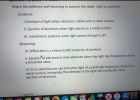 E pour Match the evidence and reasoning to support the claim: Light is a particle. Evidence: 1. Emission of light when electrons collide with a metal surface. 11. Ejection of electrons when light shines on a metal surface. III. Interference patterns when light passes through a slit. Reasoning: IV. Diffraction is a characteristic property of particles. V. Ejection of electrons is only observed when the light has frequencies above a threshold value. VI. If no electrons are ejected when light...
1. If light with a frequency below the cutoff frequency for a certain metal hits that...
1. If light with a frequency below the cutoff frequency for a certain metal hits that metal: Question 1 options: electrons will be ejected after the intensity of the light reaches a certain value no electrons will be ejected electrons will be ejected, but will fall back to the metal the light will be re-radiated by the metal I don't know. 2. One electron-volt is equivalent to Question 2 options: 1 J 1 V 1.6 x 10^-19 J 1.6 x...
Learning Goal: To understand de Broglie waves and the calculation of wave properties. In 1924, Louis...
Learning Goal: To understand de Broglie waves and the calculation of wave properties. In 1924, Louis de Broglie postulated that particles such as electrons and protons might exhibit wavelike properties. His thinking was guided by the notion that light has both wave and particle characteristics, so he postulated that particles such as electrons and protons would obey the same wavelength-momentum relation as that obeyed by light: λ=h/p, where λ is the wavelength, p the momentum, and h Planck's constant. Part...
1. Unpolarized light is incident upon a polarizer whose axis is tilted 30 degrees relative to...
1. Unpolarized light is incident upon a polarizer whose axis is tilted 30 degrees relative to vertical. What fraction of the light is transmitted through the polarizer? 2. In a two-slit interference pattern, the pattern becomes fainter as we move away from the central maximum due to Question 4 options: Interference Diffraction Resolution The Rayleigh criterion I don't know. 3. Huygens' principle states that Question 3 options: Monocromatic light incident upon two slits will form an interference pattern. Monocromatic light...
 Matter Waves - Double Slit Interference Previously we learned the wave behaviors of light - the single-slit diffraction, and the double-slit interference. In this problem, you will explore the wave behaviors of matter (particles). Double Slit Screen Interference y=Ltane 0 L bright fringes: sine Dark fringes above central sin 8 = (m m-0, 11, 12(constructive) (destructive). Matter Waves - Double Slit electrons Max Men Max photons Electrons pass through a double slit separated by d = 0.0100 um, 1um =...
 17. The distance between an electron and a hole across a band gap following electronic excitation is called A. Bohr exciton radius B. Bohr radius C. quantum D. conduction band 18. When a photon strikes an atom, the energy is absorbed by A. a proton which moves to an excited state. B. a neutron which causes the nucleus to split. C. an electron which moves from the ground to an excited state. D. nothing. A photon is never absorbed by...
 please help with both pages. thank you in advance.
1. Why is the wave model, not ray model, of light is accurate when discussing diffraction and interference? 2. Describe the effects of diffraction; the bending of light waves, as an aperture (opening) becomes smaller and approaches the wavelength of the light source 3. Describe the phase condition for two waves to create constructive interference. Write the mathematical expression for location of interference maximas 4. Describe the phase condition for two...
please help with both pages. thank you in advance.
1. Why is the wave model, not ray model, of light is accurate when discussing diffraction and interference? 2. Describe the effects of diffraction; the bending of light waves, as an aperture (opening) becomes smaller and approaches the wavelength of the light source 3. Describe the phase condition for two waves to create constructive interference. Write the mathematical expression for location of interference maximas 4. Describe the phase condition for two...
 E pour Match the evidence and reasoning to support the claim: Light is a particle. Evidence: 1. Emission of light when electrons collide with a metal surface. 11. Ejection of electrons when light shines on a metal surface. III. Interference patterns when light passes through a slit. Reasoning: IV. Diffraction is a characteristic property of particles. V. Ejection of electrons is only observed when the light has frequencies above a threshold value. VI. If no electrons are ejected when light...
Most questions answered within 3 hours.
-
Where is the error in this code sequence?
String s1 = "Hello";
String s2 = "ello";...
asked 11 months ago -
Financial data for Joel de Paris, Inc., for last year
follow:
Joel de Paris, Inc.
Balance...
asked 11 months ago -
Consider this reaction:
Al2(SO4)3 (aq)+ BaCl3
(aq) Al2Cl6 (aq)- +
3BaSO4(s) . What is the...
asked 11 months ago -
Suppose that Savneet is considering increasing her
recent random sample from 20 car rentals to 40...
asked 11 months ago -
Trucks arrive at an unloading terminal at an average rate of 120
per hour.
Trucks arrive...
asked 11 months ago -
Why are methanol and ethanol completely soluble in water while
octanol is not very little soluble....
asked 11 months ago -
A facilities manager at a university reads in a research report
that the mean amount of...
asked 11 months ago -
When the CuSO4 is rehydrated by adding water to the anhydrous
compound, is this an endothermic...
asked 11 months ago -
A ray of sunlight is passing from diamond into crown glass; the
angle of incidence is...
asked 11 months ago -
A block of mass 0.249 kg is placed on top of a light, vertical
spring of...
asked 11 months ago -
how do the kidneys compensate in the presences of acidosis
a) trigger hyperventilate
b) reserve acid...
asked 11 months ago -
Question 501 pts
The rental rate of capital to the firm increases. Which of the
following...
asked 11 months ago