a net force 28N is acting on a falling object. It experiences an air resistance of...
Homework Answers
Net force Fnet = 28 N;
AIR resistance Fa = 8.5 N:
let mass of the object is m kg;
then force of gravity F = mg;
Fnet = gravity force - air resistance;
28 = F - Fa;
28 = mg - 8.5;
mg = 36.5;
m = 3.72 kg
Add Answer to:
a
net force 28N is acting on a falling object. It experiences an air
resistance of...
A 793 N object falling in the air experiences 293 N of air resistance. What is...
A 793 N object falling in the air experiences 293 N of air resistance. What is the amount net force of the falling object? Please report your answer with no number behind the decimal and use the abbreviated form of the unit.
A package of mass 50 kg is dropped from a helicopter and experiences a drag force...
A package of mass 50 kg is dropped from a helicopter and experiences a drag force of 120 N due to air resistance. Find the resultant force and use it to calculate the acceleration of the package during the fall. Take the acceleration due to gravity as g = 9.81 m s-2 and give your answer in m s-2 to 1 decimal place. Answer: Answer m s-2
When an object falls in Earth's gravitational field (think of a skydiver jumping from an airplane or a marble falling in a tank of oil)
 When an object falls in Earth's gravitational field (think of a skydiver jumping from an airplane or a marble falling in a tank of oil), it accelerates due to the force of gravity. If gravity were the only force acting on the object, then all objects-elephants and feathers alike would fall at the same rate. But gravity is not the only force present. Moving objects also experience resistance or friction from the surrounding medium; it would be air resistance for...
1.There is a falling object, whose mass is A [kg] and experiences a force (its own weight) equal ...
1.There is a falling object, whose mass is A [kg] and experiences a force (its own weight) equal numerically to A times 9.81. The object starts from rest and the air causes a retarding force numerically equal to B times its velocity. a)Find general expression for velocity as a function of time, and draw its graph. b)Evaluate velocity for t = C (s) Depending on your value of R choose R A B C 0 6 0.180 4 1 7 ...
An object falling through air experiences a drag force that is proportional to the square of...
An object falling through air experiences a drag force that is proportional to the square of its speed. If its cross-sectional area is defined as A, its terminal speed is proportional to: A. A-1 B. A1/2 C. A2 D. A-1/2
An object experiences a net force of 20 N and has an acceleration of 4 m/s2....
An object experiences a net force of 20 N and has an acceleration of 4 m/s2. The object’s mass must be 20 kg 5 kg 80 kg 2 kg
Suppose a 2 kg object is falling through the air and accelerating downwards at 8 m/s2....
Suppose a 2 kg object is falling through the air and accelerating downwards at 8 m/s2. Taking g = 10 m/s2 What is the magnitude and direction of the force of air resistance on it? 2N downward 2N upward 1N downward 1N upward
A 10N (weight) falling object encounters 8.0N of air resistance. What is the mass of the...
A 10N (weight) falling object encounters 8.0N of air resistance. What is the mass of the object? What is the acceleration?
A 4.0 kg object experiences a3 forces acting on it. Force 1 is 7.5 N pointing...
A 4.0 kg object experiences a3 forces acting on it. Force 1 is 7.5 N pointing east. Force 2 is 13 N pointing south. Force 3 is 11 N, measured 53 degrees north of east. What is the net acceleration of this object?
Question 19 4 points Save Answer Calculate the normal force, N, acting on a rider in...
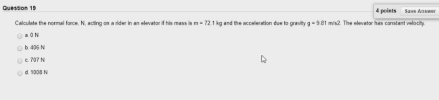 Question 19 4 points Save Answer Calculate the normal force, N, acting on a rider in an elevator if his mass is m 72.1 kg and the acceleration due to gravity g 9.81 m/s2. The elevator has constant velocity a ON b 406 N 。c. 707 N O d. 1008 N
 When an object falls in Earth's gravitational field (think of a skydiver jumping from an airplane or a marble falling in a tank of oil), it accelerates due to the force of gravity. If gravity were the only force acting on the object, then all objects-elephants and feathers alike would fall at the same rate. But gravity is not the only force present. Moving objects also experience resistance or friction from the surrounding medium; it would be air resistance for...
 Question 19 4 points Save Answer Calculate the normal force, N, acting on a rider in an elevator if his mass is m 72.1 kg and the acceleration due to gravity g 9.81 m/s2. The elevator has constant velocity a ON b 406 N 。c. 707 N O d. 1008 N
Most questions answered within 3 hours.
-
Where is the error in this code sequence?
String s1 = "Hello";
String s2 = "ello";...
asked 10 months ago -
Financial data for Joel de Paris, Inc., for last year
follow:
Joel de Paris, Inc.
Balance...
asked 10 months ago -
Consider this reaction:
Al2(SO4)3 (aq)+ BaCl3
(aq) Al2Cl6 (aq)- +
3BaSO4(s) . What is the...
asked 10 months ago -
Suppose that Savneet is considering increasing her
recent random sample from 20 car rentals to 40...
asked 10 months ago -
Trucks arrive at an unloading terminal at an average rate of 120
per hour.
Trucks arrive...
asked 10 months ago -
Why are methanol and ethanol completely soluble in water while
octanol is not very little soluble....
asked 10 months ago -
A facilities manager at a university reads in a research report
that the mean amount of...
asked 10 months ago -
When the CuSO4 is rehydrated by adding water to the anhydrous
compound, is this an endothermic...
asked 10 months ago -
A ray of sunlight is passing from diamond into crown glass; the
angle of incidence is...
asked 10 months ago -
A block of mass 0.249 kg is placed on top of a light, vertical
spring of...
asked 10 months ago -
how do the kidneys compensate in the presences of acidosis
a) trigger hyperventilate
b) reserve acid...
asked 10 months ago -
Question 501 pts
The rental rate of capital to the firm increases. Which of the
following...
asked 10 months ago