

Homework Answers
Add Answer to:
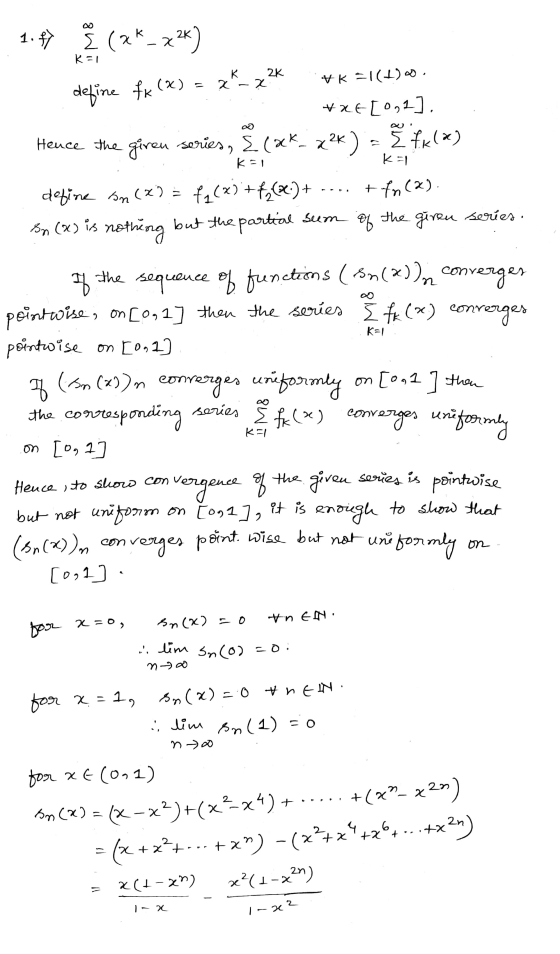
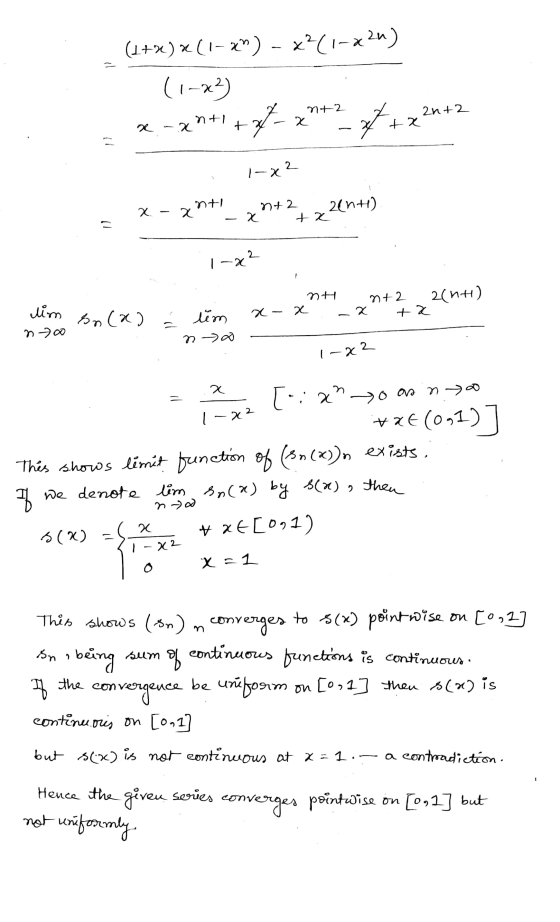
Exercise Set 7.2 Using the theorems and corollaries of this section, prove that each of the...
(2) Let {fJ be a sequence of continuous, real-valued functions that converges uniformly on the in...
 (2) Let {fJ be a sequence of continuous, real-valued functions that converges uniformly on the interval [0,1 (a) Show that there exists M> 0 such that n(x) M for all r E [0,1] and all n N. (b) Does the result in part (a) hold if uniform convergence is replaced by pointwise convergence? Prove or give a counterexample
(2) Let {fJ be a sequence of continuous, real-valued functions that converges uniformly on the interval [0,1 (a) Show that there exists...
(2) Let {fJ be a sequence of continuous, real-valued functions that converges uniformly on the interval [0,1 (a) Show that there exists M> 0 such that n(x) M for all r E [0,1] and all n N. (b) Does the result in part (a) hold if uniform convergence is replaced by pointwise convergence? Prove or give a counterexample
(2) Let {fJ be a sequence of continuous, real-valued functions that converges uniformly on the interval [0,1 (a) Show that there exists...
(1) Prove the Abel criterion for uniform convergence: 4. Suppose the series of functions 2 (x converges uniformly in some interval I. Suppose for every x E I, san(x)) forms a monotonic series, and th...
 (1) Prove the Abel criterion for uniform convergence: 4. Suppose the series of functions 2 (x converges uniformly in some interval I. Suppose for every x E I, san(x)) forms a monotonic series, and that there is a constant K such that Then the series converges uniformly in I. (2) Using Abel criterion, compute the following limit: m- n 1 rn n=
(1) Prove the Abel criterion for uniform convergence: 4. Suppose the series of functions 2 (x converges uniformly...
(1) Prove the Abel criterion for uniform convergence: 4. Suppose the series of functions 2 (x converges uniformly in some interval I. Suppose for every x E I, san(x)) forms a monotonic series, and that there is a constant K such that Then the series converges uniformly in I. (2) Using Abel criterion, compute the following limit: m- n 1 rn n=
(1) Prove the Abel criterion for uniform convergence: 4. Suppose the series of functions 2 (x converges uniformly...
Please answer in the style of a formal proof and thoroughly reference any theorems, lemmas or...
 Please answer in the style of a formal proof and thoroughly
reference any theorems, lemmas or corollaries utilized.
BUC
stands for bounded uniformly continuous
Let (X, d) be a metric space. Show that the set V of Lipschitz continu- ous bounded functions from X to R is a dense linear subspace of BUC(X, R). Since, in general, V #BUC(X, R), V is not a closed subset of BUC(X, R). Hint: For f EBUC(X, R) define the sequence (fr) by fn(x)...
Please answer in the style of a formal proof and thoroughly
reference any theorems, lemmas or corollaries utilized.
BUC
stands for bounded uniformly continuous
Let (X, d) be a metric space. Show that the set V of Lipschitz continu- ous bounded functions from X to R is a dense linear subspace of BUC(X, R). Since, in general, V #BUC(X, R), V is not a closed subset of BUC(X, R). Hint: For f EBUC(X, R) define the sequence (fr) by fn(x)...
. Prove that sequence in Example 6.2.2 (i) on p.174 converges uniformly to r on any inteval [a, b]. Prove that the...
 . Prove that sequence in Example 6.2.2 (i) on p.174 converges uniformly to r on any inteval [a, b]. Prove that the convergence cannot be uniform on [0, 0o) J() d tel argue thau Jn J Exercise 6.2.6. Assume fn → f on a set A. Theorem 6.2.6 is an example of a typical type of question which asks whether a trait possessed by each fn is inherited by the limit function. Provide an example to show that all of...
Let {h} be a sequence ofRiemann integrable functions on [a,b], such that for each x, {h(x)) is a decreasing sequence. Suppose n) converges pointwise to a Riemann integrable function f Prove that f(x)...
 Let {h} be a sequence ofRiemann integrable functions on [a,b], such that for each x, {h(x)) is a decreasing sequence. Suppose n) converges pointwise to a Riemann integrable function f Prove that f(x)dxf(x)dx. lim n00
Let {h} be a sequence ofRiemann integrable functions on [a,b], such that for each x, {h(x)) is a decreasing sequence. Suppose n) converges pointwise to a Riemann integrable function f Prove that f(x)dxf(x)dx. lim n00
Let {h} be a sequence ofRiemann integrable functions on [a,b], such that for each x, {h(x)) is a decreasing sequence. Suppose n) converges pointwise to a Riemann integrable function f Prove that f(x)dxf(x)dx. lim n00
plz help me analysis question! Thanks in advance 5. For each n є N let fn : R R be given by f,(x)-imrz. Prove that the...
 plz help me analysis question! Thanks in advance
5. For each n є N let fn : R R be given by f,(x)-imrz. Prove that the sequence {f. of functions converges pointwise to the function f R- R given by 1+nr if x#0 f(x)-0
5. For each n є N let fn : R R be given by f,(x)-imrz. Prove that the sequence {f. of functions converges pointwise to the function f R- R given by 1+nr if x#0 f(x)-0
plz help me analysis question! Thanks in advance
5. For each n є N let fn : R R be given by f,(x)-imrz. Prove that the sequence {f. of functions converges pointwise to the function f R- R given by 1+nr if x#0 f(x)-0
5. For each n є N let fn : R R be given by f,(x)-imrz. Prove that the sequence {f. of functions converges pointwise to the function f R- R given by 1+nr if x#0 f(x)-0
prove each of the following theorems using weak induction 1 Weak Induction Prove each of the...
 prove each of the following theorems using weak
induction
1 Weak Induction Prove each of the following theorems using weak induction. Theorem 1. an = 10.4" is a closed form for an = 4an-1 with ao = 10. Theorem 2. an = (-3)"-1.15 is a closed form for an = -3an-1 with a1 = 15. Theorem 3. In E NU{0}, D, 21 = 2n+1 -1. Theorem 4. Vn e N, 2" <2n+1 - 2n-1 – 1. Theorem 5. In E...
prove each of the following theorems using weak
induction
1 Weak Induction Prove each of the following theorems using weak induction. Theorem 1. an = 10.4" is a closed form for an = 4an-1 with ao = 10. Theorem 2. an = (-3)"-1.15 is a closed form for an = -3an-1 with a1 = 15. Theorem 3. In E NU{0}, D, 21 = 2n+1 -1. Theorem 4. Vn e N, 2" <2n+1 - 2n-1 – 1. Theorem 5. In E...
PLEASE ANSWER ALL! SHOWS STEPS 2. (a) Prove by using the definition of convergence only, without using limit theo- (b) Prove by using the definition of continuity, or by using the є_ó property, that 3...
 PLEASE ANSWER ALL! SHOWS STEPS
2. (a) Prove by using the definition of convergence only, without using limit theo- (b) Prove by using the definition of continuity, or by using the є_ó property, that 3. Let f be a twice differentiable function defined on the closed interval [0, 1]. Suppose rems, that if (S) is a sequence converging to s, then lim, 10 2 f (x) is a continuous function on R r,s,t e [0,1] are defined so that r...
PLEASE ANSWER ALL! SHOWS STEPS
2. (a) Prove by using the definition of convergence only, without using limit theo- (b) Prove by using the definition of continuity, or by using the є_ó property, that 3. Let f be a twice differentiable function defined on the closed interval [0, 1]. Suppose rems, that if (S) is a sequence converging to s, then lim, 10 2 f (x) is a continuous function on R r,s,t e [0,1] are defined so that r...
4. Suppose (fr)nen is a sequence of functions on [0, 1] such that each fn is...
 4. Suppose (fr)nen is a sequence of functions on [0, 1] such that each fn is differentiable on (0,1) and f(x) < 1 for all x € (0,1) and n e N. (a) If (fn (0))nen converges to a number A, prove that lim sup|fn(x) = 1+|A| for all x € [0, 1]. n-too : (b) Suppose that (fr) converges uniformly on [0, 1] to a function F : [0, 1] + R. Is F necessarily differentiable on (0,1)? If...
PLEASE use the THEORY below to give PROOF STEP BY STEP. This is an analysis class. Thank you. application of power series\Weierstrass M-test\term by term differentiability of power series sequence an...
 PLEASE use the THEORY below to
give PROOF STEP BY STEP. This is an analysis class. Thank
you.
application of power series\Weierstrass M-test\term by term
differentiability of power series
sequence and series of function: pointwise and the theorem of
uniform convergence
which function is integrable: continuous and monotone
Fri 19 Apr: The Fundamental Theorem of Calculus. (§7.5.)
Wed 17 Apr: Example (∫10x2dx=1/3∫01x2dx=1/3). Basic properties
of the integral. (mostly Theorem 7.4.2.)
Fri 12 Apr: More on integrability, basic properties of the...
PLEASE use the THEORY below to
give PROOF STEP BY STEP. This is an analysis class. Thank
you.
application of power series\Weierstrass M-test\term by term
differentiability of power series
sequence and series of function: pointwise and the theorem of
uniform convergence
which function is integrable: continuous and monotone
Fri 19 Apr: The Fundamental Theorem of Calculus. (§7.5.)
Wed 17 Apr: Example (∫10x2dx=1/3∫01x2dx=1/3). Basic properties
of the integral. (mostly Theorem 7.4.2.)
Fri 12 Apr: More on integrability, basic properties of the...
 (2) Let {fJ be a sequence of continuous, real-valued functions that converges uniformly on the interval [0,1 (a) Show that there exists M> 0 such that n(x) M for all r E [0,1] and all n N. (b) Does the result in part (a) hold if uniform convergence is replaced by pointwise convergence? Prove or give a counterexample
(2) Let {fJ be a sequence of continuous, real-valued functions that converges uniformly on the interval [0,1 (a) Show that there exists...
(2) Let {fJ be a sequence of continuous, real-valued functions that converges uniformly on the interval [0,1 (a) Show that there exists M> 0 such that n(x) M for all r E [0,1] and all n N. (b) Does the result in part (a) hold if uniform convergence is replaced by pointwise convergence? Prove or give a counterexample
(2) Let {fJ be a sequence of continuous, real-valued functions that converges uniformly on the interval [0,1 (a) Show that there exists...
 (1) Prove the Abel criterion for uniform convergence: 4. Suppose the series of functions 2 (x converges uniformly in some interval I. Suppose for every x E I, san(x)) forms a monotonic series, and that there is a constant K such that Then the series converges uniformly in I. (2) Using Abel criterion, compute the following limit: m- n 1 rn n=
(1) Prove the Abel criterion for uniform convergence: 4. Suppose the series of functions 2 (x converges uniformly...
(1) Prove the Abel criterion for uniform convergence: 4. Suppose the series of functions 2 (x converges uniformly in some interval I. Suppose for every x E I, san(x)) forms a monotonic series, and that there is a constant K such that Then the series converges uniformly in I. (2) Using Abel criterion, compute the following limit: m- n 1 rn n=
(1) Prove the Abel criterion for uniform convergence: 4. Suppose the series of functions 2 (x converges uniformly...
 Please answer in the style of a formal proof and thoroughly
reference any theorems, lemmas or corollaries utilized.
BUC
stands for bounded uniformly continuous
Let (X, d) be a metric space. Show that the set V of Lipschitz continu- ous bounded functions from X to R is a dense linear subspace of BUC(X, R). Since, in general, V #BUC(X, R), V is not a closed subset of BUC(X, R). Hint: For f EBUC(X, R) define the sequence (fr) by fn(x)...
Please answer in the style of a formal proof and thoroughly
reference any theorems, lemmas or corollaries utilized.
BUC
stands for bounded uniformly continuous
Let (X, d) be a metric space. Show that the set V of Lipschitz continu- ous bounded functions from X to R is a dense linear subspace of BUC(X, R). Since, in general, V #BUC(X, R), V is not a closed subset of BUC(X, R). Hint: For f EBUC(X, R) define the sequence (fr) by fn(x)...
 . Prove that sequence in Example 6.2.2 (i) on p.174 converges uniformly to r on any inteval [a, b]. Prove that the convergence cannot be uniform on [0, 0o) J() d tel argue thau Jn J Exercise 6.2.6. Assume fn → f on a set A. Theorem 6.2.6 is an example of a typical type of question which asks whether a trait possessed by each fn is inherited by the limit function. Provide an example to show that all of...
 Let {h} be a sequence ofRiemann integrable functions on [a,b], such that for each x, {h(x)) is a decreasing sequence. Suppose n) converges pointwise to a Riemann integrable function f Prove that f(x)dxf(x)dx. lim n00
Let {h} be a sequence ofRiemann integrable functions on [a,b], such that for each x, {h(x)) is a decreasing sequence. Suppose n) converges pointwise to a Riemann integrable function f Prove that f(x)dxf(x)dx. lim n00
Let {h} be a sequence ofRiemann integrable functions on [a,b], such that for each x, {h(x)) is a decreasing sequence. Suppose n) converges pointwise to a Riemann integrable function f Prove that f(x)dxf(x)dx. lim n00
 plz help me analysis question! Thanks in advance
5. For each n є N let fn : R R be given by f,(x)-imrz. Prove that the sequence {f. of functions converges pointwise to the function f R- R given by 1+nr if x#0 f(x)-0
5. For each n є N let fn : R R be given by f,(x)-imrz. Prove that the sequence {f. of functions converges pointwise to the function f R- R given by 1+nr if x#0 f(x)-0
plz help me analysis question! Thanks in advance
5. For each n є N let fn : R R be given by f,(x)-imrz. Prove that the sequence {f. of functions converges pointwise to the function f R- R given by 1+nr if x#0 f(x)-0
5. For each n є N let fn : R R be given by f,(x)-imrz. Prove that the sequence {f. of functions converges pointwise to the function f R- R given by 1+nr if x#0 f(x)-0
 prove each of the following theorems using weak
induction
1 Weak Induction Prove each of the following theorems using weak induction. Theorem 1. an = 10.4" is a closed form for an = 4an-1 with ao = 10. Theorem 2. an = (-3)"-1.15 is a closed form for an = -3an-1 with a1 = 15. Theorem 3. In E NU{0}, D, 21 = 2n+1 -1. Theorem 4. Vn e N, 2" <2n+1 - 2n-1 – 1. Theorem 5. In E...
prove each of the following theorems using weak
induction
1 Weak Induction Prove each of the following theorems using weak induction. Theorem 1. an = 10.4" is a closed form for an = 4an-1 with ao = 10. Theorem 2. an = (-3)"-1.15 is a closed form for an = -3an-1 with a1 = 15. Theorem 3. In E NU{0}, D, 21 = 2n+1 -1. Theorem 4. Vn e N, 2" <2n+1 - 2n-1 – 1. Theorem 5. In E...
 PLEASE ANSWER ALL! SHOWS STEPS
2. (a) Prove by using the definition of convergence only, without using limit theo- (b) Prove by using the definition of continuity, or by using the є_ó property, that 3. Let f be a twice differentiable function defined on the closed interval [0, 1]. Suppose rems, that if (S) is a sequence converging to s, then lim, 10 2 f (x) is a continuous function on R r,s,t e [0,1] are defined so that r...
PLEASE ANSWER ALL! SHOWS STEPS
2. (a) Prove by using the definition of convergence only, without using limit theo- (b) Prove by using the definition of continuity, or by using the є_ó property, that 3. Let f be a twice differentiable function defined on the closed interval [0, 1]. Suppose rems, that if (S) is a sequence converging to s, then lim, 10 2 f (x) is a continuous function on R r,s,t e [0,1] are defined so that r...
 4. Suppose (fr)nen is a sequence of functions on [0, 1] such that each fn is differentiable on (0,1) and f(x) < 1 for all x € (0,1) and n e N. (a) If (fn (0))nen converges to a number A, prove that lim sup|fn(x) = 1+|A| for all x € [0, 1]. n-too : (b) Suppose that (fr) converges uniformly on [0, 1] to a function F : [0, 1] + R. Is F necessarily differentiable on (0,1)? If...
 PLEASE use the THEORY below to
give PROOF STEP BY STEP. This is an analysis class. Thank
you.
application of power series\Weierstrass M-test\term by term
differentiability of power series
sequence and series of function: pointwise and the theorem of
uniform convergence
which function is integrable: continuous and monotone
Fri 19 Apr: The Fundamental Theorem of Calculus. (§7.5.)
Wed 17 Apr: Example (∫10x2dx=1/3∫01x2dx=1/3). Basic properties
of the integral. (mostly Theorem 7.4.2.)
Fri 12 Apr: More on integrability, basic properties of the...
PLEASE use the THEORY below to
give PROOF STEP BY STEP. This is an analysis class. Thank
you.
application of power series\Weierstrass M-test\term by term
differentiability of power series
sequence and series of function: pointwise and the theorem of
uniform convergence
which function is integrable: continuous and monotone
Fri 19 Apr: The Fundamental Theorem of Calculus. (§7.5.)
Wed 17 Apr: Example (∫10x2dx=1/3∫01x2dx=1/3). Basic properties
of the integral. (mostly Theorem 7.4.2.)
Fri 12 Apr: More on integrability, basic properties of the...
Most questions answered within 3 hours.
-
Where is the error in this code sequence?
String s1 = "Hello";
String s2 = "ello";...
asked 10 months ago -
Financial data for Joel de Paris, Inc., for last year
follow:
Joel de Paris, Inc.
Balance...
asked 10 months ago -
Consider this reaction:
Al2(SO4)3 (aq)+ BaCl3
(aq) Al2Cl6 (aq)- +
3BaSO4(s) . What is the...
asked 10 months ago -
Suppose that Savneet is considering increasing her
recent random sample from 20 car rentals to 40...
asked 10 months ago -
Trucks arrive at an unloading terminal at an average rate of 120
per hour.
Trucks arrive...
asked 10 months ago -
Why are methanol and ethanol completely soluble in water while
octanol is not very little soluble....
asked 10 months ago -
A facilities manager at a university reads in a research report
that the mean amount of...
asked 10 months ago -
When the CuSO4 is rehydrated by adding water to the anhydrous
compound, is this an endothermic...
asked 10 months ago -
A ray of sunlight is passing from diamond into crown glass; the
angle of incidence is...
asked 10 months ago -
A block of mass 0.249 kg is placed on top of a light, vertical
spring of...
asked 10 months ago -
how do the kidneys compensate in the presences of acidosis
a) trigger hyperventilate
b) reserve acid...
asked 10 months ago -
Question 501 pts
The rental rate of capital to the firm increases. Which of the
following...
asked 10 months ago