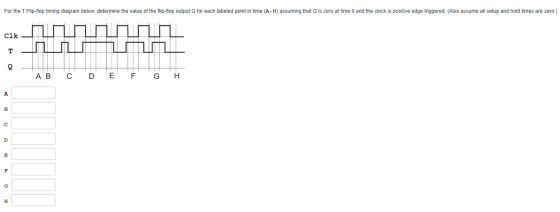
For the T Flip-flop timing diagram below, determine the value of the flip-flop output Q for each labeled point in time (A-H) assuming that Q is zero at time 0 and the clock is positive edge triggered. (Also assume all setup and hold times are zero.)
Homework Answers
![Answer :- cik +2772 John - - -- m- truth table for T Flipflop CK TO TX lo Oo Ao B= scanner at CamScanner Dilo .G=10] E=1 H= m](http://img.homeworklib.com/questions/ae745050-fdc9-11eb-aee1-ffe0a2a30f36.png?x-oss-process=image/resize,w_560)
Add Answer to:
For the T Flip-flop timing diagram below, determine the value of
the flip-flop output Q for...
For the input shown below, draw the timing diagrams for the flip flop output Q (assume...
 For the input shown below, draw the timing diagrams for the flip flop output Q (assume negative edge triggered flip flops) 1 CLOCK D or T CLR PRE 1.1 Assume a D flip-flop without a clear or preset 1.2 Assume a D flip-flop with active low clear CLR' 1.3 Assume a D flip-flop with active low clear CLR' and preset PRE 1.4 Assume a T flip-flop without a clear or preset (Q is initially 1) 1.5 Assume a T flip-flop...
Please give me explanation. The JK flip-flop 1. The figure below is a timing diagram for...
 Please give me
explanation.
The JK flip-flop 1. The figure below is a timing diagram for the J, K, and clock inputs of a positive edge-triggered JK-flip-flop. Draw the corresponding Q and Q' outputs. (4 points) clockoUU Q'
Please give me
explanation.
The JK flip-flop 1. The figure below is a timing diagram for the J, K, and clock inputs of a positive edge-triggered JK-flip-flop. Draw the corresponding Q and Q' outputs. (4 points) clockoUU Q'
e Q and Q output waveforms of the flip-flop in Figure 6-18 for the D and...
 e Q and Q output waveforms of the flip-flop in Figure 6-18 for the D and CLK inpusts in Figure 6-19.(a). Assume that the positive edge-triggered flip-flop is initially RESEI CLK 4. For the positive edge-triggered J-K flip-flop with preset and clear inputs in Figure 6-27, determine the Q output for the inputs shown in the timing diagram in part (a) if Q is initially LOW CLK 几几几几几几 PRE PRE CLR CLR 5. Use a K-map to reduce the following...
102. Determine the output state Q during 5th clock cycle for positive-edge triggered SR Flip Flop...
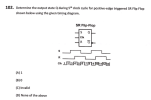 102. Determine the output state Q during 5th clock cycle for positive-edge triggered SR Flip Flop shown below using the given timing diagram. SR Flip-Flop SQL — сік | T1 Cik 1 2 3 4 5 6 7 8 9 10 11 12 13 (A) 1 (B) O (C) Invalid (D) None of the above
please show all work JK Flip-Flop S R Flip-Flop From(Q) To (Q+) S 0 0 R...
 please show all work
JK Flip-Flop S R Flip-Flop From(Q) To (Q+) S 0 0 R T Flip-Flop From(Q) To(Q+) 0 0 JK From(Q 0 To (Q+) 0 -- - c) Complete the timing diagram below. Assume that both of flip-flops are edge triggered. (10 pts) Clock
please show all work
JK Flip-Flop S R Flip-Flop From(Q) To (Q+) S 0 0 R T Flip-Flop From(Q) To(Q+) 0 0 JK From(Q 0 To (Q+) 0 -- - c) Complete the timing diagram below. Assume that both of flip-flops are edge triggered. (10 pts) Clock
All flip flops are positive-edge triggered. Assume each flip flop starts at 0.
 All flip flops are
positive-edge triggered. Assume each flip flop starts at 0.
Problem 11: (8 pts) For the following circuit, complete the timing diagram for the state of each flip flop and the output, where shown. All flip flops are positive-edge triggered. Assume each flip flop starts at 0. J-K FF TFF CLK PRE CLR PRE CLR CLR回 Clock CLR
Problem 11: (8 pts) For the following circuit, complete the timing diagram for the state of each flip flop...
All flip flops are
positive-edge triggered. Assume each flip flop starts at 0.
Problem 11: (8 pts) For the following circuit, complete the timing diagram for the state of each flip flop and the output, where shown. All flip flops are positive-edge triggered. Assume each flip flop starts at 0. J-K FF TFF CLK PRE CLR PRE CLR CLR回 Clock CLR
Problem 11: (8 pts) For the following circuit, complete the timing diagram for the state of each flip flop...
a) (5 marks) Explain the difference between a latch, a gated latch and a flip flop....
 a) (5 marks) Explain the difference between a latch, a gated latch and a flip flop. b) (5 marks) A gated SR latch has the following schematic diagram CLK a) Draw a timing diagram showing the Q and Q outputs for the following sequence of inputs: CLK R Assume that the initial state of the outputs is Q 0 and Q 1 c) (5 marks) Draw a schematic diagram for a rising edge-triggered master-slave D flip- flop built using two...
1. The D Flip-Flop ) Look for the datasheet of the 7474 D flip-flop and wire it on the breadboard...
 1. The D Flip-Flop ) Look for the datasheet of the 7474 D flip-flop and wire it on the breadboard making sure to supply 5V to both Preset and Clear. Utilize the function generator to provide a Clock signal of 1 Hz: i) Press AMPL and set value to 5 Vpp ii) Press FREQ and set value to 1 Hz ili) Press OFFSET and set value to 2.5 V This Clock signal will be the same for all circuits in...
Design a double edge-triggered D flip-flop. The output of the flip-flop Q should "sample" the value...
 Design a double edge-triggered D flip-flop. The output of the flip-flop Q should "sample" the value of the input D on both rising (+ve) and falling (-ve) edges of the clock CLK. Design an FSM counter that counts the sequence: 00, 11, 01, 10,00, 11, ..
Design a double edge-triggered D flip-flop using multiplexers only. The output of the flip-flop Q should...
Design a double edge-triggered D flip-flop using multiplexers only. The output of the flip-flop Q should “sample” the value of the input D on both rising (+ve) and falling (-ve) edges of the clock CLK. Provide detailed solution and explanation.
 For the input shown below, draw the timing diagrams for the flip flop output Q (assume negative edge triggered flip flops) 1 CLOCK D or T CLR PRE 1.1 Assume a D flip-flop without a clear or preset 1.2 Assume a D flip-flop with active low clear CLR' 1.3 Assume a D flip-flop with active low clear CLR' and preset PRE 1.4 Assume a T flip-flop without a clear or preset (Q is initially 1) 1.5 Assume a T flip-flop...
 Please give me
explanation.
The JK flip-flop 1. The figure below is a timing diagram for the J, K, and clock inputs of a positive edge-triggered JK-flip-flop. Draw the corresponding Q and Q' outputs. (4 points) clockoUU Q'
Please give me
explanation.
The JK flip-flop 1. The figure below is a timing diagram for the J, K, and clock inputs of a positive edge-triggered JK-flip-flop. Draw the corresponding Q and Q' outputs. (4 points) clockoUU Q'
 e Q and Q output waveforms of the flip-flop in Figure 6-18 for the D and CLK inpusts in Figure 6-19.(a). Assume that the positive edge-triggered flip-flop is initially RESEI CLK 4. For the positive edge-triggered J-K flip-flop with preset and clear inputs in Figure 6-27, determine the Q output for the inputs shown in the timing diagram in part (a) if Q is initially LOW CLK 几几几几几几 PRE PRE CLR CLR 5. Use a K-map to reduce the following...
 102. Determine the output state Q during 5th clock cycle for positive-edge triggered SR Flip Flop shown below using the given timing diagram. SR Flip-Flop SQL — сік | T1 Cik 1 2 3 4 5 6 7 8 9 10 11 12 13 (A) 1 (B) O (C) Invalid (D) None of the above
 please show all work
JK Flip-Flop S R Flip-Flop From(Q) To (Q+) S 0 0 R T Flip-Flop From(Q) To(Q+) 0 0 JK From(Q 0 To (Q+) 0 -- - c) Complete the timing diagram below. Assume that both of flip-flops are edge triggered. (10 pts) Clock
please show all work
JK Flip-Flop S R Flip-Flop From(Q) To (Q+) S 0 0 R T Flip-Flop From(Q) To(Q+) 0 0 JK From(Q 0 To (Q+) 0 -- - c) Complete the timing diagram below. Assume that both of flip-flops are edge triggered. (10 pts) Clock
 All flip flops are
positive-edge triggered. Assume each flip flop starts at 0.
Problem 11: (8 pts) For the following circuit, complete the timing diagram for the state of each flip flop and the output, where shown. All flip flops are positive-edge triggered. Assume each flip flop starts at 0. J-K FF TFF CLK PRE CLR PRE CLR CLR回 Clock CLR
Problem 11: (8 pts) For the following circuit, complete the timing diagram for the state of each flip flop...
All flip flops are
positive-edge triggered. Assume each flip flop starts at 0.
Problem 11: (8 pts) For the following circuit, complete the timing diagram for the state of each flip flop and the output, where shown. All flip flops are positive-edge triggered. Assume each flip flop starts at 0. J-K FF TFF CLK PRE CLR PRE CLR CLR回 Clock CLR
Problem 11: (8 pts) For the following circuit, complete the timing diagram for the state of each flip flop...
 a) (5 marks) Explain the difference between a latch, a gated latch and a flip flop. b) (5 marks) A gated SR latch has the following schematic diagram CLK a) Draw a timing diagram showing the Q and Q outputs for the following sequence of inputs: CLK R Assume that the initial state of the outputs is Q 0 and Q 1 c) (5 marks) Draw a schematic diagram for a rising edge-triggered master-slave D flip- flop built using two...
 1. The D Flip-Flop ) Look for the datasheet of the 7474 D flip-flop and wire it on the breadboard making sure to supply 5V to both Preset and Clear. Utilize the function generator to provide a Clock signal of 1 Hz: i) Press AMPL and set value to 5 Vpp ii) Press FREQ and set value to 1 Hz ili) Press OFFSET and set value to 2.5 V This Clock signal will be the same for all circuits in...
 Design a double edge-triggered D flip-flop. The output of the flip-flop Q should "sample" the value of the input D on both rising (+ve) and falling (-ve) edges of the clock CLK. Design an FSM counter that counts the sequence: 00, 11, 01, 10,00, 11, ..
Most questions answered within 3 hours.
-
Where is the error in this code sequence?
String s1 = "Hello";
String s2 = "ello";...
asked 10 months ago -
Financial data for Joel de Paris, Inc., for last year
follow:
Joel de Paris, Inc.
Balance...
asked 10 months ago -
Consider this reaction:
Al2(SO4)3 (aq)+ BaCl3
(aq) Al2Cl6 (aq)- +
3BaSO4(s) . What is the...
asked 10 months ago -
Suppose that Savneet is considering increasing her
recent random sample from 20 car rentals to 40...
asked 10 months ago -
Trucks arrive at an unloading terminal at an average rate of 120
per hour.
Trucks arrive...
asked 10 months ago -
Why are methanol and ethanol completely soluble in water while
octanol is not very little soluble....
asked 10 months ago -
A facilities manager at a university reads in a research report
that the mean amount of...
asked 10 months ago -
When the CuSO4 is rehydrated by adding water to the anhydrous
compound, is this an endothermic...
asked 10 months ago -
A ray of sunlight is passing from diamond into crown glass; the
angle of incidence is...
asked 10 months ago -
A block of mass 0.249 kg is placed on top of a light, vertical
spring of...
asked 10 months ago -
how do the kidneys compensate in the presences of acidosis
a) trigger hyperventilate
b) reserve acid...
asked 10 months ago -
Question 501 pts
The rental rate of capital to the firm increases. Which of the
following...
asked 10 months ago