
Homework Answers

Add Answer to:
diameter. Each circle represents a solid disk which can spin about a perpendicular axis through the...
4) A disk-shaped space station 175 m in diameter spins uniformly about an axis perpendicular to...
 4) A disk-shaped space station 175 m in diameter spins uniformly about an axis perpendicular to the plane of the disk through its center. How many rpm (rev/min) must this disk make so that the acceleration of all points on its rim is g/2?
Each of the disks in (Figure 3) has radius r. Each disk can rotate freely about the axis passing through the center...
 Each of the disks in (Figure 3) has radius
r. Each disk can rotate freely about the axis passing
through the center of the disk perpendicular to the plane of the
figure, as shown. For which diagrams is the angular momentum
constant? In your calculations, use the information provided in the
diagrams.
Type the letters corresponding to the correct diagrams. For
instance, if you think that only diagrams A, B, and C answer the
question, type ABC.
Each of the disks in (Figure 3) has radius
r. Each disk can rotate freely about the axis passing
through the center of the disk perpendicular to the plane of the
figure, as shown. For which diagrams is the angular momentum
constant? In your calculations, use the information provided in the
diagrams.
Type the letters corresponding to the correct diagrams. For
instance, if you think that only diagrams A, B, and C answer the
question, type ABC.
Refer to the picture below for FNTs 2-5: 2) The disk in the picture rotates about...
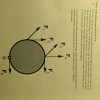 Refer to the picture below for FNTs 2-5: 2) The disk in the picture rotates about the point labelled 9 (not about its center). Circle all of the forces shown acting on a disk which exert a non-zero torque about point 8. Cross out all forces which exert a zero torque about point 9. (This is a top view of the disk, as seen from above.) If you are having trouble, try printing the disk out on pivot point, actually...
A square metal plate 0.180 m on each side is pivoted about an axis through point...
 A square metal plate 0.180 m on each side is pivoted about an axis through point 0 at its center and perpendicular to the plate (Figure 1). Part A Calculate the net torque about this axis due to the three forces shown in the figure if the magnitudes of the forces are F 22.0 N, F 14.6 N, and F 16.1 N. The plate and all forces are in the plane of the page. Take positive torques to be counterclockwise....
A 0.74-m-diameter solid sphere can be rotated about an axis through its center by a torque...
A 0.74-m-diameter solid sphere can be rotated about an axis through its center by a torque of 10.8 m∗N which accelerates it uniformly from rest through a total of 150 revolutions in 16.0 s . What is the mass of the sphere? Express your answer to two significant figures and include the appropriate units.
Hand In Problem 2 A solid globe of mass M and radius R can rotate about...
 Hand In Problem 2 A solid globe of mass M and radius R can rotate about its axis. A block of mass m is attached by a massless-string/pulley system as shown. As the block falls it causes the globe to spin. If the block starts at rest, at what speed does the block hit the ground after it falls a distance h? ' State your answer in terms of the given variables: M, R, m, h and g. Solve this...
A solid disk with mass M (1.00 kg) and radius R (0.200 m) is sitting on...
 A solid disk with mass M (1.00 kg)
and radius R (0.200 m) is sitting on a frictionless surface. We
analyzed the situation at left below, where a force F (2.00 N) is
applied for four seconds, by a string that has been wrapped around
the outer surface of a cylindrical disk.
Two students are debating the
following question. ‘The same force is applied for the same amount
of time, but this time by a string attached to the edge...
A solid disk with mass M (1.00 kg)
and radius R (0.200 m) is sitting on a frictionless surface. We
analyzed the situation at left below, where a force F (2.00 N) is
applied for four seconds, by a string that has been wrapped around
the outer surface of a cylindrical disk.
Two students are debating the
following question. ‘The same force is applied for the same amount
of time, but this time by a string attached to the edge...
Problem 7 A satellite consists two cylinders which can rotate relative to each other about the common axis of summetry. The rotation can be precisely controlled through a built-in motor. Both cyllind...
 Problem 7 A satellite consists two cylinders which can rotate relative to each other about the common axis of summetry. The rotation can be precisely controlled through a built-in motor. Both cyllinders can be asuumed to be uniform; they have the same mass, m 10.0 kg, and the same radius 0.30 m. The top cylinder has attached to it two balls, each of which has mass 1.0kg and radius b 0.1 m. Each ball is fastened to the end of...
A satellite consists two cylinders which can rotate relative to each other about the common axis of summetry. The rotation can be precisely controlled through a built-in motor. Both cyllinders can be...
 A satellite consists two cylinders which can rotate relative to
each other about the common axis of summetry. The rotation can be
precisely controlled through a built-in motor. Both cyllinders can
be asuumed to be uniform; they have the same mass, m = 10.0 kg, and
the same radius rc = 0.30m. The top cylinder has attached to it two
balls, each of which has mass 1.0 kg and radius rb = 0.1m. Each
ball is fastened to the end...
A satellite consists two cylinders which can rotate relative to
each other about the common axis of summetry. The rotation can be
precisely controlled through a built-in motor. Both cyllinders can
be asuumed to be uniform; they have the same mass, m = 10.0 kg, and
the same radius rc = 0.30m. The top cylinder has attached to it two
balls, each of which has mass 1.0 kg and radius rb = 0.1m. Each
ball is fastened to the end...
Between figure the acceleration arrow you should draw through each position dot during step 1 sho...
 N3M.12
between figure the acceleration arrow you should draw through each position dot during step 1 should point from the puck's position at that instant toward the table's center, since the Ca string's tension force acts in that direction.] (b) Check your work using the Newton program. N3M.12 In this problem, we will explore the necessary con- t ditions for uniform circular motion. (a) According to chapter N1, an object moving in a circle of radius rat constant speed llexperiences...
N3M.12
between figure the acceleration arrow you should draw through each position dot during step 1 should point from the puck's position at that instant toward the table's center, since the Ca string's tension force acts in that direction.] (b) Check your work using the Newton program. N3M.12 In this problem, we will explore the necessary con- t ditions for uniform circular motion. (a) According to chapter N1, an object moving in a circle of radius rat constant speed llexperiences...
 4) A disk-shaped space station 175 m in diameter spins uniformly about an axis perpendicular to the plane of the disk through its center. How many rpm (rev/min) must this disk make so that the acceleration of all points on its rim is g/2?
 Each of the disks in (Figure 3) has radius
r. Each disk can rotate freely about the axis passing
through the center of the disk perpendicular to the plane of the
figure, as shown. For which diagrams is the angular momentum
constant? In your calculations, use the information provided in the
diagrams.
Type the letters corresponding to the correct diagrams. For
instance, if you think that only diagrams A, B, and C answer the
question, type ABC.
Each of the disks in (Figure 3) has radius
r. Each disk can rotate freely about the axis passing
through the center of the disk perpendicular to the plane of the
figure, as shown. For which diagrams is the angular momentum
constant? In your calculations, use the information provided in the
diagrams.
Type the letters corresponding to the correct diagrams. For
instance, if you think that only diagrams A, B, and C answer the
question, type ABC.
 Refer to the picture below for FNTs 2-5: 2) The disk in the picture rotates about the point labelled 9 (not about its center). Circle all of the forces shown acting on a disk which exert a non-zero torque about point 8. Cross out all forces which exert a zero torque about point 9. (This is a top view of the disk, as seen from above.) If you are having trouble, try printing the disk out on pivot point, actually...
 A square metal plate 0.180 m on each side is pivoted about an axis through point 0 at its center and perpendicular to the plate (Figure 1). Part A Calculate the net torque about this axis due to the three forces shown in the figure if the magnitudes of the forces are F 22.0 N, F 14.6 N, and F 16.1 N. The plate and all forces are in the plane of the page. Take positive torques to be counterclockwise....
 Hand In Problem 2 A solid globe of mass M and radius R can rotate about its axis. A block of mass m is attached by a massless-string/pulley system as shown. As the block falls it causes the globe to spin. If the block starts at rest, at what speed does the block hit the ground after it falls a distance h? ' State your answer in terms of the given variables: M, R, m, h and g. Solve this...
 A solid disk with mass M (1.00 kg)
and radius R (0.200 m) is sitting on a frictionless surface. We
analyzed the situation at left below, where a force F (2.00 N) is
applied for four seconds, by a string that has been wrapped around
the outer surface of a cylindrical disk.
Two students are debating the
following question. ‘The same force is applied for the same amount
of time, but this time by a string attached to the edge...
A solid disk with mass M (1.00 kg)
and radius R (0.200 m) is sitting on a frictionless surface. We
analyzed the situation at left below, where a force F (2.00 N) is
applied for four seconds, by a string that has been wrapped around
the outer surface of a cylindrical disk.
Two students are debating the
following question. ‘The same force is applied for the same amount
of time, but this time by a string attached to the edge...
 Problem 7 A satellite consists two cylinders which can rotate relative to each other about the common axis of summetry. The rotation can be precisely controlled through a built-in motor. Both cyllinders can be asuumed to be uniform; they have the same mass, m 10.0 kg, and the same radius 0.30 m. The top cylinder has attached to it two balls, each of which has mass 1.0kg and radius b 0.1 m. Each ball is fastened to the end of...
 A satellite consists two cylinders which can rotate relative to
each other about the common axis of summetry. The rotation can be
precisely controlled through a built-in motor. Both cyllinders can
be asuumed to be uniform; they have the same mass, m = 10.0 kg, and
the same radius rc = 0.30m. The top cylinder has attached to it two
balls, each of which has mass 1.0 kg and radius rb = 0.1m. Each
ball is fastened to the end...
A satellite consists two cylinders which can rotate relative to
each other about the common axis of summetry. The rotation can be
precisely controlled through a built-in motor. Both cyllinders can
be asuumed to be uniform; they have the same mass, m = 10.0 kg, and
the same radius rc = 0.30m. The top cylinder has attached to it two
balls, each of which has mass 1.0 kg and radius rb = 0.1m. Each
ball is fastened to the end...
 N3M.12
between figure the acceleration arrow you should draw through each position dot during step 1 should point from the puck's position at that instant toward the table's center, since the Ca string's tension force acts in that direction.] (b) Check your work using the Newton program. N3M.12 In this problem, we will explore the necessary con- t ditions for uniform circular motion. (a) According to chapter N1, an object moving in a circle of radius rat constant speed llexperiences...
N3M.12
between figure the acceleration arrow you should draw through each position dot during step 1 should point from the puck's position at that instant toward the table's center, since the Ca string's tension force acts in that direction.] (b) Check your work using the Newton program. N3M.12 In this problem, we will explore the necessary con- t ditions for uniform circular motion. (a) According to chapter N1, an object moving in a circle of radius rat constant speed llexperiences...
Most questions answered within 3 hours.
-
Where is the error in this code sequence?
String s1 = "Hello";
String s2 = "ello";...
asked 10 months ago -
Financial data for Joel de Paris, Inc., for last year
follow:
Joel de Paris, Inc.
Balance...
asked 10 months ago -
Consider this reaction:
Al2(SO4)3 (aq)+ BaCl3
(aq) Al2Cl6 (aq)- +
3BaSO4(s) . What is the...
asked 10 months ago -
Suppose that Savneet is considering increasing her
recent random sample from 20 car rentals to 40...
asked 10 months ago -
Trucks arrive at an unloading terminal at an average rate of 120
per hour.
Trucks arrive...
asked 10 months ago -
Why are methanol and ethanol completely soluble in water while
octanol is not very little soluble....
asked 10 months ago -
A facilities manager at a university reads in a research report
that the mean amount of...
asked 10 months ago -
When the CuSO4 is rehydrated by adding water to the anhydrous
compound, is this an endothermic...
asked 10 months ago -
A ray of sunlight is passing from diamond into crown glass; the
angle of incidence is...
asked 10 months ago -
A block of mass 0.249 kg is placed on top of a light, vertical
spring of...
asked 10 months ago -
how do the kidneys compensate in the presences of acidosis
a) trigger hyperventilate
b) reserve acid...
asked 10 months ago -
Question 501 pts
The rental rate of capital to the firm increases. Which of the
following...
asked 10 months ago