
Homework Answers
Given data :-
- Thickness of Aluminium Cover, t = 4 mm = 0.004 m
- Thermal conductivity of Aluminium, K = 240 W/mk
- Convective heat ttansfer coefficient, h = 1000

- Temperature of surrounding Fluid,
 = 25 °C
 - Temperature of Chip, T = 85 °C
- Thermal contact resistance of chip/Aluminium interface, R =

- Surface area of chip A = 100
 =
= 

 = 25 °C
 =
= 
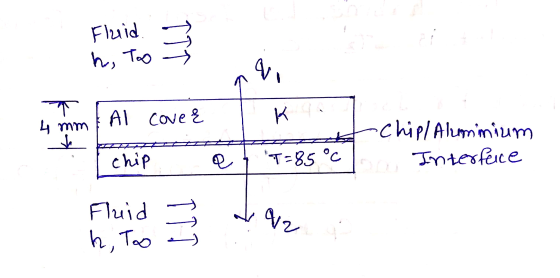
Let the heat generated due to power dissipation per unit area in
chip is q  . From that heat generated, some amount of heat will be transfered
by the top surface ( Let say
. From that heat generated, some amount of heat will be transfered
by the top surface ( Let say 
 ) and remaining amount of heat will be transfered from the bottom
surface of the chip ( Let say
) and remaining amount of heat will be transfered from the bottom
surface of the chip ( Let say  ).
).
So, 
(1) Heat transfer from the top surface,
Now heat transfer from the top surface of the chip per unit area to the surrounding fluid can be found by,

Where ,  = Total Thermal resistance between the top surface of chip and
surrounding
= Total Thermal resistance between the top surface of chip and
surrounding
So,
= Thermal contact resistance of chip/Aluminium interface +
Conductive resistance of Aluminium cover + Concective resistance of
fluid
So, 
So, 
So, 

Now,
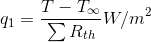
So, 
(2) Heat transfer from the bottom surface of the chip
,
Heat transfer from the bottom surface of the chip per unit area to the surrounding fluid can be found by,
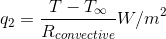
So, 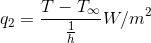
So, 
So, 
Now, Total heat generation in the chip per unit surface area , q
So, 
Now, Total Power Dissipation in the chip can be given by,
Q = q × Surface area of the chip
So, Q = 116250 ×  = 11.625 watt
So, maximum power dissipation allowed in the chip is 11.625 Watt.
Add Answer to:
(8 marks) The heat generated from power dissipation of a silicon chip is transferred by convection...
blem 4 (20 pts) A square chip that is 12.7mm on a side has a maximum allowable chip operating temperature -75°C. To dissipate heat produced in the chip, a 4 x 4 array of copper (k-400 W/m.K) pin fins...
 blem 4 (20 pts) A square chip that is 12.7mm on a side has a maximum allowable chip operating temperature -75°C. To dissipate heat produced in the chip, a 4 x 4 array of copper (k-400 W/m.K) pin fins is proposed to be etallurgically joined to the outer surface of the chip. The convection coefficient is h-250 W/m'K and ambient air mperature isTo-20°C. The pin fin dimeter is D,-1.5mm and length is L,-16mm. Assuming steady-state uniform chip temperature Te-75°C and...
this is a mechanical engineering question heat transfer Problem 3: An array of six square silicon chips, each 12 mm lon...
 this is a mechanical engineering question heat
transfer
Problem 3: An array of six square silicon chips, each 12 mm long on a side, are laid side by side on a motherboard. They are insulated on the bottom surface and exposed to cooling airflow on the top surface, at a velocity of 20 m/s and an air temperature of 20°C. The chips all dissipate the same power such that they maintain a uniform heat flux condition at their top surface...
this is a mechanical engineering question heat
transfer
Problem 3: An array of six square silicon chips, each 12 mm long on a side, are laid side by side on a motherboard. They are insulated on the bottom surface and exposed to cooling airflow on the top surface, at a velocity of 20 m/s and an air temperature of 20°C. The chips all dissipate the same power such that they maintain a uniform heat flux condition at their top surface...
As more and more components are placed on a single integrated circuit (chip), the amount of heat that is dissipated continues to increase. However, this increase is limited by the maximum allowable...
 As more and more components are placed on a single integrated
circuit (chip), the amount of heat that is dissipated continues to
increase. However, this increase is limited by the maximum
allowable chip operating temperature, which is approximately 75°C.
To maximize heat dissipation. it is proposed that a 4 × 4 array of
copper pin fins of length 12.7 mm and diameter 1.5mm be
metallurgically joined to the outer surface of a square chip that
is 12.7 mm on a...
As more and more components are placed on a single integrated
circuit (chip), the amount of heat that is dissipated continues to
increase. However, this increase is limited by the maximum
allowable chip operating temperature, which is approximately 75°C.
To maximize heat dissipation. it is proposed that a 4 × 4 array of
copper pin fins of length 12.7 mm and diameter 1.5mm be
metallurgically joined to the outer surface of a square chip that
is 12.7 mm on a...
7.33 A square (10 mm × 10 mm) silicon chip is insulated on one side and cooled on the opposite si...
 7.33 A square (10 mm × 10 mm) silicon chip is insulated on one side and cooled on the opposite side by atmospheric air in parallel flow at u 20 m/s and T 24°C. When in use, electrical power dissipation within the chip maintains a uniform heat flux at the cooled surface. If the chip temperature may not exceed 80°C at any point on its surface, what is the maximum allowable power? What is the maximunm allowable power if the...
Consider the manufacture of photovoltaic silicon where a thin sheet of silicon is pulled from the...
 Consider the manufacture of photovoltaic silicon where a thin sheet of silicon is pulled from the pool of molten material very slowly and is subjected to an ambient temperature of T 627°C within the growth chamber. The silicon sheet is Wsi =85 mm wide and tsi =150um thick. A convection coefficient of h 7.5 W/m2.K is associated with the exposed surfaces of the silicon sheet when it is inside the growth chamber. Calculate the maximum allowable velocity of the silicon...
4. A silicon chip is attached with a copper pin fin in order to enhance the...
 4. A silicon chip is attached with a copper pin fin in order to enhance the heat transfer. The square shape silicon chip has a width of W=10 mm on each side. The length and diameter of the copper pin are L=20 mm and D=4 mm, respectively. During the operation, the surface of the chip, as well as the base of the pin, are maintained at the temperature of To=375 K. The thermal conductivity of the copper pin fin is...
4. A silicon chip is attached with a copper pin fin in order to enhance the...
 4. A silicon chip is attached with a copper pin fin in order to enhance the heat transfer. The square shape silicon chip has a width of W=10 mm on each side. The length and diameter of the copper pin are L=20 mm and D=4 mm, respectively. During the operation, the surface of the chip, as well as the base of the pin, are maintained at the temperature of To=375 K. The thermal conductivity of the copper pin fin is...
4. A silicon chip is attached with a copper pin fin in order to enhance the...
 4. A silicon chip is attached with a copper pin fin in order to enhance the heat transfer. The square shape silicon chip has a width of W=10 mm on each side. The length and diameter of the copper pin are L=20 mm and D=4 mm, respectively. During the operation, the surface of the chip, as well as the base of the pin, are maintained at the temperature of To=375 K. The thermal conductivity of the copper pin fin is...
Consider a single stack of rectangular fins of length L and thickness t, with convection conditions...
 Consider a single stack of rectangular fins of length L and thickness t, with convection conditions corresponding to h and To. The bottom plate is well-insulated and an adiabatic fin tip condition may be assumed (a) Obtain the expression for the fin heat transfer rate (b) In a specific application, a stack that is 200 mm wide and 100 mm deep contains 50 fins, each of length L - 12 mm. The base and fins are made from aluminum (k...
Problem 1 Consider a 15-mm by 15-mm chip that is cooled on its top surface by a 6 m/s flow of 25 ...
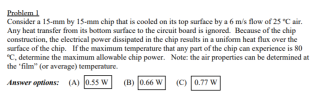 Problem 1 Consider a 15-mm by 15-mm chip that is cooled on its top surface by a 6 m/s flow of 25 °C air. Any heat transfer from its bottom surface to the circuit board is ignored. Because of the chip construction, the electrical power dissipated in the chip results in a uniform heat flux over the surface of the chip. If the maximum temperature that any part of the chip can experience is 80 "C, determine the maximum allowable...
 blem 4 (20 pts) A square chip that is 12.7mm on a side has a maximum allowable chip operating temperature -75°C. To dissipate heat produced in the chip, a 4 x 4 array of copper (k-400 W/m.K) pin fins is proposed to be etallurgically joined to the outer surface of the chip. The convection coefficient is h-250 W/m'K and ambient air mperature isTo-20°C. The pin fin dimeter is D,-1.5mm and length is L,-16mm. Assuming steady-state uniform chip temperature Te-75°C and...
 this is a mechanical engineering question heat
transfer
Problem 3: An array of six square silicon chips, each 12 mm long on a side, are laid side by side on a motherboard. They are insulated on the bottom surface and exposed to cooling airflow on the top surface, at a velocity of 20 m/s and an air temperature of 20°C. The chips all dissipate the same power such that they maintain a uniform heat flux condition at their top surface...
this is a mechanical engineering question heat
transfer
Problem 3: An array of six square silicon chips, each 12 mm long on a side, are laid side by side on a motherboard. They are insulated on the bottom surface and exposed to cooling airflow on the top surface, at a velocity of 20 m/s and an air temperature of 20°C. The chips all dissipate the same power such that they maintain a uniform heat flux condition at their top surface...
 As more and more components are placed on a single integrated
circuit (chip), the amount of heat that is dissipated continues to
increase. However, this increase is limited by the maximum
allowable chip operating temperature, which is approximately 75°C.
To maximize heat dissipation. it is proposed that a 4 × 4 array of
copper pin fins of length 12.7 mm and diameter 1.5mm be
metallurgically joined to the outer surface of a square chip that
is 12.7 mm on a...
As more and more components are placed on a single integrated
circuit (chip), the amount of heat that is dissipated continues to
increase. However, this increase is limited by the maximum
allowable chip operating temperature, which is approximately 75°C.
To maximize heat dissipation. it is proposed that a 4 × 4 array of
copper pin fins of length 12.7 mm and diameter 1.5mm be
metallurgically joined to the outer surface of a square chip that
is 12.7 mm on a...
 7.33 A square (10 mm × 10 mm) silicon chip is insulated on one side and cooled on the opposite side by atmospheric air in parallel flow at u 20 m/s and T 24°C. When in use, electrical power dissipation within the chip maintains a uniform heat flux at the cooled surface. If the chip temperature may not exceed 80°C at any point on its surface, what is the maximum allowable power? What is the maximunm allowable power if the...
 Consider the manufacture of photovoltaic silicon where a thin sheet of silicon is pulled from the pool of molten material very slowly and is subjected to an ambient temperature of T 627°C within the growth chamber. The silicon sheet is Wsi =85 mm wide and tsi =150um thick. A convection coefficient of h 7.5 W/m2.K is associated with the exposed surfaces of the silicon sheet when it is inside the growth chamber. Calculate the maximum allowable velocity of the silicon...
 4. A silicon chip is attached with a copper pin fin in order to enhance the heat transfer. The square shape silicon chip has a width of W=10 mm on each side. The length and diameter of the copper pin are L=20 mm and D=4 mm, respectively. During the operation, the surface of the chip, as well as the base of the pin, are maintained at the temperature of To=375 K. The thermal conductivity of the copper pin fin is...
 4. A silicon chip is attached with a copper pin fin in order to enhance the heat transfer. The square shape silicon chip has a width of W=10 mm on each side. The length and diameter of the copper pin are L=20 mm and D=4 mm, respectively. During the operation, the surface of the chip, as well as the base of the pin, are maintained at the temperature of To=375 K. The thermal conductivity of the copper pin fin is...
 4. A silicon chip is attached with a copper pin fin in order to enhance the heat transfer. The square shape silicon chip has a width of W=10 mm on each side. The length and diameter of the copper pin are L=20 mm and D=4 mm, respectively. During the operation, the surface of the chip, as well as the base of the pin, are maintained at the temperature of To=375 K. The thermal conductivity of the copper pin fin is...
 Consider a single stack of rectangular fins of length L and thickness t, with convection conditions corresponding to h and To. The bottom plate is well-insulated and an adiabatic fin tip condition may be assumed (a) Obtain the expression for the fin heat transfer rate (b) In a specific application, a stack that is 200 mm wide and 100 mm deep contains 50 fins, each of length L - 12 mm. The base and fins are made from aluminum (k...
 Problem 1 Consider a 15-mm by 15-mm chip that is cooled on its top surface by a 6 m/s flow of 25 °C air. Any heat transfer from its bottom surface to the circuit board is ignored. Because of the chip construction, the electrical power dissipated in the chip results in a uniform heat flux over the surface of the chip. If the maximum temperature that any part of the chip can experience is 80 "C, determine the maximum allowable...
Most questions answered within 3 hours.
-
Where is the error in this code sequence?
String s1 = "Hello";
String s2 = "ello";...
asked 10 months ago -
Financial data for Joel de Paris, Inc., for last year
follow:
Joel de Paris, Inc.
Balance...
asked 10 months ago -
Consider this reaction:
Al2(SO4)3 (aq)+ BaCl3
(aq) Al2Cl6 (aq)- +
3BaSO4(s) . What is the...
asked 10 months ago -
Suppose that Savneet is considering increasing her
recent random sample from 20 car rentals to 40...
asked 10 months ago -
Trucks arrive at an unloading terminal at an average rate of 120
per hour.
Trucks arrive...
asked 10 months ago -
Why are methanol and ethanol completely soluble in water while
octanol is not very little soluble....
asked 10 months ago -
A facilities manager at a university reads in a research report
that the mean amount of...
asked 10 months ago -
When the CuSO4 is rehydrated by adding water to the anhydrous
compound, is this an endothermic...
asked 10 months ago -
A ray of sunlight is passing from diamond into crown glass; the
angle of incidence is...
asked 10 months ago -
A block of mass 0.249 kg is placed on top of a light, vertical
spring of...
asked 10 months ago -
how do the kidneys compensate in the presences of acidosis
a) trigger hyperventilate
b) reserve acid...
asked 10 months ago -
Question 501 pts
The rental rate of capital to the firm increases. Which of the
following...
asked 10 months ago