
Homework Answers
Add Answer to:
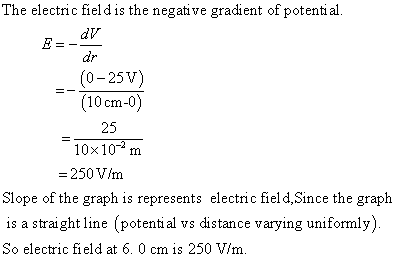
The following graph shown the voltage (V) as, the distance (d) from the positive electrode between...
a parallel-plate capacitor of capacitance C and distance d between plates is fully charged from a...
a parallel-plate capacitor of capacitance C and distance d between plates is fully charged from a battery of voltage V, and then disconnected. the plates of the capacitor are slowly pulled to the half of the initial distance (d/2). a) The charged stored on the capacitor is: b)The voltage across the capacitor is now: c)How does the energy stored in the capacitor change after this process: d) How does the electric field inside the capacitor change after this process:
Electric fields - with a distance vs voltage graph being a straight line, and equipotential lines...
Electric fields - with a distance vs voltage graph being a straight line, and equipotential lines parallel, what does that tell us about the electric field between the two parallel plates? Explain.
Two rectangular parallel plates have area A and are separated by a distance d. They are...
 Two rectangular parallel plates have area A and are separated by a distance d. They are connected to a power supply and charged with a voltage V. There no insulating material between them. In this configuration the plates make a capacitor with capacitance C. The electric field between the plates is E and the energy stored is U While still connected to the power supply, the plates are moved so the distance between them is one-half what it was. By...
Exercise 1 Electric Fields In this exercise, you will use a digital multimeter to collect voltage...
Exercise 1 Electric Fields In this exercise, you will use a digital multimeter to collect voltage data to graph electric fields. Procedure Place the sheet of graph paper on a table and center the clear tray over the grid. Attach the end of each jumper cable to a metal nut by clamping the free alligator clip onto it as shown in Figure 4. The figure is a photo of an alligator clip attached to a metal nut. It is attached...
A parallel plate capacitor has square plates with sides of length 11 cm. The distance between...
A parallel plate capacitor has square plates with sides of length 11 cm. The distance between the plates is 2 mm. The plates are charged up to 20volts. Part A What is the electric field between the plates? Express your answer using three significant figures. Electric field = N/C Part B What is the amount of charge on each plate? charge = C Part C What is the capacitance? Capacitance = μF Part D What is the energy stored by...
Problem1 In the concentric spherical conductors system shown in Figure 1, the inner conductor has positive charge-q and radius a. The outer conductor has radius b a) Using Gauss' Law determin...
 Problem1 In the concentric spherical conductors system shown in Figure 1, the inner conductor has positive charge-q and radius a. The outer conductor has radius b a) Using Gauss' Law determine the electric field vector E(r) in the region between the conductors (acrcb) and the potential difference Vab between them. b) Calculate E(r) and Vab if the two conductors have a 30 mm, b-40 mm, q 10uc, r-35 mm ε,-8.85x10⁻¹²C3(N.m2. For the circuit shown in Figure 2 find: a) the...
Two parallel plates Equipotential Lines represent for us on a graph the same thing Elevation Line...
 Two parallel plates
Equipotential Lines represent for us on a graph the same thing
Elevation Lines do for us on a map: They represent a line where the
Electric or Gravitational potential is a constant. Maps and voltage
graphs have even spacing between values (1V or 500ft or 100m etc)so
they can be read easier. These potentials were at 3V, 6V, 9V, 12V,
and 15V. In the figure are 5 lines of electric potential drawn from
positive charge at left...
Two parallel plates
Equipotential Lines represent for us on a graph the same thing
Elevation Lines do for us on a map: They represent a line where the
Electric or Gravitational potential is a constant. Maps and voltage
graphs have even spacing between values (1V or 500ft or 100m etc)so
they can be read easier. These potentials were at 3V, 6V, 9V, 12V,
and 15V. In the figure are 5 lines of electric potential drawn from
positive charge at left...
V(V) In the right figure, the top panel of graph shows the potential V as a...
 V(V) In the right figure, the top panel of graph shows the potential V as a function of position x in three regions I, II, and III. Accordingly, four parallel plates, A through D, can be setup to realized the distribution of potential, as schematically drawn in the bottom panel of the figure. The unit of the distance is cm, and the unit of potential is V. III The potential on plate D is Submit Answer Incorrect. Tries 1/2 Previous...
Exam 2 for Electric Drives Name Problem i (30%) Faraday's Law In the following drawing, four conductors compose a rectangular loop that is perpendicular to a magnetic field, where the top and...
 Exam 2 for Electric Drives Name Problem i (30%) Faraday's Law In the following drawing, four conductors compose a rectangular loop that is perpendicular to a magnetic field, where the top and the bottom conductors are fixed and the distance between them is a constant value Wo. 1.1) If conductor 1 is not moving, the magnetic field is evenly distributed, the flux density B is a constant B, is moving at a speed vo and remaining touching the top and...
7. A positive charge, Q1 , is placed on the +y axis, a distance d from...
 7. A positive charge, Q1 , is placed on the +y axis, a distance d from the origin. A negative charge, Q2, is placed on the +x axis, also a distance d from the origin. Find the magnitude of the net electric potential at the origin if Q1 = +25 nC, Q2 = -10 nC, and d = 1.5 cm. A B C D E 13,732 V 5,025 V 8.990 V 20,977 V 7,676 V
 Two rectangular parallel plates have area A and are separated by a distance d. They are connected to a power supply and charged with a voltage V. There no insulating material between them. In this configuration the plates make a capacitor with capacitance C. The electric field between the plates is E and the energy stored is U While still connected to the power supply, the plates are moved so the distance between them is one-half what it was. By...
 Problem1 In the concentric spherical conductors system shown in Figure 1, the inner conductor has positive charge-q and radius a. The outer conductor has radius b a) Using Gauss' Law determine the electric field vector E(r) in the region between the conductors (acrcb) and the potential difference Vab between them. b) Calculate E(r) and Vab if the two conductors have a 30 mm, b-40 mm, q 10uc, r-35 mm ε,-8.85x10⁻¹²C3(N.m2. For the circuit shown in Figure 2 find: a) the...
 Two parallel plates
Equipotential Lines represent for us on a graph the same thing
Elevation Lines do for us on a map: They represent a line where the
Electric or Gravitational potential is a constant. Maps and voltage
graphs have even spacing between values (1V or 500ft or 100m etc)so
they can be read easier. These potentials were at 3V, 6V, 9V, 12V,
and 15V. In the figure are 5 lines of electric potential drawn from
positive charge at left...
Two parallel plates
Equipotential Lines represent for us on a graph the same thing
Elevation Lines do for us on a map: They represent a line where the
Electric or Gravitational potential is a constant. Maps and voltage
graphs have even spacing between values (1V or 500ft or 100m etc)so
they can be read easier. These potentials were at 3V, 6V, 9V, 12V,
and 15V. In the figure are 5 lines of electric potential drawn from
positive charge at left...
 V(V) In the right figure, the top panel of graph shows the potential V as a function of position x in three regions I, II, and III. Accordingly, four parallel plates, A through D, can be setup to realized the distribution of potential, as schematically drawn in the bottom panel of the figure. The unit of the distance is cm, and the unit of potential is V. III The potential on plate D is Submit Answer Incorrect. Tries 1/2 Previous...
 Exam 2 for Electric Drives Name Problem i (30%) Faraday's Law In the following drawing, four conductors compose a rectangular loop that is perpendicular to a magnetic field, where the top and the bottom conductors are fixed and the distance between them is a constant value Wo. 1.1) If conductor 1 is not moving, the magnetic field is evenly distributed, the flux density B is a constant B, is moving at a speed vo and remaining touching the top and...
 7. A positive charge, Q1 , is placed on the +y axis, a distance d from the origin. A negative charge, Q2, is placed on the +x axis, also a distance d from the origin. Find the magnitude of the net electric potential at the origin if Q1 = +25 nC, Q2 = -10 nC, and d = 1.5 cm. A B C D E 13,732 V 5,025 V 8.990 V 20,977 V 7,676 V
Most questions answered within 3 hours.
-
Where is the error in this code sequence?
String s1 = "Hello";
String s2 = "ello";...
asked 10 months ago -
Financial data for Joel de Paris, Inc., for last year
follow:
Joel de Paris, Inc.
Balance...
asked 10 months ago -
Consider this reaction:
Al2(SO4)3 (aq)+ BaCl3
(aq) Al2Cl6 (aq)- +
3BaSO4(s) . What is the...
asked 10 months ago -
Suppose that Savneet is considering increasing her
recent random sample from 20 car rentals to 40...
asked 10 months ago -
Trucks arrive at an unloading terminal at an average rate of 120
per hour.
Trucks arrive...
asked 10 months ago -
Why are methanol and ethanol completely soluble in water while
octanol is not very little soluble....
asked 10 months ago -
A facilities manager at a university reads in a research report
that the mean amount of...
asked 10 months ago -
When the CuSO4 is rehydrated by adding water to the anhydrous
compound, is this an endothermic...
asked 10 months ago -
A ray of sunlight is passing from diamond into crown glass; the
angle of incidence is...
asked 10 months ago -
A block of mass 0.249 kg is placed on top of a light, vertical
spring of...
asked 10 months ago -
how do the kidneys compensate in the presences of acidosis
a) trigger hyperventilate
b) reserve acid...
asked 10 months ago -
Question 501 pts
The rental rate of capital to the firm increases. Which of the
following...
asked 10 months ago