
Homework Answers
Add Answer to:
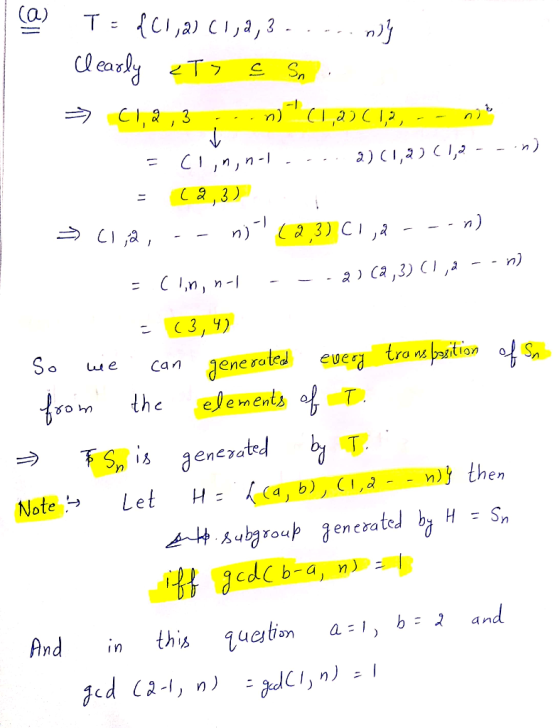
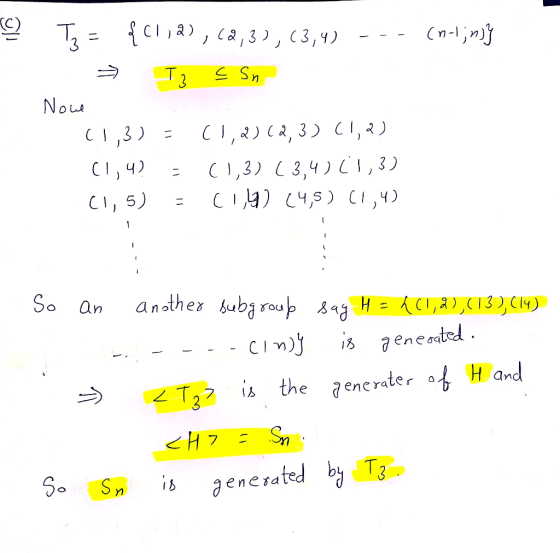
25. Suppose that n > 2. Prove that Sn is generated by each of the following...
6. Let si = 4 and sn +1 (sn +-) for n > 0. Prove lim...
 6. Let si = 4 and sn +1 (sn +-) for n > 0. Prove lim n→oo sn exists and find limn-oo Sn. (Hint: First use induction to show sn 2 2 and the.show (sn) is decreasing)
prove by mathematical induction n> 1. n(n + 1) 72 for all integers n > 1....
 prove by mathematical induction
n> 1. n(n + 1) 72 for all integers n > 1. 11. 1° +2° + ... +n3 =
prove by mathematical induction
n> 1. n(n + 1) 72 for all integers n > 1. 11. 1° +2° + ... +n3 =
Please Prove. Prove 2 n > n2 by induction using a basis > 4: Basis: n...
 Please Prove.
Prove 2 n > n2 by induction using a basis > 4: Basis: n 5 32> 25 Assume: Prove:
Please Prove.
Prove 2 n > n2 by induction using a basis > 4: Basis: n 5 32> 25 Assume: Prove:
For each of the following pairs of sets, prove that they are equinumerous. Remember that we...
 For each of the following pairs of sets, prove that they are
equinumerous. Remember that we have two ways to do this: we can
find a bijection explicitly, or we can prove that there is an
injection in each direction and then use the Schr¨oder-Bernstein
theorem.
4. N and Qd for d > 1 5. R and R x R {a + bi |2 =-1, a,bE R} is the complex numbers) 6. R and C (where C
For each of the following pairs of sets, prove that they are
equinumerous. Remember that we have two ways to do this: we can
find a bijection explicitly, or we can prove that there is an
injection in each direction and then use the Schr¨oder-Bernstein
theorem.
4. N and Qd for d > 1 5. R and R x R {a + bi |2 =-1, a,bE R} is the complex numbers) 6. R and C (where C
9. Prove by mathematical induction: -, i = 1 + 2 + 3+...+ n = n(n+1)...
 9. Prove by mathematical induction: -, i = 1 + 2 + 3+...+ n = n(n+1) for all n > 2.
8. Suppose that B = {p € Q: p? > 2}. Prove that B contains no...
 8. Suppose that B = {p € Q: p? > 2}. Prove that B contains no smallest element.
Consider the following relation R on the set A = {1,2,3,4,5}. R= {(1, 1), (2, 2),...
 Consider the following relation R on the set A = {1,2,3,4,5}. R= {(1, 1), (2, 2), (2, 3), (3, 2), (3, 3), (4,4), (4,5), (5,4), (5,5)} Given that R is an equivalence relation on A, which of the following is the partition of A into equivalence classes? Select the correct response. A. P = {{1}, {1, 2}, {3}, {3,4}, {4},{5}} B. P ={{1,2,3,4,5}} C. P ={{1,2},{3,4}, {5}} D. P = {{1}, {2,3}, {4,5}} E. P ={{1,2,3}, {1,5}} F. P= {{1},...
2. Prove by induction that Ση.c)-(7+1) for n > 0 and i > 0.
 2. Prove by induction that Ση.c)-(7+1) for n > 0 and i > 0.
(2) Using the identity: n! k!(n - k)! for n > 2, prove that the following...
 (2) Using the identity: n! k!(n - k)! for n > 2, prove that the following identity is even: 1 n
Exercise 1.6.4: Prove the following by induction: (a) “k - n(n+1)(2n +1) k= 1 (b) If...
 Exercise 1.6.4: Prove the following by induction: (a) “k - n(n+1)(2n +1) k= 1 (b) If n > 1, then 13-n is divisible by 3. (c) For n 3, we have n +4 <2". (d) For any positive integer n, one of n, n+2, and 11+ 4 must be divisible by 3. (e) For all n e N, we have 3" > 2n +1. ()/Prove that, for any x > -1 and any n e N, we have (1+x)" 21+1x.
 6. Let si = 4 and sn +1 (sn +-) for n > 0. Prove lim n→oo sn exists and find limn-oo Sn. (Hint: First use induction to show sn 2 2 and the.show (sn) is decreasing)
 prove by mathematical induction
n> 1. n(n + 1) 72 for all integers n > 1. 11. 1° +2° + ... +n3 =
prove by mathematical induction
n> 1. n(n + 1) 72 for all integers n > 1. 11. 1° +2° + ... +n3 =
 Please Prove.
Prove 2 n > n2 by induction using a basis > 4: Basis: n 5 32> 25 Assume: Prove:
Please Prove.
Prove 2 n > n2 by induction using a basis > 4: Basis: n 5 32> 25 Assume: Prove:
 For each of the following pairs of sets, prove that they are
equinumerous. Remember that we have two ways to do this: we can
find a bijection explicitly, or we can prove that there is an
injection in each direction and then use the Schr¨oder-Bernstein
theorem.
4. N and Qd for d > 1 5. R and R x R {a + bi |2 =-1, a,bE R} is the complex numbers) 6. R and C (where C
For each of the following pairs of sets, prove that they are
equinumerous. Remember that we have two ways to do this: we can
find a bijection explicitly, or we can prove that there is an
injection in each direction and then use the Schr¨oder-Bernstein
theorem.
4. N and Qd for d > 1 5. R and R x R {a + bi |2 =-1, a,bE R} is the complex numbers) 6. R and C (where C
 9. Prove by mathematical induction: -, i = 1 + 2 + 3+...+ n = n(n+1) for all n > 2.
 8. Suppose that B = {p € Q: p? > 2}. Prove that B contains no smallest element.
 Consider the following relation R on the set A = {1,2,3,4,5}. R= {(1, 1), (2, 2), (2, 3), (3, 2), (3, 3), (4,4), (4,5), (5,4), (5,5)} Given that R is an equivalence relation on A, which of the following is the partition of A into equivalence classes? Select the correct response. A. P = {{1}, {1, 2}, {3}, {3,4}, {4},{5}} B. P ={{1,2,3,4,5}} C. P ={{1,2},{3,4}, {5}} D. P = {{1}, {2,3}, {4,5}} E. P ={{1,2,3}, {1,5}} F. P= {{1},...
 2. Prove by induction that Ση.c)-(7+1) for n > 0 and i > 0.
 (2) Using the identity: n! k!(n - k)! for n > 2, prove that the following identity is even: 1 n
 Exercise 1.6.4: Prove the following by induction: (a) “k - n(n+1)(2n +1) k= 1 (b) If n > 1, then 13-n is divisible by 3. (c) For n 3, we have n +4 <2". (d) For any positive integer n, one of n, n+2, and 11+ 4 must be divisible by 3. (e) For all n e N, we have 3" > 2n +1. ()/Prove that, for any x > -1 and any n e N, we have (1+x)" 21+1x.
Most questions answered within 3 hours.
-
Where is the error in this code sequence?
String s1 = "Hello";
String s2 = "ello";...
asked 10 months ago -
Financial data for Joel de Paris, Inc., for last year
follow:
Joel de Paris, Inc.
Balance...
asked 10 months ago -
Consider this reaction:
Al2(SO4)3 (aq)+ BaCl3
(aq) Al2Cl6 (aq)- +
3BaSO4(s) . What is the...
asked 10 months ago -
Suppose that Savneet is considering increasing her
recent random sample from 20 car rentals to 40...
asked 10 months ago -
Trucks arrive at an unloading terminal at an average rate of 120
per hour.
Trucks arrive...
asked 10 months ago -
Why are methanol and ethanol completely soluble in water while
octanol is not very little soluble....
asked 10 months ago -
A facilities manager at a university reads in a research report
that the mean amount of...
asked 10 months ago -
When the CuSO4 is rehydrated by adding water to the anhydrous
compound, is this an endothermic...
asked 10 months ago -
A ray of sunlight is passing from diamond into crown glass; the
angle of incidence is...
asked 10 months ago -
A block of mass 0.249 kg is placed on top of a light, vertical
spring of...
asked 10 months ago -
how do the kidneys compensate in the presences of acidosis
a) trigger hyperventilate
b) reserve acid...
asked 10 months ago -
Question 501 pts
The rental rate of capital to the firm increases. Which of the
following...
asked 10 months ago