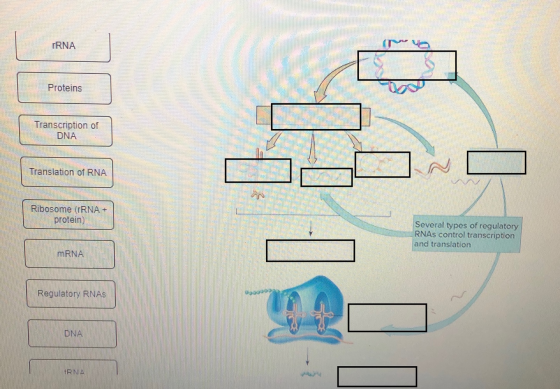
Please label the image to review recent changes made to
the central dogma of biology.
Homework Answers
The central dogma of life includes replication, transcription, translation, reverse transcription. It is the process of how the DNA is replicated into daughter DNA then transcribed into RNA and then translated into proteins.
DNA is transcribed into three forms of RNA- mRNA, tRNA, rRNA
which functions coordinately for translation into proteins. The non
coding forms of RNA are called as regulatory RNA that includes
siRNA, miRNA snRNA which plays a major role in gene expression.
They assist in on or off of the gene expression.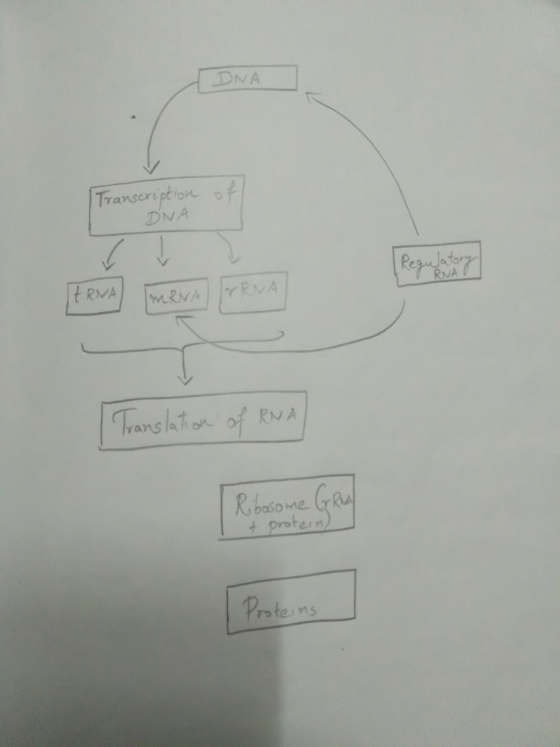
Add Answer to:
Please label the image to review recent changes made to
the central dogma of biology.
TRNA...
Label the image to test your understanding of the flow of genetic information in cells. TRNA...
 Label the image to test your understanding of the flow of genetic information in cells. TRNA DNA DNA Regulatory RNAS Translation of RNA Transcription of DNA Protein Ribosome RNA proteini IRNA mRNA Prey 1 of 10 !! Next > a Search or type URL
Label the image to test your understanding of the flow of genetic information in cells Translation...
 Label the image to test your understanding of the flow of genetic information in cells Translation of RNA DNA Regulatory RNAs mRNA Ribosome (rRNA + protein) RNA Transcription of DNA RNA Micro RNA interfering RNA antisense RNA Protein Reset
Genetics concept map. Make a concept map that connects and describes the following terms: Central dogma...
 Genetics concept map. Make a concept map that connects and describes the following terms: Central dogma DNA Nucleus Chromosome Gene Allele mRNA Transcription Translation Ribosome Amino acid Protein Allele Genotype Phenotype
the several other 10.4 to show t 3. The base uracil substitutes for the base thymine in RNA. Complete Table ways...
 the several other 10.4 to show t 3. The base uracil substitutes for the base thymine in RNA. Complete Table ways RNA differs from DNA Table 10.4 DNA Structure Compared with RNA Structure RNA Sugar Bases Strands Helix DNA Deoxyribose Adenine, guanine, thymine, cytosine Double stranded with base pairing Yes Complementary Base Pairing Complementary base pairing occurs between DNA and RNA. The RNA base uracil pairs with the DNA base adenine; the other bases pair as shown previously. Complete Table...
The central dogma of molecular biology consists of which of the following steps? a) Ribosomes are...
 The central dogma of molecular biology consists of which of the following steps? a) Ribosomes are involved in the translation process Ob) RNA is translated into proteins O c) All of the above d) DNA is transcribed into RNA e) The enzyme RNA polymerase is involved in transcription Ribosomes bind protein and synthesize RNA. O a) True b) False Question 9 (3 points) Lysosomes use_ enzymes to carry out_ in -- -- polymers. reactions that break bonds O a) acid...
moose the correct alphabet (letter, noting that each and may have only ch answer can be...
 moose the correct alphabet (letter, noting that each and may have only ch answer can be used more than once Answers a Eukaryotic mRNAS b.Prokaryotic mRNAs e . Transfer RNAS d. RNAs f. All RNAS e. Pre-mRNA the have a cloverleaf structure are synthesized by RNA polymerases the RNA that has the anti-codon are the template of genetic information during protein synthesis contains exons and introns is a structural component of the ribosome is the RNA that goes into the...
Please explain the following question and answer all 29. The central dogma of molecular genetics is...
 Please explain the following question and answer all
29. The central dogma of molecular genetics is that DNA encodes an mRNA, and mRNA allows proteins to be made. In the lecture on making cDNA libraries there was a statement that jokingly) said "central dogma be damned". What is it about making a cDNA library that goes against the central dogma? A. although a primer is required to make a cDNA, the primer is simply a long run of "T's", B....
Please explain the following question and answer all
29. The central dogma of molecular genetics is that DNA encodes an mRNA, and mRNA allows proteins to be made. In the lecture on making cDNA libraries there was a statement that jokingly) said "central dogma be damned". What is it about making a cDNA library that goes against the central dogma? A. although a primer is required to make a cDNA, the primer is simply a long run of "T's", B....
answer all the questions 18) A mutation occurs such that a spliceosome cannot remove one of...
 answer all the questions
18) A mutation occurs such that a spliceosome cannot remove one of the introns in a gene. What effect will this have on the gene? Translation will continue, but a nonfunctional protein will be made b) Translation will continue and will skip the intron sequence c) It will have no effect; the gene will be transcribed and translated into protein d) Transcription will terminate easily and the protein will not be made 19. During the process...
answer all the questions
18) A mutation occurs such that a spliceosome cannot remove one of the introns in a gene. What effect will this have on the gene? Translation will continue, but a nonfunctional protein will be made b) Translation will continue and will skip the intron sequence c) It will have no effect; the gene will be transcribed and translated into protein d) Transcription will terminate easily and the protein will not be made 19. During the process...
Table 1B: Protein Synthesis with 2nd DNA Template Strand DNA Codons in the 2nd Template Strand...
 Table 1B: Protein Synthesis with 2nd DNA Template Strand DNA Codons in the 2nd Template Strand mRNA Sequence (List codons) Amino Acids in the Protein **Use the Genetic Code Chart on page 217 to determine the amino acids that will be placed in the protein Questions: 19. The three letter "code words of DNA and RNA that specify amino acids are called: A. codons B. promoters C. Introns D. anticodons 20. Proteins are composed of building blocks called: A. fatty...
Please explain Why is a cap added to MRNA, but not to 1RNA or RRNA? Each...
 Please explain
Why is a cap added to MRNA, but not to 1RNA or RRNA? Each of the three types of RNA are transcribed by different RNA polymerases. Only RNA polymerase II, involved in mRNA synthesis, contains a domain capable of interacting with enzymes that form the cap. Transcription and processing of MRNA occur in the nucleus, where cap binding proteins are found. These proteins, which add and modify the cap, are not found in the cytoplasm, where tRNA and...
Please explain
Why is a cap added to MRNA, but not to 1RNA or RRNA? Each of the three types of RNA are transcribed by different RNA polymerases. Only RNA polymerase II, involved in mRNA synthesis, contains a domain capable of interacting with enzymes that form the cap. Transcription and processing of MRNA occur in the nucleus, where cap binding proteins are found. These proteins, which add and modify the cap, are not found in the cytoplasm, where tRNA and...
 Label the image to test your understanding of the flow of genetic information in cells. TRNA DNA DNA Regulatory RNAS Translation of RNA Transcription of DNA Protein Ribosome RNA proteini IRNA mRNA Prey 1 of 10 !! Next > a Search or type URL
 Label the image to test your understanding of the flow of genetic information in cells Translation of RNA DNA Regulatory RNAs mRNA Ribosome (rRNA + protein) RNA Transcription of DNA RNA Micro RNA interfering RNA antisense RNA Protein Reset
 Genetics concept map. Make a concept map that connects and describes the following terms: Central dogma DNA Nucleus Chromosome Gene Allele mRNA Transcription Translation Ribosome Amino acid Protein Allele Genotype Phenotype
 the several other 10.4 to show t 3. The base uracil substitutes for the base thymine in RNA. Complete Table ways RNA differs from DNA Table 10.4 DNA Structure Compared with RNA Structure RNA Sugar Bases Strands Helix DNA Deoxyribose Adenine, guanine, thymine, cytosine Double stranded with base pairing Yes Complementary Base Pairing Complementary base pairing occurs between DNA and RNA. The RNA base uracil pairs with the DNA base adenine; the other bases pair as shown previously. Complete Table...
 The central dogma of molecular biology consists of which of the following steps? a) Ribosomes are involved in the translation process Ob) RNA is translated into proteins O c) All of the above d) DNA is transcribed into RNA e) The enzyme RNA polymerase is involved in transcription Ribosomes bind protein and synthesize RNA. O a) True b) False Question 9 (3 points) Lysosomes use_ enzymes to carry out_ in -- -- polymers. reactions that break bonds O a) acid...
 moose the correct alphabet (letter, noting that each and may have only ch answer can be used more than once Answers a Eukaryotic mRNAS b.Prokaryotic mRNAs e . Transfer RNAS d. RNAs f. All RNAS e. Pre-mRNA the have a cloverleaf structure are synthesized by RNA polymerases the RNA that has the anti-codon are the template of genetic information during protein synthesis contains exons and introns is a structural component of the ribosome is the RNA that goes into the...
 Please explain the following question and answer all
29. The central dogma of molecular genetics is that DNA encodes an mRNA, and mRNA allows proteins to be made. In the lecture on making cDNA libraries there was a statement that jokingly) said "central dogma be damned". What is it about making a cDNA library that goes against the central dogma? A. although a primer is required to make a cDNA, the primer is simply a long run of "T's", B....
Please explain the following question and answer all
29. The central dogma of molecular genetics is that DNA encodes an mRNA, and mRNA allows proteins to be made. In the lecture on making cDNA libraries there was a statement that jokingly) said "central dogma be damned". What is it about making a cDNA library that goes against the central dogma? A. although a primer is required to make a cDNA, the primer is simply a long run of "T's", B....
 answer all the questions
18) A mutation occurs such that a spliceosome cannot remove one of the introns in a gene. What effect will this have on the gene? Translation will continue, but a nonfunctional protein will be made b) Translation will continue and will skip the intron sequence c) It will have no effect; the gene will be transcribed and translated into protein d) Transcription will terminate easily and the protein will not be made 19. During the process...
answer all the questions
18) A mutation occurs such that a spliceosome cannot remove one of the introns in a gene. What effect will this have on the gene? Translation will continue, but a nonfunctional protein will be made b) Translation will continue and will skip the intron sequence c) It will have no effect; the gene will be transcribed and translated into protein d) Transcription will terminate easily and the protein will not be made 19. During the process...
 Table 1B: Protein Synthesis with 2nd DNA Template Strand DNA Codons in the 2nd Template Strand mRNA Sequence (List codons) Amino Acids in the Protein **Use the Genetic Code Chart on page 217 to determine the amino acids that will be placed in the protein Questions: 19. The three letter "code words of DNA and RNA that specify amino acids are called: A. codons B. promoters C. Introns D. anticodons 20. Proteins are composed of building blocks called: A. fatty...
 Please explain
Why is a cap added to MRNA, but not to 1RNA or RRNA? Each of the three types of RNA are transcribed by different RNA polymerases. Only RNA polymerase II, involved in mRNA synthesis, contains a domain capable of interacting with enzymes that form the cap. Transcription and processing of MRNA occur in the nucleus, where cap binding proteins are found. These proteins, which add and modify the cap, are not found in the cytoplasm, where tRNA and...
Please explain
Why is a cap added to MRNA, but not to 1RNA or RRNA? Each of the three types of RNA are transcribed by different RNA polymerases. Only RNA polymerase II, involved in mRNA synthesis, contains a domain capable of interacting with enzymes that form the cap. Transcription and processing of MRNA occur in the nucleus, where cap binding proteins are found. These proteins, which add and modify the cap, are not found in the cytoplasm, where tRNA and...
Most questions answered within 3 hours.
-
Where is the error in this code sequence?
String s1 = "Hello";
String s2 = "ello";...
asked 10 months ago -
Financial data for Joel de Paris, Inc., for last year
follow:
Joel de Paris, Inc.
Balance...
asked 10 months ago -
Consider this reaction:
Al2(SO4)3 (aq)+ BaCl3
(aq) Al2Cl6 (aq)- +
3BaSO4(s) . What is the...
asked 10 months ago -
Suppose that Savneet is considering increasing her
recent random sample from 20 car rentals to 40...
asked 10 months ago -
Trucks arrive at an unloading terminal at an average rate of 120
per hour.
Trucks arrive...
asked 10 months ago -
Why are methanol and ethanol completely soluble in water while
octanol is not very little soluble....
asked 10 months ago -
A facilities manager at a university reads in a research report
that the mean amount of...
asked 10 months ago -
When the CuSO4 is rehydrated by adding water to the anhydrous
compound, is this an endothermic...
asked 10 months ago -
A ray of sunlight is passing from diamond into crown glass; the
angle of incidence is...
asked 10 months ago -
A block of mass 0.249 kg is placed on top of a light, vertical
spring of...
asked 10 months ago -
how do the kidneys compensate in the presences of acidosis
a) trigger hyperventilate
b) reserve acid...
asked 10 months ago -
Question 501 pts
The rental rate of capital to the firm increases. Which of the
following...
asked 10 months ago