
Homework Answers
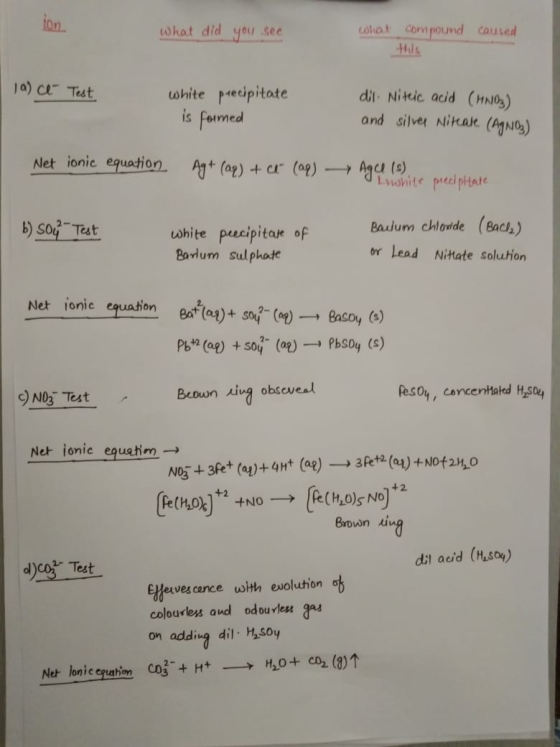
Add Answer to:
1. Known solution of anions. What did you see? (Observation) Which compound caused this? (Conclusion) 1a....
5. Why does benzene float on water? 6. What is the meaning of a boiling point?...
5. Why does benzene float on water? 6. What is the meaning of a boiling point? Provide a scientific definition. 7. What does anion mean? 8. The insoluble compound (the white ppt) resulted from testing for SO4-2 ion is ------------------------- 9. The gas bubbles that are produced when adding HCl to a solution that contains CO3-2 represents the formation of ______________. 10. When a solution of Cl- ion is mixed with a solution of AgNO3 (in acidic environment), what is...
1A. With a significance level of 0.05, you observe a p-value of 0.09. What conclusion should...
1A. With a significance level of 0.05, you observe a p-value of 0.09. What conclusion should you draw? a. Reject the null hypothesis b. Accept the null hypothesis c. Fail to reject the null hypothesis d. Fail to accept the null hypothesis 1B. With a significance level of 0.05, and a p-value of 0.02, what conclusion should you draw? a. Reject the null hypothesis b. Accept the null hypothesis c. Fail to reject the null hypothesis d. Accept the alternative...
In many chemical reactions of two or more compounds, ions are present in the solution that...
In many chemical reactions of two or more compounds, ions are present in the solution that do not participate in the reaction. These ions, known as spectator ions, can be removed from the chemical equation describing the reaction. A chemical equation that has the spectator ions removed is known as a net ionic equation. Reactions between ionic compounds often result in the precipitation of an insoluble compound. Spectator ions and precipitation products of a chemical reaction can be predicted by...
Post-Lab Questions: 1. If you had a solution which contained only chloride, bromide, or iodide ion,...
 Post-Lab Questions: 1. If you had a solution which contained only chloride, bromide, or iodide ion, which of the three tests would most clearly tell you which anion was in the solution? Explain. 2.) Suppose that you were quite sure that your unknown centained only sulfate ion. Which test would most quickly 3. Consider each set of results below which were carried out on a solution containing either (1)one of the six anions studied in this experiment, or (2) none...
Post-Lab Questions: 1. If you had a solution which contained only chloride, bromide, or iodide ion,...
 Post-Lab Questions: 1. If you had a solution which contained only chloride, bromide, or iodide ion, which of the three tests would most clearly tell you which anion was in the solution? Explain. 2.) Suppose that you were quite sure that your unknown contained only sulfate ion. Which test would most quickly (that is, in the fewest steps) confirm your hypothesis? Explain. Consider each set of results below which were carried out on a solution containing either (1)one of the...
Don't do the conclusion I just need help with questions 1a, 1b, 1c, 1d, 1e, 1f, and 1g
 Don't do the conclusion I just need help with questions 1a, 1b,
1c, 1d, 1e, 1f, and 1g
V. Conclusions Write a conclusion on a separate sheet of paper. It should be approximately one page in length and include brief discus- sions of what you did, your observations, your results, and an analysis of your data, including potential sources of error. 1. . On the axes to the right draw a graph of the period of a pendulunm as a...
Don't do the conclusion I just need help with questions 1a, 1b,
1c, 1d, 1e, 1f, and 1g
V. Conclusions Write a conclusion on a separate sheet of paper. It should be approximately one page in length and include brief discus- sions of what you did, your observations, your results, and an analysis of your data, including potential sources of error. 1. . On the axes to the right draw a graph of the period of a pendulunm as a...
Seven Solution Problem Deduction Lab This experiment is an exercise in observation and deduction, both critical...
 Seven Solution Problem Deduction Lab This experiment is an exercise in observation and deduction, both critical skills for productive scientific study. You will be making observations on the results of binary mixing from a total of seven known solutions. From your observations and your knowledge of chemical behavior and solubility. you identify the identity of each of the nine unmarked solutions. As you can probably already see, careful observations, recording of results and deductions will be the key to success....
1. You have a solution that you believe contains either ANO, or Fe(NOX). Describe a test that will let you confirm...
 1. You have a solution that you believe contains either ANO, or Fe(NOX). Describe a test that will let you confirm which is present. Describe the test in detail, and include a chemi- cal equation. 2. Would any of the tests you have used let you determine if a solution contained the potas- sium ion, K+? Either identify a test, or explain in detail why such a test is not possible using the simple methods described here. 3. A sample...
Part 1- Could someone tell me which of these are soluble and insoluable. Part 2- How...
 Part 1- Could someone tell me which of these are soluble and
insoluable.
Part 2- How do you write a net ionic equation for the
precipitate?
Briefly review the reagents involved in the procedures for test tubes #2 and 3 (see pp. 8-3 and 8-4 in your lab manual.). Each test tube started with a solution containing the sodium or potassium salt of each anion. In test tube 2, a solution of silver nitrate (AgNO3) was added. In test tube...
Part 1- Could someone tell me which of these are soluble and
insoluable.
Part 2- How do you write a net ionic equation for the
precipitate?
Briefly review the reagents involved in the procedures for test tubes #2 and 3 (see pp. 8-3 and 8-4 in your lab manual.). Each test tube started with a solution containing the sodium or potassium salt of each anion. In test tube 2, a solution of silver nitrate (AgNO3) was added. In test tube...
Hello, i did a lab where i was given a sample of contaminated water and must determine the identity of the metals and m...
 Hello, i did a lab where i was given a sample of contaminated water
and must determine the identity of the metals and must percipitate
one out. I was able to determine the identity of metal Y which is
aluminium and metal X which is lithium. Im confused on part 3
though. lithium and alumnium are soluble in almost anything and i
cant use hydroxide or carbonate since lithium is in there, some
help please! I would also like to...
Hello, i did a lab where i was given a sample of contaminated water
and must determine the identity of the metals and must percipitate
one out. I was able to determine the identity of metal Y which is
aluminium and metal X which is lithium. Im confused on part 3
though. lithium and alumnium are soluble in almost anything and i
cant use hydroxide or carbonate since lithium is in there, some
help please! I would also like to...
 Post-Lab Questions: 1. If you had a solution which contained only chloride, bromide, or iodide ion, which of the three tests would most clearly tell you which anion was in the solution? Explain. 2.) Suppose that you were quite sure that your unknown centained only sulfate ion. Which test would most quickly 3. Consider each set of results below which were carried out on a solution containing either (1)one of the six anions studied in this experiment, or (2) none...
 Post-Lab Questions: 1. If you had a solution which contained only chloride, bromide, or iodide ion, which of the three tests would most clearly tell you which anion was in the solution? Explain. 2.) Suppose that you were quite sure that your unknown contained only sulfate ion. Which test would most quickly (that is, in the fewest steps) confirm your hypothesis? Explain. Consider each set of results below which were carried out on a solution containing either (1)one of the...
 Don't do the conclusion I just need help with questions 1a, 1b,
1c, 1d, 1e, 1f, and 1g
V. Conclusions Write a conclusion on a separate sheet of paper. It should be approximately one page in length and include brief discus- sions of what you did, your observations, your results, and an analysis of your data, including potential sources of error. 1. . On the axes to the right draw a graph of the period of a pendulunm as a...
Don't do the conclusion I just need help with questions 1a, 1b,
1c, 1d, 1e, 1f, and 1g
V. Conclusions Write a conclusion on a separate sheet of paper. It should be approximately one page in length and include brief discus- sions of what you did, your observations, your results, and an analysis of your data, including potential sources of error. 1. . On the axes to the right draw a graph of the period of a pendulunm as a...
 Seven Solution Problem Deduction Lab This experiment is an exercise in observation and deduction, both critical skills for productive scientific study. You will be making observations on the results of binary mixing from a total of seven known solutions. From your observations and your knowledge of chemical behavior and solubility. you identify the identity of each of the nine unmarked solutions. As you can probably already see, careful observations, recording of results and deductions will be the key to success....
 1. You have a solution that you believe contains either ANO, or Fe(NOX). Describe a test that will let you confirm which is present. Describe the test in detail, and include a chemi- cal equation. 2. Would any of the tests you have used let you determine if a solution contained the potas- sium ion, K+? Either identify a test, or explain in detail why such a test is not possible using the simple methods described here. 3. A sample...
 Part 1- Could someone tell me which of these are soluble and
insoluable.
Part 2- How do you write a net ionic equation for the
precipitate?
Briefly review the reagents involved in the procedures for test tubes #2 and 3 (see pp. 8-3 and 8-4 in your lab manual.). Each test tube started with a solution containing the sodium or potassium salt of each anion. In test tube 2, a solution of silver nitrate (AgNO3) was added. In test tube...
Part 1- Could someone tell me which of these are soluble and
insoluable.
Part 2- How do you write a net ionic equation for the
precipitate?
Briefly review the reagents involved in the procedures for test tubes #2 and 3 (see pp. 8-3 and 8-4 in your lab manual.). Each test tube started with a solution containing the sodium or potassium salt of each anion. In test tube 2, a solution of silver nitrate (AgNO3) was added. In test tube...
 Hello, i did a lab where i was given a sample of contaminated water
and must determine the identity of the metals and must percipitate
one out. I was able to determine the identity of metal Y which is
aluminium and metal X which is lithium. Im confused on part 3
though. lithium and alumnium are soluble in almost anything and i
cant use hydroxide or carbonate since lithium is in there, some
help please! I would also like to...
Hello, i did a lab where i was given a sample of contaminated water
and must determine the identity of the metals and must percipitate
one out. I was able to determine the identity of metal Y which is
aluminium and metal X which is lithium. Im confused on part 3
though. lithium and alumnium are soluble in almost anything and i
cant use hydroxide or carbonate since lithium is in there, some
help please! I would also like to...
Most questions answered within 3 hours.
-
Where is the error in this code sequence?
String s1 = "Hello";
String s2 = "ello";...
asked 11 months ago -
Financial data for Joel de Paris, Inc., for last year
follow:
Joel de Paris, Inc.
Balance...
asked 11 months ago -
Consider this reaction:
Al2(SO4)3 (aq)+ BaCl3
(aq) Al2Cl6 (aq)- +
3BaSO4(s) . What is the...
asked 11 months ago -
Suppose that Savneet is considering increasing her
recent random sample from 20 car rentals to 40...
asked 11 months ago -
Trucks arrive at an unloading terminal at an average rate of 120
per hour.
Trucks arrive...
asked 11 months ago -
Why are methanol and ethanol completely soluble in water while
octanol is not very little soluble....
asked 11 months ago -
A facilities manager at a university reads in a research report
that the mean amount of...
asked 11 months ago -
When the CuSO4 is rehydrated by adding water to the anhydrous
compound, is this an endothermic...
asked 11 months ago -
A ray of sunlight is passing from diamond into crown glass; the
angle of incidence is...
asked 11 months ago -
A block of mass 0.249 kg is placed on top of a light, vertical
spring of...
asked 11 months ago -
how do the kidneys compensate in the presences of acidosis
a) trigger hyperventilate
b) reserve acid...
asked 11 months ago -
Question 501 pts
The rental rate of capital to the firm increases. Which of the
following...
asked 11 months ago