
Homework Answers


Add Answer to:
Problem 3 (50%) P1.21 For the mechanism shown on Figure P1.21, con- struct Cayley's triangles and...
Problem # 4 ( CLO 3) (25 Pts). Using Complex Numbers Methed. In the mechanism shown,...
 Problem # 4 ( CLO 3) (25 Pts). Using Complex Numbers Methed. In the mechanism shown, AB-8 em. CB BD-4 cm 1 fik 4 is traanslating riahtward with constant velocity of 5 m/sec.. At an instant when 6,-45, determine: Distance AC and the angular position of link 2 b) The angular velocities of links 2 and 3. Velocity of point D. c) B 03
Problem # 4 ( CLO 3) (25 Pts). Using Complex Numbers Methed. In the mechanism shown,...
Problem # 4 ( CLO 3) (25 Pts). Using Complex Numbers Methed. In the mechanism shown, AB-8 em. CB BD-4 cm 1 fik 4 is traanslating riahtward with constant velocity of 5 m/sec.. At an instant when 6,-45, determine: Distance AC and the angular position of link 2 b) The angular velocities of links 2 and 3. Velocity of point D. c) B 03
Problem # 4 ( CLO 3) (25 Pts). Using Complex Numbers Methed. In the mechanism shown,...
Problem # 4 ( CLO 3) (25 Pts). Using Complex Numbers Methed. In the mechanism shown,...
 Problem # 4 ( CLO 3) (25 Pts). Using Complex Numbers Methed. In the mechanism shown, AB-8 em. CB BD-4 cm 1 fik 4 is traanslating riahtward with constant velocity of 5 m/sec.. At an instant when 6,-45, determine: Distance AC and the angular position of link 2 b) The angular velocities of links 2 and 3. Velocity of point D. c) B 03
Problem # 4 ( CLO 3) (25 Pts). Using Complex Numbers Methed. In the mechanism shown,...
Problem # 4 ( CLO 3) (25 Pts). Using Complex Numbers Methed. In the mechanism shown, AB-8 em. CB BD-4 cm 1 fik 4 is traanslating riahtward with constant velocity of 5 m/sec.. At an instant when 6,-45, determine: Distance AC and the angular position of link 2 b) The angular velocities of links 2 and 3. Velocity of point D. c) B 03
Problem # 4 ( CLO 3) (25 Pts). Using Complex Numbers Methed. In the mechanism shown,...
kinematic Problem #4 [CLO 3] [25 Pts). Using Complex Numbers Method, In the mechanism shown, AB...
 kinematic
Problem #4 [CLO 3] [25 Pts). Using Complex Numbers Method, In the mechanism shown, AB = 8 cm, CB BD 4 em. If link 4 is translating rightward with constant velocity of 5 m/sec. At an instant when 0= 45, determine: a) Distance AC and the angular position of link 2 b) The angular velocities of links 2 and 3. w c) Velocity of point D. D 3 A 03
Problem #4 [CLO 3] [25 Pts). Using Complex Numbers...
kinematic
Problem #4 [CLO 3] [25 Pts). Using Complex Numbers Method, In the mechanism shown, AB = 8 cm, CB BD 4 em. If link 4 is translating rightward with constant velocity of 5 m/sec. At an instant when 0= 45, determine: a) Distance AC and the angular position of link 2 b) The angular velocities of links 2 and 3. w c) Velocity of point D. D 3 A 03
Problem #4 [CLO 3] [25 Pts). Using Complex Numbers...
The mechanism shown in the figure below has rigid links pivoted at A, B, C and D. The link BCE is a rigid plate. The d...
 The mechanism shown in the figure below has rigid links pivoted at A, B, C and D. The link BCE is a rigid plate. The dimensions of the links are BC = 110 mm BE 70 mm CE 60 mm CD 30 mm AB = 50 mm At the instant when both angles ABC and BCD are 90°, the link AB has a clockwise angular velocity of 40 rad/s. Determine the angular velocity of link BCE A Determine the angular...
Part B The dimension of the links in a four-bar mechanism shown in Figure 2a below...
 Part B The dimension of the links in a four-bar mechanism shown in Figure 2a below are: 02A = 60 mm, AB = 110 mm, 04B = 90 mm, 0204 = 150 mm, AC = 80 mm, and <BAC = 30°. If 02 = 60° and the angular velocity of link 02A = 20 rad/s in clockwise direction. Using vectorial approach, 0,0, Figure 2 3. Determine the velocity of B, VB 4. Determine the velocity of C, Vc Hint: Figure...
Important Note: • It is required to solve each problem in separate sheet. • You are...
 Important Note: • It is required to solve each problem in separate sheet. • You are requested to solve problems 1, 3, and 5 using AutoCAD. Problem (1) In the mechanism shown, link 2 is rotating CW at the constant rate of 4 rad/s. In the position shown, is 53. Determine: vc, 03, 04. Link Lengths: AB = 100 mm, BC = 160 mm, CD = 200 mm 160 mm 220 mm DO Problem (2) In the mechanism shown, link...
kinematic design of machinery Problem #9: For the mechanism shown in shown, determine the rotational speed...
 kinematic design of machinery
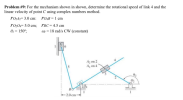
Problem #9: For the mechanism shown in shown, determine the rotational speed of link 4 and the near velocity of point C using complex numbers method. rozA2 3.0 cm: ro4B = 1cm roO 5.0 cm; rBC 4.5 cm 18 rad/s CW (constant) 02= 150° 6 A2 on 2 A4 on 4 -2.0 cm
Problem #9: For the mechanism shown in shown, determine the rotational speed of link 4 and the near velocity of point C using...
kinematic design of machinery
Problem #9: For the mechanism shown in shown, determine the rotational speed of link 4 and the near velocity of point C using complex numbers method. rozA2 3.0 cm: ro4B = 1cm roO 5.0 cm; rBC 4.5 cm 18 rad/s CW (constant) 02= 150° 6 A2 on 2 A4 on 4 -2.0 cm
Problem #9: For the mechanism shown in shown, determine the rotational speed of link 4 and the near velocity of point C using...
Problem #9: For the mechanism shown in shown, determine the rotational speed of link 4 and the linear velocity of p...
 Problem #9: For the mechanism shown in shown, determine the rotational speed of link 4 and the linear velocity of point C using complex numbers method. roAz=3.0 cm: roB= 1 cm 4.5 cm ro2O4= 5.0 cm; rBC 02 150°; an 18 rad/s CW (constant) 6 A2 on 2 As on 4 Bo 2.0 cm m 777
Problem #9: For the mechanism shown in shown, determine the rotational speed of link 4 and the linear velocity of point C using complex...
Problem #9: For the mechanism shown in shown, determine the rotational speed of link 4 and the linear velocity of point C using complex numbers method. roAz=3.0 cm: roB= 1 cm 4.5 cm ro2O4= 5.0 cm; rBC 02 150°; an 18 rad/s CW (constant) 6 A2 on 2 As on 4 Bo 2.0 cm m 777
Problem #9: For the mechanism shown in shown, determine the rotational speed of link 4 and the linear velocity of point C using complex...
3. Link 2 (AB) of the slider crank inversion shown in Figure 3 is rotating at a constant 2 11.00k(rad/s). Determine the angular velocity of link 4 (DC) at the instant shown in the figure. Hints: The...
 3. Link 2 (AB) of the slider crank inversion shown in Figure 3 is rotating at a constant 2 11.00k(rad/s). Determine the angular velocity of link 4 (DC) at the instant shown in the figure. Hints: The angle between links 3 and 4 is fized so they have the same angular velocity. Consider Cs as point on Link 3 sliding through the bearing on link 4. (100 points) C3 90° A = (0,0). Figure 3: Slider crank inversion. (110.09,0) cm....
4.45 Part of an eight-link mechanism is shown in Figure P4.45. Links 7 and 8 are...
 4.45 Part of an eight-link mechanism is shown in Figure P4.45. Links 7 and 8 are drawn to scale, and the velocity of point Az is 5.0 in/s in the direction shown. Link 8 slides on the frame. The acceleration of Az is 40.0 in/s in the direction shown. Find w and a, for the position given. Also find the velocity of C, by 351 image. 260° 40 AB = 1.5 in AC = 0.7 in BC = 1.65 in...
 Problem # 4 ( CLO 3) (25 Pts). Using Complex Numbers Methed. In the mechanism shown, AB-8 em. CB BD-4 cm 1 fik 4 is traanslating riahtward with constant velocity of 5 m/sec.. At an instant when 6,-45, determine: Distance AC and the angular position of link 2 b) The angular velocities of links 2 and 3. Velocity of point D. c) B 03
Problem # 4 ( CLO 3) (25 Pts). Using Complex Numbers Methed. In the mechanism shown,...
Problem # 4 ( CLO 3) (25 Pts). Using Complex Numbers Methed. In the mechanism shown, AB-8 em. CB BD-4 cm 1 fik 4 is traanslating riahtward with constant velocity of 5 m/sec.. At an instant when 6,-45, determine: Distance AC and the angular position of link 2 b) The angular velocities of links 2 and 3. Velocity of point D. c) B 03
Problem # 4 ( CLO 3) (25 Pts). Using Complex Numbers Methed. In the mechanism shown,...
 Problem # 4 ( CLO 3) (25 Pts). Using Complex Numbers Methed. In the mechanism shown, AB-8 em. CB BD-4 cm 1 fik 4 is traanslating riahtward with constant velocity of 5 m/sec.. At an instant when 6,-45, determine: Distance AC and the angular position of link 2 b) The angular velocities of links 2 and 3. Velocity of point D. c) B 03
Problem # 4 ( CLO 3) (25 Pts). Using Complex Numbers Methed. In the mechanism shown,...
Problem # 4 ( CLO 3) (25 Pts). Using Complex Numbers Methed. In the mechanism shown, AB-8 em. CB BD-4 cm 1 fik 4 is traanslating riahtward with constant velocity of 5 m/sec.. At an instant when 6,-45, determine: Distance AC and the angular position of link 2 b) The angular velocities of links 2 and 3. Velocity of point D. c) B 03
Problem # 4 ( CLO 3) (25 Pts). Using Complex Numbers Methed. In the mechanism shown,...
 kinematic
Problem #4 [CLO 3] [25 Pts). Using Complex Numbers Method, In the mechanism shown, AB = 8 cm, CB BD 4 em. If link 4 is translating rightward with constant velocity of 5 m/sec. At an instant when 0= 45, determine: a) Distance AC and the angular position of link 2 b) The angular velocities of links 2 and 3. w c) Velocity of point D. D 3 A 03
Problem #4 [CLO 3] [25 Pts). Using Complex Numbers...
kinematic
Problem #4 [CLO 3] [25 Pts). Using Complex Numbers Method, In the mechanism shown, AB = 8 cm, CB BD 4 em. If link 4 is translating rightward with constant velocity of 5 m/sec. At an instant when 0= 45, determine: a) Distance AC and the angular position of link 2 b) The angular velocities of links 2 and 3. w c) Velocity of point D. D 3 A 03
Problem #4 [CLO 3] [25 Pts). Using Complex Numbers...
 The mechanism shown in the figure below has rigid links pivoted at A, B, C and D. The link BCE is a rigid plate. The dimensions of the links are BC = 110 mm BE 70 mm CE 60 mm CD 30 mm AB = 50 mm At the instant when both angles ABC and BCD are 90°, the link AB has a clockwise angular velocity of 40 rad/s. Determine the angular velocity of link BCE A Determine the angular...
 Part B The dimension of the links in a four-bar mechanism shown in Figure 2a below are: 02A = 60 mm, AB = 110 mm, 04B = 90 mm, 0204 = 150 mm, AC = 80 mm, and <BAC = 30°. If 02 = 60° and the angular velocity of link 02A = 20 rad/s in clockwise direction. Using vectorial approach, 0,0, Figure 2 3. Determine the velocity of B, VB 4. Determine the velocity of C, Vc Hint: Figure...
 Important Note: • It is required to solve each problem in separate sheet. • You are requested to solve problems 1, 3, and 5 using AutoCAD. Problem (1) In the mechanism shown, link 2 is rotating CW at the constant rate of 4 rad/s. In the position shown, is 53. Determine: vc, 03, 04. Link Lengths: AB = 100 mm, BC = 160 mm, CD = 200 mm 160 mm 220 mm DO Problem (2) In the mechanism shown, link...
 kinematic design of machinery
Problem #9: For the mechanism shown in shown, determine the rotational speed of link 4 and the near velocity of point C using complex numbers method. rozA2 3.0 cm: ro4B = 1cm roO 5.0 cm; rBC 4.5 cm 18 rad/s CW (constant) 02= 150° 6 A2 on 2 A4 on 4 -2.0 cm
Problem #9: For the mechanism shown in shown, determine the rotational speed of link 4 and the near velocity of point C using...
kinematic design of machinery
Problem #9: For the mechanism shown in shown, determine the rotational speed of link 4 and the near velocity of point C using complex numbers method. rozA2 3.0 cm: ro4B = 1cm roO 5.0 cm; rBC 4.5 cm 18 rad/s CW (constant) 02= 150° 6 A2 on 2 A4 on 4 -2.0 cm
Problem #9: For the mechanism shown in shown, determine the rotational speed of link 4 and the near velocity of point C using...
 Problem #9: For the mechanism shown in shown, determine the rotational speed of link 4 and the linear velocity of point C using complex numbers method. roAz=3.0 cm: roB= 1 cm 4.5 cm ro2O4= 5.0 cm; rBC 02 150°; an 18 rad/s CW (constant) 6 A2 on 2 As on 4 Bo 2.0 cm m 777
Problem #9: For the mechanism shown in shown, determine the rotational speed of link 4 and the linear velocity of point C using complex...
Problem #9: For the mechanism shown in shown, determine the rotational speed of link 4 and the linear velocity of point C using complex numbers method. roAz=3.0 cm: roB= 1 cm 4.5 cm ro2O4= 5.0 cm; rBC 02 150°; an 18 rad/s CW (constant) 6 A2 on 2 As on 4 Bo 2.0 cm m 777
Problem #9: For the mechanism shown in shown, determine the rotational speed of link 4 and the linear velocity of point C using complex...
 3. Link 2 (AB) of the slider crank inversion shown in Figure 3 is rotating at a constant 2 11.00k(rad/s). Determine the angular velocity of link 4 (DC) at the instant shown in the figure. Hints: The angle between links 3 and 4 is fized so they have the same angular velocity. Consider Cs as point on Link 3 sliding through the bearing on link 4. (100 points) C3 90° A = (0,0). Figure 3: Slider crank inversion. (110.09,0) cm....
 4.45 Part of an eight-link mechanism is shown in Figure P4.45. Links 7 and 8 are drawn to scale, and the velocity of point Az is 5.0 in/s in the direction shown. Link 8 slides on the frame. The acceleration of Az is 40.0 in/s in the direction shown. Find w and a, for the position given. Also find the velocity of C, by 351 image. 260° 40 AB = 1.5 in AC = 0.7 in BC = 1.65 in...
Most questions answered within 3 hours.
-
Where is the error in this code sequence?
String s1 = "Hello";
String s2 = "ello";...
asked 10 months ago -
Financial data for Joel de Paris, Inc., for last year
follow:
Joel de Paris, Inc.
Balance...
asked 10 months ago -
Consider this reaction:
Al2(SO4)3 (aq)+ BaCl3
(aq) Al2Cl6 (aq)- +
3BaSO4(s) . What is the...
asked 10 months ago -
Suppose that Savneet is considering increasing her
recent random sample from 20 car rentals to 40...
asked 10 months ago -
Trucks arrive at an unloading terminal at an average rate of 120
per hour.
Trucks arrive...
asked 10 months ago -
Why are methanol and ethanol completely soluble in water while
octanol is not very little soluble....
asked 10 months ago -
A facilities manager at a university reads in a research report
that the mean amount of...
asked 10 months ago -
When the CuSO4 is rehydrated by adding water to the anhydrous
compound, is this an endothermic...
asked 10 months ago -
A ray of sunlight is passing from diamond into crown glass; the
angle of incidence is...
asked 10 months ago -
A block of mass 0.249 kg is placed on top of a light, vertical
spring of...
asked 10 months ago -
how do the kidneys compensate in the presences of acidosis
a) trigger hyperventilate
b) reserve acid...
asked 10 months ago -
Question 501 pts
The rental rate of capital to the firm increases. Which of the
following...
asked 10 months ago