
Homework Answers
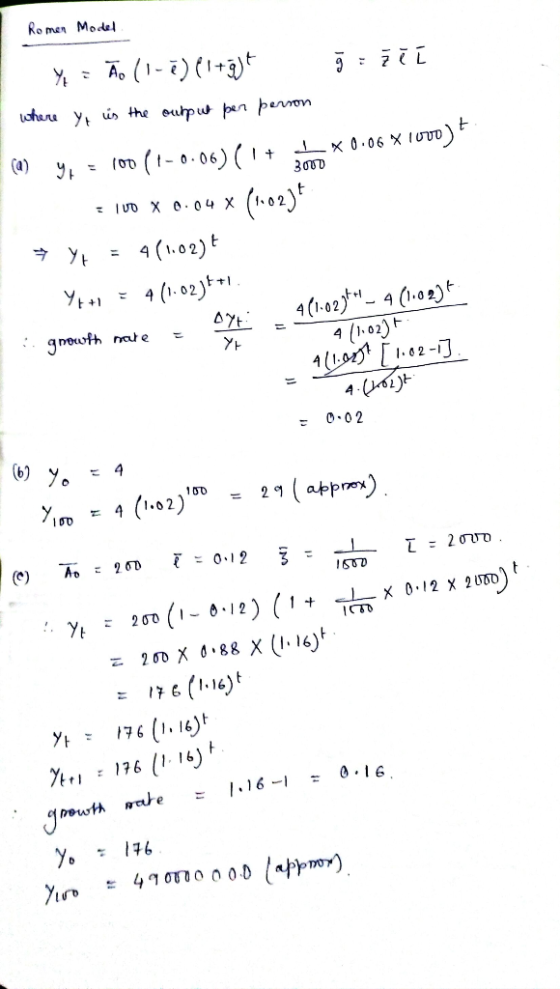
d) I would increase g bar because that will lead to a further increase in my growth rate of output. As seen from the equation it has a multiplier effect as the function (1+g) has the power t. As time period increases, Higher my g, Higher is my output even if I start from a very low level of output.
Add Answer to:
7. Numbers in the Romer model (Il): Now suppose the parameters of the model take the...
The Romer model consists of the following equations: Output production function: Y4 = A Lyt Idea...
 The Romer model consists of the following equations: Output production function: Y4 = A Lyt Idea production function: AA +1 = 2A Lat Resource constraint: Ly + Lat = L Allocation of labor: Lat = IL Suppose the parameters of the Romer model take the following values: Ao = 100, 1 = 0.06, 3 = 1/3000, L = 1000 18. What is the growth rate of output per person in this economy? a) 1% b) 2% c) 4% d) 10%...
46. 42. Suppose the parameters of the Romer model take the following values: Ao= 10, I= 0.01, D= 1/500, and N 10,00...
 46. 42. Suppose the parameters of the Romer model take the following values: Ao= 10, I= 0.01, D= 1/500, and N 10,000. What is the per capita income of this country in the tenth period, y10? a. about 6.13 b. about 61.3 s: c. about 12.0 d. about 11.9 106 e. about 10.9 av 20.m0 Answer: b. Section: 6.3 4 43. Suppose the parameters of the Romer model take the following values: A 10, 1 - 0.01, D= 1/500, and...
explain why this has not happenear 9. A variation on the Romer model: Consider the following...
 explain why this has not happenear 9. A variation on the Romer model: Consider the following variation: Y, = A}"?L) A4+1 = ZAL. L.: + Lee = , Lar = EL. There is only a single difference: we've changed the exponent on 4, in the production of the output good so that there is now a diminishing marginal product to ideas in that sector. (a) Provide an economic interpretation for each equation. (b) What is the growth rate of knowledge...
Consider the Solow growth model. Output at time t is given by the production function Y-AK3...
 Consider the Solow growth model. Output at time t is given by the production function Y-AK3 Lš where K, is total capital at time t, L is the labour force and A is total factor productivity. The labour force and total factor productivity are constant over time and capital evolves according the transition equation KH = (1-d) * Kit It: where d is the depreciation rate. Every person saves share s of his income and, therefore, aggregate saving is St-s...
Question 5. (4 points each) Consider the Solow model in Chapter 6. Production function is given...
 Question 5. (4 points each) Consider the Solow model in Chapter 6. Production function is given by Y = A_KENZ The notations of variables are the same as the slides for Ch.6.The depreciation rate d is 0.1, the population growth rate n is 0.1, and the saving rate s is 0.2. The level of productivity is constant, so At = 2 all the time. (1) Compute the steady-state level of capital per person k*. (2) Compute the steady-state level of...
Consider the Solow growth model. Output at time t is given by the production function Yt...
Consider the Solow growth model. Output at time t is given by the production function Yt = AK 1 3 t L 2 3 where Kt is total capital at time t, L is the labour force and A is total factor productivity. The labour force and total factor productivity are constant over time and capital evolves according the transition equation Kt+1 = (1 − d) ∗ Kt + It , where d is the depreciation rate. Every person saves...
Here with the chp6 21 Question 5. (4 points each) Consider the Solow model in Chapter...
 Here with the chp6 21
Question 5. (4 points each) Consider the Solow model in Chapter 6. Production function is given by 1 1 YA = A_KŽ NĚ The notations of variables are the same as the slides for Ch.6. The depreciation rate d is 0.1, the population growth rate n is 0.1, and the saving rate s is 0.2. The level of productivity is constant, so At = 2 all the time. (5) What is the Growth Accounting equation...
Here with the chp6 21
Question 5. (4 points each) Consider the Solow model in Chapter 6. Production function is given by 1 1 YA = A_KŽ NĚ The notations of variables are the same as the slides for Ch.6. The depreciation rate d is 0.1, the population growth rate n is 0.1, and the saving rate s is 0.2. The level of productivity is constant, so At = 2 all the time. (5) What is the Growth Accounting equation...
PS addtional info Question 5. (4 points each) Consider the Solow model in Chapter 6. Production...
 PS addtional info
Question 5. (4 points each) Consider the Solow model in Chapter 6. Production function is given by Yt = A+KENZ The notations of variables are the same as the slides for Ch.6.The depreciation rate d is 0.1, the population growth rate n is 0.1, and the saving rate s is 0.2. The level of productivity is constant, so At = 2 all the time. (7) Is the policy to change saving rate from 0.2 to the one...
PS addtional info
Question 5. (4 points each) Consider the Solow model in Chapter 6. Production function is given by Yt = A+KENZ The notations of variables are the same as the slides for Ch.6.The depreciation rate d is 0.1, the population growth rate n is 0.1, and the saving rate s is 0.2. The level of productivity is constant, so At = 2 all the time. (7) Is the policy to change saving rate from 0.2 to the one...
1. Practice with the Keynesian model algebra Suppose C = 100+ 0.6 * DI (In other...
 1. Practice with the Keynesian model algebra Suppose C = 100+ 0.6 * DI (In other words, A= 100 and MPC = 0.6); also, I = 250; X = 200; M = 100; G = 90; TR = 70; and t = 0.3. (a) Calculate equilibrium output. (b) Explain in words what would happen if output were above the level you calculated in (a). What would happen if output were below the equilibrium level? (c) Recompute equilibrium output assuming that...
1.Suppose an economy experiences a 4% increase in each of the following variables: N, K, and...
1.Suppose an economy experiences a 4% increase in each of the following variables: N, K, and H (human capital). If the production function is Y=KαN(1-α)Hβ, where α<1 and β<1, we know with certainty that Y will increase by less than 4%. none of the other answers is correct Y will increase by less than 12% but by more than 4%. Y will increase by exactly 4%. Y will increase by more than 4%. 2. Why do banks maintain a certain...
 The Romer model consists of the following equations: Output production function: Y4 = A Lyt Idea production function: AA +1 = 2A Lat Resource constraint: Ly + Lat = L Allocation of labor: Lat = IL Suppose the parameters of the Romer model take the following values: Ao = 100, 1 = 0.06, 3 = 1/3000, L = 1000 18. What is the growth rate of output per person in this economy? a) 1% b) 2% c) 4% d) 10%...
 46. 42. Suppose the parameters of the Romer model take the following values: Ao= 10, I= 0.01, D= 1/500, and N 10,000. What is the per capita income of this country in the tenth period, y10? a. about 6.13 b. about 61.3 s: c. about 12.0 d. about 11.9 106 e. about 10.9 av 20.m0 Answer: b. Section: 6.3 4 43. Suppose the parameters of the Romer model take the following values: A 10, 1 - 0.01, D= 1/500, and...
 explain why this has not happenear 9. A variation on the Romer model: Consider the following variation: Y, = A}"?L) A4+1 = ZAL. L.: + Lee = , Lar = EL. There is only a single difference: we've changed the exponent on 4, in the production of the output good so that there is now a diminishing marginal product to ideas in that sector. (a) Provide an economic interpretation for each equation. (b) What is the growth rate of knowledge...
 Consider the Solow growth model. Output at time t is given by the production function Y-AK3 Lš where K, is total capital at time t, L is the labour force and A is total factor productivity. The labour force and total factor productivity are constant over time and capital evolves according the transition equation KH = (1-d) * Kit It: where d is the depreciation rate. Every person saves share s of his income and, therefore, aggregate saving is St-s...
 Question 5. (4 points each) Consider the Solow model in Chapter 6. Production function is given by Y = A_KENZ The notations of variables are the same as the slides for Ch.6.The depreciation rate d is 0.1, the population growth rate n is 0.1, and the saving rate s is 0.2. The level of productivity is constant, so At = 2 all the time. (1) Compute the steady-state level of capital per person k*. (2) Compute the steady-state level of...
 Here with the chp6 21
Question 5. (4 points each) Consider the Solow model in Chapter 6. Production function is given by 1 1 YA = A_KŽ NĚ The notations of variables are the same as the slides for Ch.6. The depreciation rate d is 0.1, the population growth rate n is 0.1, and the saving rate s is 0.2. The level of productivity is constant, so At = 2 all the time. (5) What is the Growth Accounting equation...
Here with the chp6 21
Question 5. (4 points each) Consider the Solow model in Chapter 6. Production function is given by 1 1 YA = A_KŽ NĚ The notations of variables are the same as the slides for Ch.6. The depreciation rate d is 0.1, the population growth rate n is 0.1, and the saving rate s is 0.2. The level of productivity is constant, so At = 2 all the time. (5) What is the Growth Accounting equation...
 PS addtional info
Question 5. (4 points each) Consider the Solow model in Chapter 6. Production function is given by Yt = A+KENZ The notations of variables are the same as the slides for Ch.6.The depreciation rate d is 0.1, the population growth rate n is 0.1, and the saving rate s is 0.2. The level of productivity is constant, so At = 2 all the time. (7) Is the policy to change saving rate from 0.2 to the one...
PS addtional info
Question 5. (4 points each) Consider the Solow model in Chapter 6. Production function is given by Yt = A+KENZ The notations of variables are the same as the slides for Ch.6.The depreciation rate d is 0.1, the population growth rate n is 0.1, and the saving rate s is 0.2. The level of productivity is constant, so At = 2 all the time. (7) Is the policy to change saving rate from 0.2 to the one...
 1. Practice with the Keynesian model algebra Suppose C = 100+ 0.6 * DI (In other words, A= 100 and MPC = 0.6); also, I = 250; X = 200; M = 100; G = 90; TR = 70; and t = 0.3. (a) Calculate equilibrium output. (b) Explain in words what would happen if output were above the level you calculated in (a). What would happen if output were below the equilibrium level? (c) Recompute equilibrium output assuming that...
Most questions answered within 3 hours.
-
Where is the error in this code sequence?
String s1 = "Hello";
String s2 = "ello";...
asked 10 months ago -
Financial data for Joel de Paris, Inc., for last year
follow:
Joel de Paris, Inc.
Balance...
asked 10 months ago -
Consider this reaction:
Al2(SO4)3 (aq)+ BaCl3
(aq) Al2Cl6 (aq)- +
3BaSO4(s) . What is the...
asked 10 months ago -
Suppose that Savneet is considering increasing her
recent random sample from 20 car rentals to 40...
asked 10 months ago -
Trucks arrive at an unloading terminal at an average rate of 120
per hour.
Trucks arrive...
asked 10 months ago -
Why are methanol and ethanol completely soluble in water while
octanol is not very little soluble....
asked 10 months ago -
A facilities manager at a university reads in a research report
that the mean amount of...
asked 10 months ago -
When the CuSO4 is rehydrated by adding water to the anhydrous
compound, is this an endothermic...
asked 10 months ago -
A ray of sunlight is passing from diamond into crown glass; the
angle of incidence is...
asked 10 months ago -
A block of mass 0.249 kg is placed on top of a light, vertical
spring of...
asked 10 months ago -
how do the kidneys compensate in the presences of acidosis
a) trigger hyperventilate
b) reserve acid...
asked 10 months ago -
Question 501 pts
The rental rate of capital to the firm increases. Which of the
following...
asked 10 months ago