

Homework Answers

Add Answer to:
Challenge Problem 02.81 The following compound is an intermediate in the synthesis of a gelator, which...
Problem 18.23 The structure shown above is an intermediate in the synthesis of which biogenic amine?...
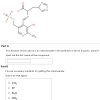 Problem 18.23
The structure shown above is an intermediate in the synthesis of which biogenic amine? Spell out the full name of the compound. Choose necessary reactants for getting this intermediate. Check all that apply. CO_2 H^+ H_2 O NH_3
Problem 18.23
The structure shown above is an intermediate in the synthesis of which biogenic amine? Spell out the full name of the compound. Choose necessary reactants for getting this intermediate. Check all that apply. CO_2 H^+ H_2 O NH_3
Synthesis with 10 steps or less Synthesis Problem Show all the steps required, including intermediates, for the synthesis of the following target compound, using any starting material with six (6) ca...
 Synthesis with 10 steps or less
Synthesis Problem Show all the steps required, including intermediates, for the synthesis of the following target compound, using any starting material with six (6) carbons or less, plus any other organic or inorganic reagents necessary. Determine the IUPAC systematic chemical name for your target compound. Try for io sieps or tesvs
Synthesis Problem Show all the steps required, including intermediates, for the synthesis of the following target compound, using any starting material with six...
Synthesis with 10 steps or less
Synthesis Problem Show all the steps required, including intermediates, for the synthesis of the following target compound, using any starting material with six (6) carbons or less, plus any other organic or inorganic reagents necessary. Determine the IUPAC systematic chemical name for your target compound. Try for io sieps or tesvs
Synthesis Problem Show all the steps required, including intermediates, for the synthesis of the following target compound, using any starting material with six...
17. Outline the reactions necessary to accomplish the synthesis of the following compound starting from benzene....
 17. Outline the reactions necessary to accomplish the synthesis of the following compound starting from benzene. Provide the necessary reagents/reactants and include the structure of intermediate organic products. Any additional organic starting materials used (excluding solvents) must not contain more than 3 carbons. You do not need to provide the mechanism of each reaction. ОН 18. Outline the reactions necessary to accomplish the synthesis of the following compound. Provide the necessary reagents/reactants and include the structure of intermediate organic products....
Synthesis is a major area of organic chemistry which often requires multiple material to a target compound. A systemati...
 Synthesis is a major area of organic chemistry which often requires multiple material to a target compound. A systematic way to propose a synthesis e chemistry which often requires multiple steps to convert one organic systematic way to propose a synthesis is to work backwards from the target compound to a readily available starting material. This 'retrosynthesis app arrow wie starting material. This 'retrosynthesis' approach is indicated by the within a synthesis proposal. (See Wade textbook, pg 410ff, Problem Solving...
Devise a synthesis of the following compound from styrene (CH3CH=CH). You may use any inorganic or...
 Devise a synthesis of the following compound from styrene (CH3CH=CH). You may use any inorganic or organic reagents. More than one step is required. CH3CH2COOH Part 1 out of 2 CHECH=CH2 12] H202, OH
An organic compound X was found to contain only C, H, and Cl. The following experiments...
 An organic compound X was found to contain only C, H, and Cl. The following experiments were carried out with compound X: 1) When a 1.50-g sample of the compound was completely combusted in air, 3.52 g Co, was formed. 2) When a 1.00-8 sample of the compound was allowed to react with an excess of Ag, 1.27 gof AgCl was obtained Determine the empirical formula of compound X. ОСН4С O CH4Cl2 Осенсі 0 C₃H₂ Ch Оснсі Question 25 3.5...
Draw the least stable resonance form for the intermediate in the following electrophilic substitution reaction. NO2...
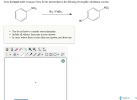 Draw the least stable resonance form for the intermediate in the following electrophilic substitution reaction. NO2 NO2 Brz/ FeBrz Br . You do not have to consider stereochemistry. Include all valence lone pairs in your answer. • In cases where there is more than one answer, just draw one. . с ору P aste [] Previous NE Draw the most stable resonance form for the intermediate in the following electrophilic substitution reaction. OH OH CH3 CH3 CH2 H3PO4 CH3 H3C...
Be sure to answer all parts. Devise a synthesis of the following compound from styrene (CGH-CH=CH2)....
 Be sure to answer all parts. Devise a synthesis of the following compound from styrene (CGH-CH=CH2). You may use any inorganic or organic reagents. More than one step is required. CGH-CH2COOH Part 1 out of 2 (1) BH, H2CC6H5-CH2OH C6H3CH=CH2 [2] H202, OH edit structure ... 2 attempts left Check my work Next part
What are the following syntheses for each compound? 7. Propose a synthesis for each of the...
 What are the following syntheses for each compound?
7. Propose a synthesis for each of the following compounds using the indicated starting material. You may use any organic compounds, inorganic compounds, organometallic compounds, or solvents of your choice. Do not show any reactive intermediates, mechanisms, or transition states, but be sure to show each isolable compound along your synthetic route. осон steps H₂C (ra (racemic) Hoc OH Hac CH3 сна N-OH steps
What are the following syntheses for each compound?
7. Propose a synthesis for each of the following compounds using the indicated starting material. You may use any organic compounds, inorganic compounds, organometallic compounds, or solvents of your choice. Do not show any reactive intermediates, mechanisms, or transition states, but be sure to show each isolable compound along your synthetic route. осон steps H₂C (ra (racemic) Hoc OH Hac CH3 сна N-OH steps
1.5 pts Question 24 Which of the following compounds would have the strongest intermolecular attractive forces...
 1.5 pts Question 24 Which of the following compounds would have the strongest intermolecular attractive forces ? CH3-NH-CH2-CH3 CH3-CH2-CH2-OH CH3-CH2-O-CH3 CH3-CH2-CO2H CO2 3.5 pts D Question 25 A 0.258-g sample of a pure triprotic acid, H3A, (where A is the generic anion of the acid). was dissolved in water and titrated with 0.150 M barium hydroxide solution. The titration required 13.9 mL of the base to reach the equivalence point. What is the molar mass of the acid? o 227...
 Problem 18.23
The structure shown above is an intermediate in the synthesis of which biogenic amine? Spell out the full name of the compound. Choose necessary reactants for getting this intermediate. Check all that apply. CO_2 H^+ H_2 O NH_3
Problem 18.23
The structure shown above is an intermediate in the synthesis of which biogenic amine? Spell out the full name of the compound. Choose necessary reactants for getting this intermediate. Check all that apply. CO_2 H^+ H_2 O NH_3
 Synthesis with 10 steps or less
Synthesis Problem Show all the steps required, including intermediates, for the synthesis of the following target compound, using any starting material with six (6) carbons or less, plus any other organic or inorganic reagents necessary. Determine the IUPAC systematic chemical name for your target compound. Try for io sieps or tesvs
Synthesis Problem Show all the steps required, including intermediates, for the synthesis of the following target compound, using any starting material with six...
Synthesis with 10 steps or less
Synthesis Problem Show all the steps required, including intermediates, for the synthesis of the following target compound, using any starting material with six (6) carbons or less, plus any other organic or inorganic reagents necessary. Determine the IUPAC systematic chemical name for your target compound. Try for io sieps or tesvs
Synthesis Problem Show all the steps required, including intermediates, for the synthesis of the following target compound, using any starting material with six...
 17. Outline the reactions necessary to accomplish the synthesis of the following compound starting from benzene. Provide the necessary reagents/reactants and include the structure of intermediate organic products. Any additional organic starting materials used (excluding solvents) must not contain more than 3 carbons. You do not need to provide the mechanism of each reaction. ОН 18. Outline the reactions necessary to accomplish the synthesis of the following compound. Provide the necessary reagents/reactants and include the structure of intermediate organic products....
 Synthesis is a major area of organic chemistry which often requires multiple material to a target compound. A systematic way to propose a synthesis e chemistry which often requires multiple steps to convert one organic systematic way to propose a synthesis is to work backwards from the target compound to a readily available starting material. This 'retrosynthesis app arrow wie starting material. This 'retrosynthesis' approach is indicated by the within a synthesis proposal. (See Wade textbook, pg 410ff, Problem Solving...
 Devise a synthesis of the following compound from styrene (CH3CH=CH). You may use any inorganic or organic reagents. More than one step is required. CH3CH2COOH Part 1 out of 2 CHECH=CH2 12] H202, OH
 An organic compound X was found to contain only C, H, and Cl. The following experiments were carried out with compound X: 1) When a 1.50-g sample of the compound was completely combusted in air, 3.52 g Co, was formed. 2) When a 1.00-8 sample of the compound was allowed to react with an excess of Ag, 1.27 gof AgCl was obtained Determine the empirical formula of compound X. ОСН4С O CH4Cl2 Осенсі 0 C₃H₂ Ch Оснсі Question 25 3.5...
 Draw the least stable resonance form for the intermediate in the following electrophilic substitution reaction. NO2 NO2 Brz/ FeBrz Br . You do not have to consider stereochemistry. Include all valence lone pairs in your answer. • In cases where there is more than one answer, just draw one. . с ору P aste [] Previous NE Draw the most stable resonance form for the intermediate in the following electrophilic substitution reaction. OH OH CH3 CH3 CH2 H3PO4 CH3 H3C...
 Be sure to answer all parts. Devise a synthesis of the following compound from styrene (CGH-CH=CH2). You may use any inorganic or organic reagents. More than one step is required. CGH-CH2COOH Part 1 out of 2 (1) BH, H2CC6H5-CH2OH C6H3CH=CH2 [2] H202, OH edit structure ... 2 attempts left Check my work Next part
 What are the following syntheses for each compound?
7. Propose a synthesis for each of the following compounds using the indicated starting material. You may use any organic compounds, inorganic compounds, organometallic compounds, or solvents of your choice. Do not show any reactive intermediates, mechanisms, or transition states, but be sure to show each isolable compound along your synthetic route. осон steps H₂C (ra (racemic) Hoc OH Hac CH3 сна N-OH steps
What are the following syntheses for each compound?
7. Propose a synthesis for each of the following compounds using the indicated starting material. You may use any organic compounds, inorganic compounds, organometallic compounds, or solvents of your choice. Do not show any reactive intermediates, mechanisms, or transition states, but be sure to show each isolable compound along your synthetic route. осон steps H₂C (ra (racemic) Hoc OH Hac CH3 сна N-OH steps
 1.5 pts Question 24 Which of the following compounds would have the strongest intermolecular attractive forces ? CH3-NH-CH2-CH3 CH3-CH2-CH2-OH CH3-CH2-O-CH3 CH3-CH2-CO2H CO2 3.5 pts D Question 25 A 0.258-g sample of a pure triprotic acid, H3A, (where A is the generic anion of the acid). was dissolved in water and titrated with 0.150 M barium hydroxide solution. The titration required 13.9 mL of the base to reach the equivalence point. What is the molar mass of the acid? o 227...
Most questions answered within 3 hours.
-
Where is the error in this code sequence?
String s1 = "Hello";
String s2 = "ello";...
asked 11 months ago -
Financial data for Joel de Paris, Inc., for last year
follow:
Joel de Paris, Inc.
Balance...
asked 11 months ago -
Consider this reaction:
Al2(SO4)3 (aq)+ BaCl3
(aq) Al2Cl6 (aq)- +
3BaSO4(s) . What is the...
asked 11 months ago -
Suppose that Savneet is considering increasing her
recent random sample from 20 car rentals to 40...
asked 11 months ago -
Trucks arrive at an unloading terminal at an average rate of 120
per hour.
Trucks arrive...
asked 11 months ago -
Why are methanol and ethanol completely soluble in water while
octanol is not very little soluble....
asked 11 months ago -
A facilities manager at a university reads in a research report
that the mean amount of...
asked 11 months ago -
When the CuSO4 is rehydrated by adding water to the anhydrous
compound, is this an endothermic...
asked 11 months ago -
A ray of sunlight is passing from diamond into crown glass; the
angle of incidence is...
asked 11 months ago -
A block of mass 0.249 kg is placed on top of a light, vertical
spring of...
asked 11 months ago -
how do the kidneys compensate in the presences of acidosis
a) trigger hyperventilate
b) reserve acid...
asked 11 months ago -
Question 501 pts
The rental rate of capital to the firm increases. Which of the
following...
asked 11 months ago